Bitget App
Trade smarter
Buy cryptoMarketsTradeFuturesStocksEarnInstitutionAI & More
Pi Network at Risk? 4 Factors Pointing to a Potential 45% Crash

Pi Network at Risk? 4 Factors Pointing to a Potential 45% Crash

CryptonewslandCryptonewsland2025/05/24 03:16
By:by Irene Kimsy
  • A bearish technical pattern indicates a potential 45% price drop amid a weak market structure.
  • Lack of exchange listings reflects deep-rooted project limitations, impacting token visibility and investor trust.
  • Declining network activity and upcoming unlock events raise red flags about PI’s long-term sustainability

A recent technical analysis of the Pi Network’s PI token reveals a bearish pennant pattern, often considered a precursor to downward price action. Despite a short-term price surge of 8.85%, pushing PI to $0.8015, the pattern’s structure suggests a weakening trend. The support level sits at $0.7302, while resistance caps gains at $0.8406, indicating limited upside potential. With market momentum fading, analysts suggest the token could decline by up to 45% if the bearish setup fully materializes. 
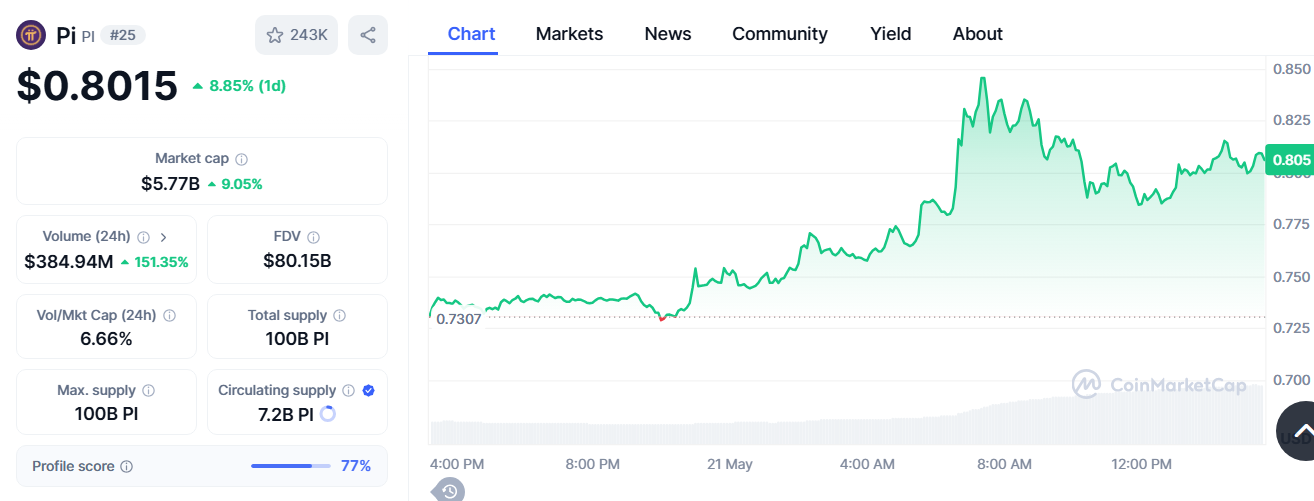
Pi Network at Risk? 4 Factors Pointing to a Potential 45% Crash image 0 Pi Network at Risk? 4 Factors Pointing to a Potential 45% Crash image 1 Source: CoinMarketCap

This pattern typically emerges after a strong downtrend, followed by a brief consolidation that fails to build the momentum needed for a reversal. The presence of this pattern aligns with several broader concerns, each reinforcing bearish sentiment.

Exchange Listings Remain Unlikely Without Structural Reform

The absence of listing s for the PI token on major exchanges continues to hinder its market potential. Industry observers argue that unless the project undergoes exceptional and structural reform, a widespread listing remains unlikely. 

$PI at $1.49 is a teaser ,it is not a top.

47M+ users.

No CEX listing yet.

When mainnet hits, disbelief turns into FOMO.

You are not early……you are pre -early. pic.twitter.com/BOPN4fNfDh

— Henry (@LordOfAlts) May 12, 2025

Without listing on premier exchanges, Pi Network lacks exposure to a broader investor base, which could have stabilized price volatility. Until meaningful change occurs, the gap between the project’s ambition and its market footprint remains wide.

Activity Decline Reveals Ghost Chain Concerns

Another major factor influencing sentiment around the Pi Network is its declining on-chain activity. Metrics suggest a significant drop in developer participation and user engagement, raising concerns that the network is becoming a ghost chain. 

It's hard to swallow but most of the Pi Community consists of middle class ordinary people who have to earn bread for the family on a recurring basis leaving them with very less to no spending power on buying the assets.

This is one of the reasons why there's very little demand… pic.twitter.com/3k3QSueLON

— Jatin Gupta (@jatingupta0003) April 15, 2025

Once considered an innovative mobile-first blockchain project, Pi Network now shows signs of stagnation. This decline in core activity weakens fundamental value and makes the network less attractive to developers and investors alike. Without a dynamic ecosystem and continuous updates, sustainability becomes uncertain. The current level of inactivity is incompatible with long-term token appreciation, reinforcing bearish pressure.

Token Unlock Events Could Flood the Market

One of the most pressing threats to the PI price is the looming risk of token unlocks. When large quantities of previously locked tokens enter circulation, it often exerts downward pressure on prices. Pi Network’s vesting schedule suggests that more unlocks are approaching, which may significantly dilute the token’s value. 

⭕️ Pi Network, a cryptocurrency project that gained popularity for allowing users to mine tokens via a mobile app, has faced significant criticism following a sharp decline in its token’s value. After its mainnet launch in February 2025, the PI token experienced a dramatic drop… pic.twitter.com/fn4wTua0KX

— Alpha Insiders (@AlphaInsiders) May 21, 2025

Without sufficient demand to match new supply, the PI token risks oversaturation. Historical data from similar projects shows that such events can trigger steep price corrections, particularly in the absence of counterbalancing catalysts. This supply-side shock, combined with weak demand indicators, could exacerbate the ongoing selloff.

Final Outlook

While PI has shown a modest short-term gain, the broader outlook remains bearish due to technical and structural factors. The bearish pennant, lack of major listings, reduced on-chain activity, and upcoming token unlocks collectively present an exceptional and dynamic risk profile. A projected 45% correction remains plausible unless the project undertakes unparalleled efforts to restore confidence and functionality. For now, Pi Network continues to face a critical inflection point that could determine its medium-term viability.

7
5

Disclaimer: The content of this article solely reflects the author's opinion and does not represent the platform in any capacity. This article is not intended to serve as a reference for making investment decisions.

Understand the market, then trade.
Bitget offers one-stop trading for cryptocurrencies, stocks, and gold.
Trade now!

You may also like

Updated: Delta Air Lines warns that as fuel prices hit profits, airline capacity will tighten further

Delta Airlines lowers its annual profit forecast due to an expected increase in fuel costs to $6 billion. The CEO stated that ticket prices have risen by about 20% this year, with limited passenger resistance. Analysts warn that maintaining high ticket prices in 2027 is critical for improving profitability. The article includes comments from the earnings call and analyst remarks. Rajesh Kumar Singh/Shivansh Tiwary, Reuters Chicago, October 9 - Delta Airlines (DAL.N) said on Friday that, despite strong travel demand and rising ticket prices, soaring fuel costs have forced it to cut its 2026 profit expectations by nearly a quarter. So, the airline industry may need to further limit flight growth next year to protect profitability. This warning highlights the increasingly tough challenges faced by U.S. airlines. While strong demand and restricted seat growth have allowed airlines to significantly raise ticket prices and offset higher fuel costs, aggressively increasing flights to capture more demand may intensify competition, making it harder to maintain high fares and protect profits. Based in Atlanta, Delta now expects its annual fuel expenditure to increase by about $6 billion compared to last year—about $2 billion higher than its July forecast—due to the Iran war (link) causing global jet fuel prices to spike. Airlines worldwide are preparing for a prolonged fuel shock. Michael O’Leary, CEO of Ryanair Group RYA.I, said Thursday that high jet fuel prices could persist for another 12-18 months (link), adding more pressure on airlines to raise fares and control costs. https://www.reuters.com/graphics/AUTOMATED-20261008/A4A-JET-FUEL-DAILY-1Y/xmpjwjnmbvr/chart.png “In a high-cost environment, you can’t simply grow your way out,” Delta CEO Ed Bastian said on the earnings call. He noted that the industry has already taken steps to restrict capacity, but more measures will be needed next year to improve profitability. Bastian said Delta raised ticket prices about 20% this year, and passenger resistance has been limited. He is confident that even if fuel costs eventually drop, the high fares can still be maintained. Delta lowered its adjusted annual earnings per share forecast from the July prediction of $6.50-$7.50 to $5.10-$5.60. According to LSEG data, the midpoint of the new range is below analysts’ average expectation of $5.46. Third-quarter adjusted earnings per share were $1.72, four cents below analysts’ average forecast. In midday trading, shares of Delta dropped 1.7%, United Airlines UAL.O fell 1.4%, and both American Airlines AAL.O and Southwest Airlines LUV.N were down about 1%. Delta partly shields itself from rising fuel costs by owning a refinery outside Philadelphia (link), which is expected to generate over $700 million in profits this year. Even with this buffer, the airline expects its fourth-quarter fuel price to rise from $3.61 per gallon in Q3 to $4.25 per gallon. Delta forecasts adjusted fourth-quarter earnings per share to be between $1.15-$1.65, with the $1.40 midpoint roughly matching analysts’ average expectation of $1.39. Fare increases Government data shows that in the first eight months of 2026, U.S. airlines spent $42.9 billion on fuel, an increase of $13.2 billion compared to the same period last year despite slightly reduced consumption. According to the U.S. Bureau of Labor Statistics, strong demand and limited seat growth pushed average U.S. airline ticket prices up by about 25% year-on-year between April and August. https://www.reuters.com/graphics/USA-AIRLINES/FUEL/lbpgdnbzwvq/chart.png Analysts at Melius Research said that despite surging fuel costs, Delta’s ability to raise fares helps keep second-half profits roughly stable. Still, they warn that the company’s profit margin has struggled to improve over the years. “It is critical for margin improvement to maintain or raise fares in 2027,” they wrote in their research report. With industry capacity growth expected to accelerate in Q4, this challenge will likely become even tougher. Deutsche Bank analysts expect the proportion of fuel costs recouped through revenue measures to fall in Q4 and predict full recovery won’t happen until early 2027. Bastian noted that low industry returns are another reason for limiting capacity growth. He said Delta will be cautious with its 2027 capacity plan until the fuel price outlook becomes clearer. He added that international routes may account for a larger share of Delta’s capacity expansion compared to domestic routes. Currently, Delta says its premium cabins and corporate travel business remain strong, and its economy cabin business is gradually improving. With Q4 ticket bookings already exceeding 60%, Delta expects revenue to increase about 20% year-on-year, despite limited capacity growth. Executives said early booking trends for Q1 2027 are also encouraging. (For the convenience of non-native English speakers, Reuters automatically translates its reports into several

路透社•2026/10/09 17:36