
Iranian Crypto Exchange Nobitex Suffers $80 Million Exploit on Tron Network

Nobitex, Iran’s top crypto exchange, has been exploited for nearly $49 million via the Tron network. While the breach impacted hot wallets, cold-stored funds remain secure, and the platform is committed to covering losses.
Iran’s largest cryptocurrency exchange, Nobitex, has reportedly been exploited for $80 million on the Tron network.
On-chain investigator ZachXBT flagged suspicious outflows from several wallets linked to the platform.
Nobitex Halts Operations After $48 Million Tron Exploit
In an official statement posted Wednesday, June 18, Nobitex confirmed unauthorized access to parts of its notification infrastructure and hot wallet, prompting an emergency shutdown of all access and services.
The platform emphasized that the breach was contained to hot wallets, and that cold-stored user funds remain fully secure.
“Nobitex takes full responsibility for this incident and assures users that all incurred losses will be fully compensated through the insurance fund and Nobitex resources,” the exchange stated.
All website and app functions have been temporarily suspended while internal investigations continue.
The exchange did not publicly confirm the total loss. However, ZachXBT’s analysis places the figure at over $80 million, involving swift transfers to unidentified Tron addresses.
“The Iranian crypto exchange ‘Nobitex’ appears to have been exploited for $81.7M on Tron after suspicious outflows were observed from many wallets linked to them,” the blockchain investigator shared on Telegram.
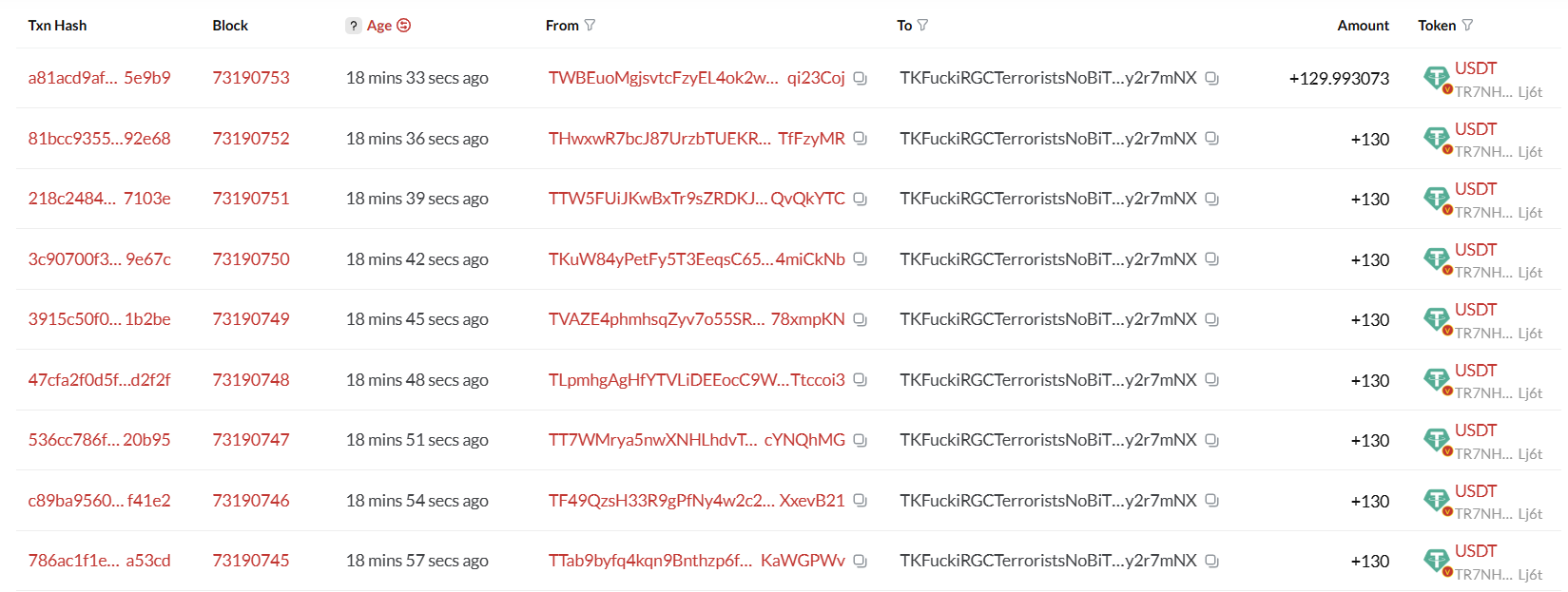 Nobitex attack transfers. Source:
PeckShield
Nobitex attack transfers. Source:
PeckShield
Following the attack, the hacker group Gonjeshke Darande (Predatory Sparrow) claimed credit.
“We, ‘Gonjeshke Darande’, conducted cyberattacks against Nobitex,” the group wrote in a post.
After the IRGC’s “Bank Sepah” comes the turn of NobitexWARNING!In 24 hours, we will release Nobitex's source code and internal information from their internal network.Any assets that remain there after that point will be at risk!The Nobitex exchange is at the heart of the… pic.twitter.com/GFyBCPCFIE
— Gonjeshke Darande (@GonjeshkeDarand) June 18, 2025
This marks one of the largest publicly known exploits of an Iranian crypto platform. It adds further pressure on digital asset infrastructure in the region amid growing geopolitical and economic uncertainty.
Nobitex, which handles most of Iran’s crypto trading volume, has previously faced scrutiny for its exposure to sanctioned entities.
“The Nobitex exchange is at the heart of the regime’s efforts to finance terror worldwide, as well as being the regime’s favorite sanctions violation tool…Nobitex doesn’t even pretend to abide by sanctions. It publicly instructs users on how to use its infrastructure to bypass sanctions. The regime’s dependence on Nobitex is evident from the fact that working at Nobitex is considered valid military service, as it is vital to its efforts,” the hacker group explained.
Who is Gonjeshke Darande?
Gonjeshke Darande, also known as Predatory Sparrow, is a hacker group widely believed to be linked to Israeli military intelligence.
The group has claimed responsibility for several high-profile cyberattacks targeting Iranian infrastructure, including:
- Bank Sepah in 2025, which destroyed data of a US-sanctioned Iranian bank, accusing it of financing terrorism and bypassing sanctions.
Destruction of the infrastructure of the Islamic Revolutionary Guard Corps “Bank Sepah”We, “Gonjeshke Darande”, conducted cyberattacks which destroyed the data of the Islamic Revolutionary Guard Corps’ “Bank Sepah”.“Bank Sepah” was an institution that circumvented… pic.twitter.com/1r4XyDmXcJ
— Gonjeshke Darande (@GonjeshkeDarand) June 17, 2025
- Disrupted 70% of Iran’s gas pumps in 2023 in response to Iranian aggression, conducted with measures to limit harm to emergency services.
- Attacked Iranian steel facilities in 2022, leaking nearly 20 GB of data, revealing ties to the Islamic Revolutionary Guard Corps (IRGC).
- Targeted Iranian railway systems and fuel distribution networks in 2021.
The group often justifies its actions as retaliation against Iran’s regional aggression and its proxies, such as Hezbollah and the Houthis.
At the same time, it emphasizes efforts to minimize civilian harm. Reports suggest Gonjeshke Darande operates with sophisticated access, potentially tied to Israel’s Unit 8200 or Unit 81, though Israel maintains ambiguity about its involvement.
The incident will likely prompt closer attention to exchange security standards in jurisdictions outside traditional regulatory frameworks.
The group warned about an imminent attack in a Tuesday post on X (Twitter).
“Caution: Associating with the regime’s instruments for evading sanctions and financing its ballistic missiles and nuclear program is bad for your long-term financial health. Who’s next?” they said on Tuesday.
More updates are expected once the investigation concludes.
Disclaimer: The content of this article solely reflects the author's opinion and does not represent the platform in any capacity. This article is not intended to serve as a reference for making investment decisions.
You may also like
The 10-year US Treasury yield approaches 5.4%, with the AI halo unable to hide the "inflated" risks of the S&P 500
Behind the S&P 500's record high, only 30% of its constituent stocks are above their 50-day moving average, marking the narrowest market breadth at a record high since 1990. The Russell 2000 has fallen for five consecutive weeks, and high-yield bond yields have soared to 15%. Societe Generale warns that if US Treasury yields rise to 6% and oil prices reach $150, the S&P 500 could fall by more than 20% next year. In addition, some top-performing fund managers have completely exited AI stocks in favor of energy, stating that once financing dries up, it will be "game over."
Oil tanker freight reaches a sixty-year high: shipping oil from the US to China is more expensive than launching a rocket!
The freight for a single barrel of crude oil has soared to $41, approaching half the oil price, and for a single trip, the freight was once enough to buy an oil tanker. The Middle East crisis has led to a structural shortage of shipping capacity in the Strait of Hormuz, coupled with ship-to-ship transfers extending turnaround times. VLCC freight rates have skyrocketed from an annual average of $9.2 million to $77 million—an increase of more than eight times. Refiners’ profits are being rapidly eroded, the average price of second-hand oil tankers has reached a historic high, and, unusually, surpassed the price of new vessels.
Following the Drop but Not the Rise! Silver Trapped in Difficulties
The logic of AI and solar energy demand continues to play out, yet prices are falling against the trend—macroeconomic forces such as a strengthening US dollar and rising real interest rates have completely suppressed fundamentals. Speculative funds offloaded $1.6 billion in a single week, marking a yearly peak, while CTA net short positions reversed by $2.6 billion to the highest level this year. However, Goldman Sachs analysts believe that the extreme short positioning itself is building reversal momentum, highlighting an asymmetry; once macro headwinds subside, a retaliatory rebound could be easily triggered. After a similar shakeout last time, silver surged 15% in six weeks.
Crypto prices
More


