
Israel-Iran Tensions Hit Crypto as the Conflict Moves On-Chain

The $81 million hack of Nobitex reveals blockchain’s growing role in geopolitical conflicts, as state actors increasingly target crypto infrastructure for both warfare and messaging.
As military tensions escalate between Israel and Iran, crypto and blockchain are being pulled into the conflict, not just financially, but digitally.
The recent $81 million hack of Iranian crypto exchange Nobitex marked a turning point, with experts warning that blockchain has officially become a geopolitical battleground.
Blockchain Becomes a New Front in Israel-Iran Conflict
Merkle Science acknowledged that Gonjeshke Darande carried out the exploit, which aligns with BeInCrypto’s recent report on the hacktivist group.
However, according to Merkle Science, a blockchain analytics and predictive risk platform, the attack was a message that blockchain is now a geopolitical front line.
“This wasn’t just theft. It was a message. Blockchain is now a geopolitical front line,” the firm stated.
This remark came after their forensic tracker revealed how the stolen funds moved across multiple addresses. It points to this attack going beyond a typical cybercrime incident, to a politically motivated move.
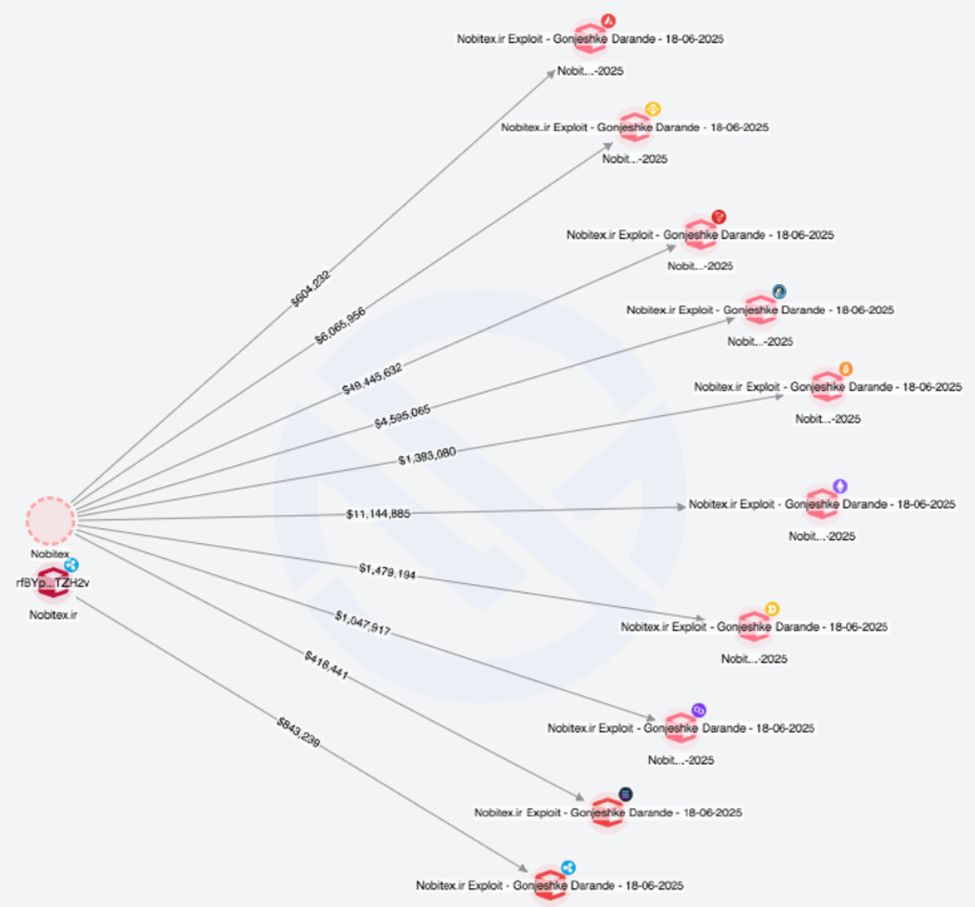 Visual of the hack distribution from Merkle Science’s Tracker. Source:
Merkle Science on X.
Visual of the hack distribution from Merkle Science’s Tracker. Source:
Merkle Science on X.
Indeed, BeInCrypto reported Gonjeshke Darande group’s motivation, clamping down on Iran as part of Israel’s perceived war against Iran-fueled terrorism.
The group is widely believed to be linked to Israeli military intelligence, though Israel maintains ambiguity about its involvement.
“The Nobitex exchange is at the heart of the regime’s efforts to finance terror worldwide, as well as being the regime’s favorite sanctions violation tool…Nobitex doesn’t even pretend to abide by sanctions. It publicly instructs users on how to use its infrastructure to bypass sanctions. The regime’s dependence on Nobitex is evident from the fact that working at Nobitex is considered valid military service, as it is vital to its efforts,” the hacker group said on Wednesday.
The attack on Nobitex shows a trend of weaponizing crypto infrastructure in state-level and asymmetric conflicts.
Attacks like the Nobitex hack highlight a growing trend where crypto infrastructure is increasingly being weaponized in geopolitical cyber campaigns.As these conflicts evolve, so does the risk to the systems we all rely on.#Crypto #CyberSecurity #ThreatIntel #PolySwarm $NCT
— PolySwarm(@PolySwarm) June 18, 2025
This shift has major implications. Investors now face a playing field where their assets are subject to market volatility and increasingly vulnerable to targeted geopolitical strikes.
If the countries hosting major crypto exchanges become involved in conflict, the platforms may become high-profile targets.
“Failure to lead in blockchain and cryptocurrency exposes nations to economic disruption, regulatory gaps, and security vulnerabilities, risks those adversarial states are ready to exploit,” Merkle Science warned in a report.
Blockchain Leadership Becomes Strategic
The report also notes that blockchain’s decentralization is not absolute. This means nation-states can exploit their infrastructure through traffic filtering or validator capture, turning a strategic asset into a liability.
Indeed, the strategic role of blockchain is already evident in US defense initiatives. The Navy’s use of SIMBA Chain to track F/A-18 aircraft parts proves the technology’s real-world utility in securing critical systems.
At the same time, its anonymity and speed have made crypto a powerful tool for illicit actors. From laundering to sanctions evasion, cryptocurrencies have long been favored by rogue states and terrorist groups.
In 2024 alone, crypto-related hacks and exploits resulted in $1.49 billion in losses, more than double the previous year. Groups like North Korea’s Lazarus have financed operations by exploiting vulnerabilities in crypto platforms, including the $1.5 billion Bybit heist.
The Nobitex hack adds another layer of urgency, highlighting the role of digital assets in modern warfare. As sanctions tighten and conventional finance becomes harder to access, state-aligned hackers and insurgent groups increasingly turn to crypto to send a message.
For Gonjeshke Darande, it is to retaliate against Iran’s regional aggression and its proxies, such as Hezbollah and the Houthis, while minimizing civilian harm
Disclaimer: The content of this article solely reflects the author's opinion and does not represent the platform in any capacity. This article is not intended to serve as a reference for making investment decisions.
You may also like
XRP Weekly Chart Blue Lines Point to These Long-Term Price Targets

The 10-year US Treasury yield approaches 5.4%, with the AI halo unable to hide the "inflated" risks of the S&P 500
Behind the S&P 500's record high, only 30% of its constituent stocks are above their 50-day moving average, marking the narrowest market breadth at a record high since 1990. The Russell 2000 has fallen for five consecutive weeks, and high-yield bond yields have soared to 15%. Societe Generale warns that if US Treasury yields rise to 6% and oil prices reach $150, the S&P 500 could fall by more than 20% next year. In addition, some top-performing fund managers have completely exited AI stocks in favor of energy, stating that once financing dries up, it will be "game over."
Oil tanker freight reaches a sixty-year high: shipping oil from the US to China is more expensive than launching a rocket!
The freight for a single barrel of crude oil has soared to $41, approaching half the oil price, and for a single trip, the freight was once enough to buy an oil tanker. The Middle East crisis has led to a structural shortage of shipping capacity in the Strait of Hormuz, coupled with ship-to-ship transfers extending turnaround times. VLCC freight rates have skyrocketed from an annual average of $9.2 million to $77 million—an increase of more than eight times. Refiners’ profits are being rapidly eroded, the average price of second-hand oil tankers has reached a historic high, and, unusually, surpassed the price of new vessels.

Following the Drop but Not the Rise! Silver Trapped in Difficulties
The logic of AI and solar energy demand continues to play out, yet prices are falling against the trend—macroeconomic forces such as a strengthening US dollar and rising real interest rates have completely suppressed fundamentals. Speculative funds offloaded $1.6 billion in a single week, marking a yearly peak, while CTA net short positions reversed by $2.6 billion to the highest level this year. However, Goldman Sachs analysts believe that the extreme short positioning itself is building reversal momentum, highlighting an asymmetry; once macro headwinds subside, a retaliatory rebound could be easily triggered. After a similar shakeout last time, silver surged 15% in six weeks.
Crypto prices
More


