
Is Aave price about to explode, or is the rally already over?

Aave remains in a bullish structure despite a correction from the recent swing high. Price is now approaching a potential higher low region that could set the stage for the next leg up.
After establishing a swing low at $114, Aave (Aave) rallied significantly, peaking near the $316 high time frame resistance. Although the price has since pulled back, the overall trend remains bullish. The current correction is viewed as a potential setup for a higher low formation, which could support the continuation of the broader uptrend.
Key technical points
- Potential Higher Low Region: Confluence between value area low, HTF support at $159, and swing low.
- Current Resistance: Trading near point of control (POC), acting as short-term resistance.
- Volume Profile: Influx in volume around higher low zone is critical to confirm bullish continuation.
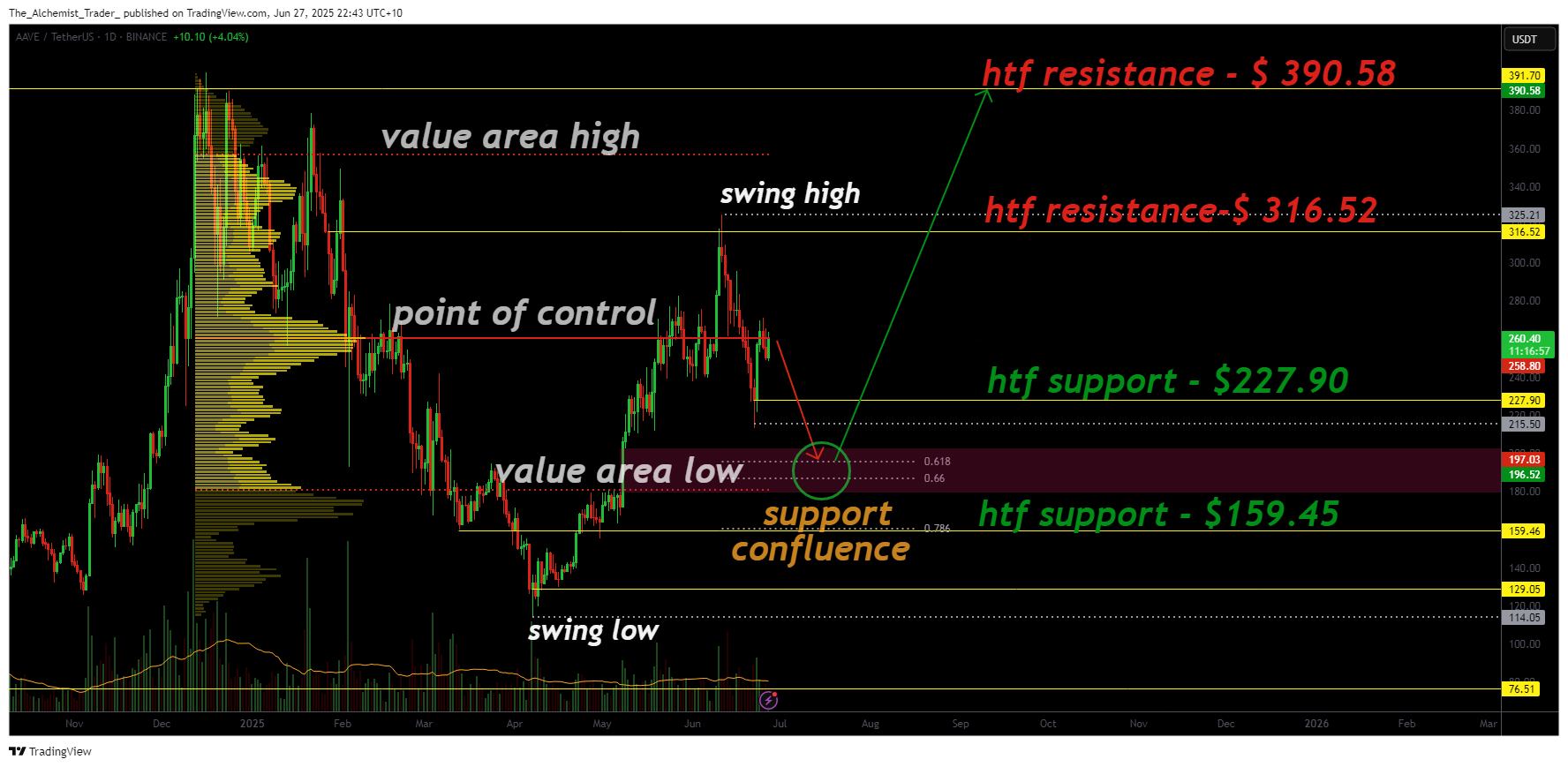
Aave’s market structure remains intact, and despite the recent correction, price action is still constructive. Corrections in bullish trends are common and often represent “bullish selling”, a healthy phase that helps re-establish balance between buyers and sellers, allowing the market to reset before continuation.
Currently, Aave is trading near the point of control, which is acting as local resistance. A pullback from this area would not be unusual, especially following the overextension seen after the last rally. The $159 level, however, is the zone to watch. This area presents strong technical confluence: it aligns with the value area low, a high time frame support level, and a key swing low, forming a prime candidate for a higher low.
If the price rotates back into this zone and attracts above-average volume, it would suggest that buyers are stepping in, not just to defend support, but to sustain the broader uptrend. Volume is critical here. Without strong participation, any bounce could lack the momentum needed to reclaim higher levels.
From a macro perspective, the correction from the $316 resistance has not invalidated the uptrend. As long as Aave prints a higher low and maintains its bullish structure, the setup remains constructive for further upside. However, failure to hold $159 could trigger a deeper retracement and shift the short-term outlook bearish.
What to expect in the coming price action
Watch the $159 support zone closely. If a higher low forms here with strong volume, Aave could resume its bullish trend and retest the $316 highs. A rejection at current resistance and a loss of $159 support would invalidate the bullish setup and tilt the structure bearish in the near term.
Disclaimer: The content of this article solely reflects the author's opinion and does not represent the platform in any capacity. This article is not intended to serve as a reference for making investment decisions.
You may also like
Deutsche Bank: The "fifth wave of tech stock rally" in US stocks since late July has peaked, prepare for a "V-shaped reversal"
Deutsche Bank has downgraded its rating on US technology stocks from overweight to neutral, noting that the fifth round of tech stock rally since July 29 is approaching the upper boundary of the long-term trend channel. The current upside potential is only about 4 percentage points, while historical trends indicate downside risks could reach 16 percentage points. Funds are expected to rotate into other sectors, and the European market, with its lower tech exposure, is likely to benefit relatively. However, Deutsche Bank emphasized that the long-term outperformance trend of technology stocks remains unchanged.
How expensive is AI computing power rental in the US? "Spot price" is twice that of long-term contracts, and four times the return threshold for cloud service providers.
The short-term spot leasing price for AI computing power reaches as high as $40 to $50 billion per gigawatt per year, while the price for long-term contracts is only $20 billion per year, and the breakeven threshold for supercomputing cloud operators is around $12 billion per year. However, according to Goldman Sachs, the fundamental reason why hyperscale cloud providers like Google rent computing power at such significant premiums is that their in-house capacity cannot keep up; once their own capacity catches up, the spot premium will disappear.

‘More bullish on Bitcoin’ – Strategy leads 91% of corporate BTC buying
RealFi Could Change How Crypto Reaches the Unbanked: 5 Best Coins Worth Having Before Adoption Accelerates

Crypto prices
More


