
Ethereum’s short-term outlook weakens amid rising exchange inflows and falling open interest

Ethereum’s recent rally may be losing momentum as exchange inflows rise and derivatives data point to softening market support.
Nearly 100,000 ETH, or about $250 million, were deposited into Binance in two sizable waves, as per a July 1 analysis by CryptoQuant contributor Amr Taha. These deposits, which usually indicate larger exchange reserves, may result in selling pressure if market sentiment shifts.
Taha also observed that the gap between Ethereum spot price and the open interest on Binance was growing. Since June 26, ETH has shown steady buying in the spot market, reaching three consecutive local highs above $2,500.
However, Binance Open Interest has lagged, hitting a series of lower highs below $5.6 billion. This suggests that fewer traders are opening new positions, which could be a sign of caution or uncertainty about the strength of the move.
The continuous reduction in U.S. Federal Reserve net liquidity is another factor that might add to the uncertainty. Liquidity has decreased from about $6.2 trillion to $5.84 trillion in recent weeks.
Lower liquidity tends to limit risk-taking by reducing access to capital in both traditional and crypto markets. Unless Ethereum sees high demand from buyers ready to absorb this environment, its upside might be limited in the short-term.
Ethereum is trading at $2,451 at press time, down 0.5% over the last day. The price is approaching $2,455, which has acted as resistance over the previous week and marks the 20-day simple moving average.
Technical indicators, such as the tightening Bollinger Bands and the relative strength index at 48.9, indicate that the market is in a consolidation phase with little volatility and no clear directional bias.
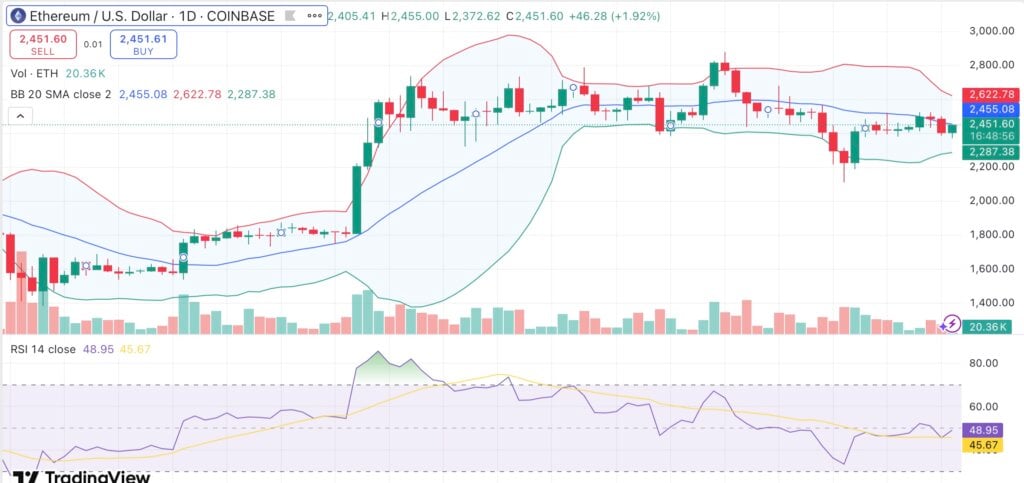 ETH price analysis. Credit: crypto.news
Although oscillators like the Stochastic RSI are approaching overbought territory, which limits the potential for short-term upside, momentum and MACD indicators display mild bullish signals.
Longer-term averages are still above the current price, suggesting broader weakness. Short-term moving averages, such as the 10-day and 50-day exponential averages, are offering little support.
The next upward target might be the upper Bollinger Band around $2,622 if buying pressure returns and Ethereum breaks above $2,500 with increased volume and rising open interest. If current support gives way and exchange inflows keep outpacing demand, the price might retest the lower band around $2,287, increasing the risk of a deeper pullback.
Disclaimer: The content of this article solely reflects the author's opinion and does not represent the platform in any capacity. This article is not intended to serve as a reference for making investment decisions.
You may also like
The "Eye of the Storm" in the Global Economy: Debt Crisis in Developed Countries
The IMF warns that developed economies are becoming the "eye of the storm" for global debt risks. Countries such as the United States and France accumulated high levels of debt during periods of low interest rates, but now rising interest rates are pushing up repayment costs, and fiscal consolidation faces political resistance. BofA Securities points out that the United States is facing declining tax revenues, France has structural income decline issues, and the UK and Japan are also under pressure. The deteriorating debt sustainability of developed countries may impact global financial markets through shocks in interest rates and capital flows.

The US market narrative undergoes a "dramatic reversal": shifting from "AI-driven deflation and controllable US debt" to "AI squeezing the bond market, and Bassen unable to control long-term interest rates"
Deutsche Bank points out that the market narrative regarding the U.S. economy has shifted from "AI drives down inflation" to "AI-related bond issuance pushes up U.S. Treasury yields," but pessimism may be overdone. The bank believes that the real risks underestimated by the market are security incidents in the AI ecosystem, failed IPOs, or underwhelming revenues, which could undermine the dollar and support the bond market. In addition, France's fiscal difficulties are putting new pressure on the euro.

Crypto prices
More


