
Cardano Jumps 12 % as Long-Term Holders Refuse to Sell
 2025/07/03 05:30
Cardano’s price has risen 12% in the last 24 hours, offering ADA holders hope for recovery after a 24% loss in June.
This shift in momentum is supported by key holder groups, long-term holders (LTHs), and short-term holders (STHs), both of whom are hesitant to sell. These factors may provide the stability needed for a price rebound.
Cardano Holders Refrain From Selling
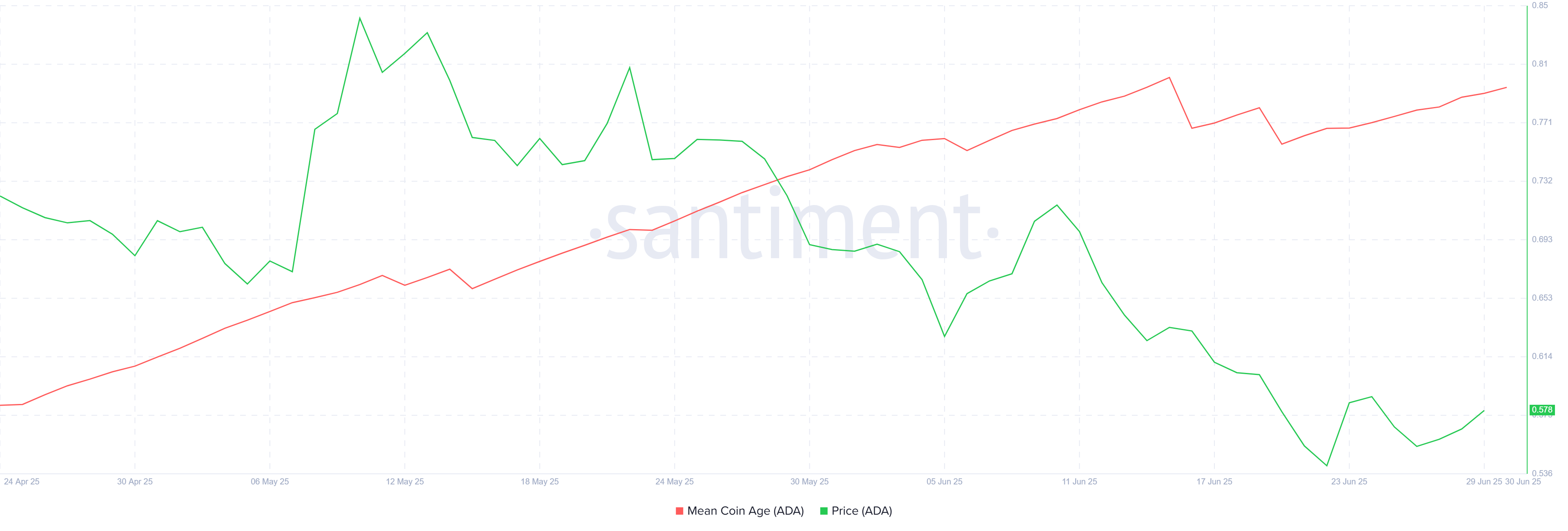
The Mean Coin Age (MCA) data reveals that LTHs are returning to HODLing after a brief period of selling. This shift toward accumulation is vital for reversing the overall negative momentum observed in recent months. LTHs control a substantial portion of Cardano’s circulating supply, and their decision to hold rather than sell can significantly influence the price.
This change in sentiment from the LTHs is helping create a more sustainable market environment for ADA. Their actions are crucial in providing support as the LTH’s stability typically stabilizes Cardano’s price.
 Cardano MCA. Source:
Santiment
Cardano MCA. Source:
Santiment
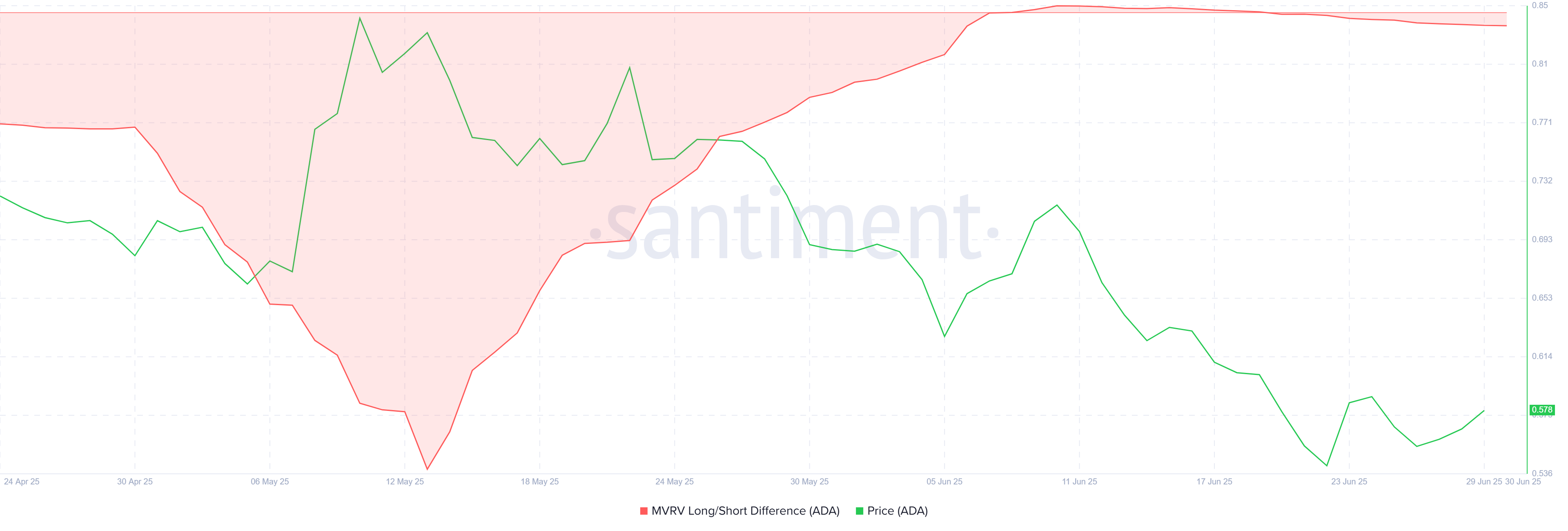
The MVRV Long/Short Difference currently sits at a neutral mark, signaling that neither LTHs nor STHs are sitting on profits. This neutrality is an important indicator, as it suggests that short-term holders are not yet in profit, which would typically prompt them to sell and drive the price down.
With both groups of holders in a neutral stance, the pressure to sell is significantly reduced, which can help stabilize Cardano’s price. This market condition provides a favorable setup for Cardano, as neither cohort is likely to cause downward price pressure through mass selling.
 Cardano MVRV Long/Short Difference. Source:
Santiment
Cardano MVRV Long/Short Difference. Source:
Santiment
ADA Price Needs To Secure Support
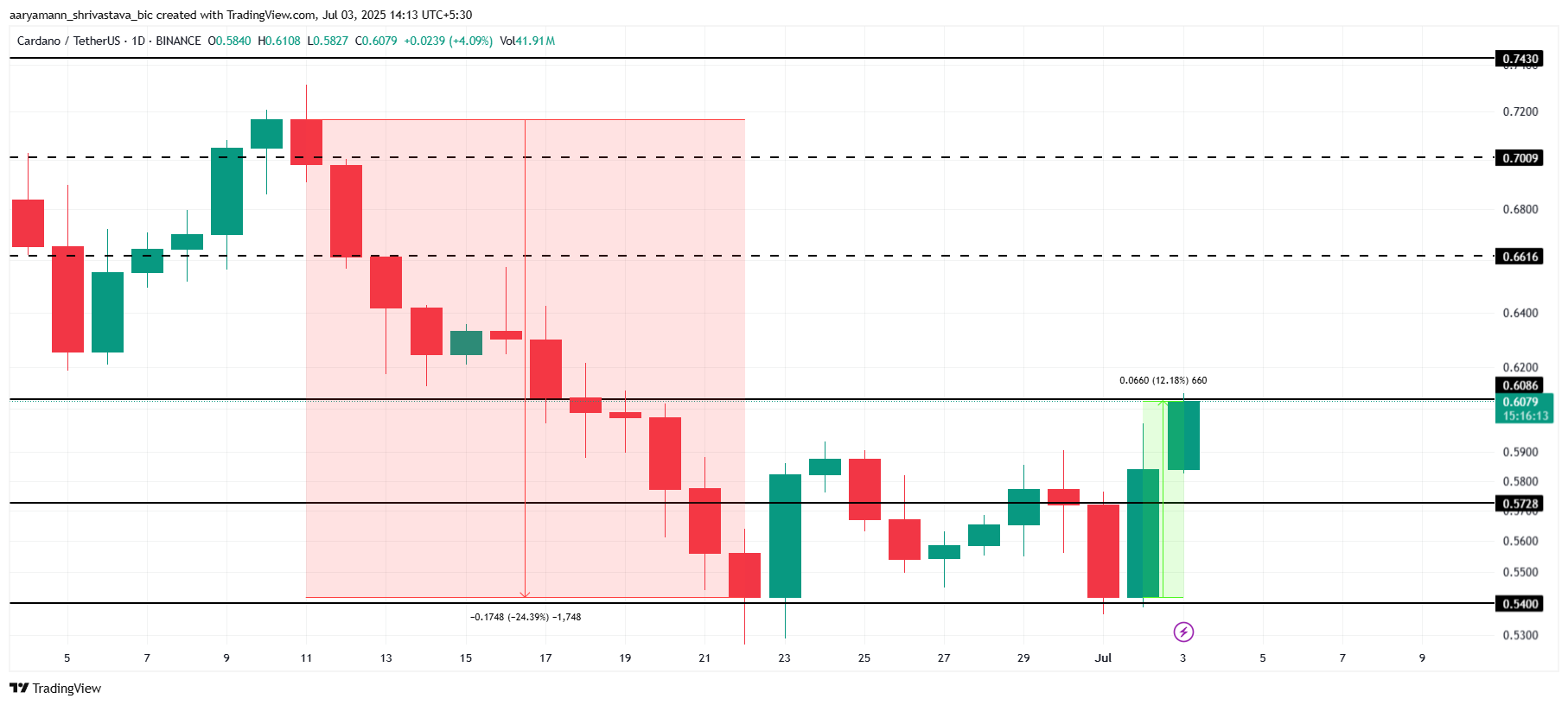
As of the time of writing, Cardano’s price is up 12%, trading at $0.60. However, this level represents a key barrier that Cardano has yet to establish as support. The market sentiment and accumulation trends provide a positive backdrop, but the altcoin faces a critical test at this level.
Securing $0.60 as support could signal the beginning of a more sustained upward movement.
If Cardano successfully flips $0.60 into a support level, the next logical price target would be $0.66. This move would indicate that the cryptocurrency is recovering more than the 24% losses seen in early June.
 Cardano Price Analysis. Source:
TradingView
Cardano Price Analysis. Source:
TradingView
However, if Cardano fails to push past the $0.60 mark and drops back due to unforeseen bearish conditions, it could consolidate within a range of $0.60 and $0.54. This would invalidate the current bullish outlook.
Disclaimer: The content of this article solely reflects the author's opinion and does not represent the platform in any capacity. This article is not intended to serve as a reference for making investment decisions.
You may also like
Micron now earns more than Apple! Apple urgently needs chips, Micron holds pricing power.
Micron Technology reported a net profit of $37.7 billion in the fourth fiscal quarter, surpassing Apple's $29.8 billion for the same period, thus becoming the more profitable company for the quarter. The memory shortage has given Micron strong pricing power, with its CEO stating that they “cannot meet customer demand.” The revenue guidance for next quarter is as high as $61.5 billion. Meanwhile, Apple's gross margin continues to be pressured by persistent memory costs, having dropped from 49.3% to a guidance range of 46.5%.
The "Eye of the Storm" in the Global Economy: Debt Crisis in Developed Countries
The IMF warns that developed economies are becoming the "eye of the storm" for global debt risks. Countries such as the United States and France accumulated high levels of debt during periods of low interest rates, but now rising interest rates are pushing up repayment costs, and fiscal consolidation faces political resistance. BofA Securities points out that the United States is facing declining tax revenues, France has structural income decline issues, and the UK and Japan are also under pressure. The deteriorating debt sustainability of developed countries may impact global financial markets through shocks in interest rates and capital flows.

The US market narrative undergoes a "dramatic reversal": shifting from "AI-driven deflation and controllable US debt" to "AI squeezing the bond market, and Bassen unable to control long-term interest rates"
Deutsche Bank points out that the market narrative regarding the U.S. economy has shifted from "AI drives down inflation" to "AI-related bond issuance pushes up U.S. Treasury yields," but pessimism may be overdone. The bank believes that the real risks underestimated by the market are security incidents in the AI ecosystem, failed IPOs, or underwhelming revenues, which could undermine the dollar and support the bond market. In addition, France's fiscal difficulties are putting new pressure on the euro.
Crypto prices
More


