
Bitcoin Tops $122K After Inflation Drops and Bulls Stay in Control


- Bitcoin sets a new ATH at $122,540, with a strong bullish trend in place
- The inflation rate dropped to 0.092 percent, which is the lowest level seen this year
- Metaplanet now owns 16,352 BTC after spending $93.6M on a fresh 797 BTC purchase.
Bitcoin has hit a record high by surging past $122k. As of press time, the pioneer cryptocurrency was trading at $122,357.10, increasing by 3.85% over the past 24 hours and 12% over the past 7 days.
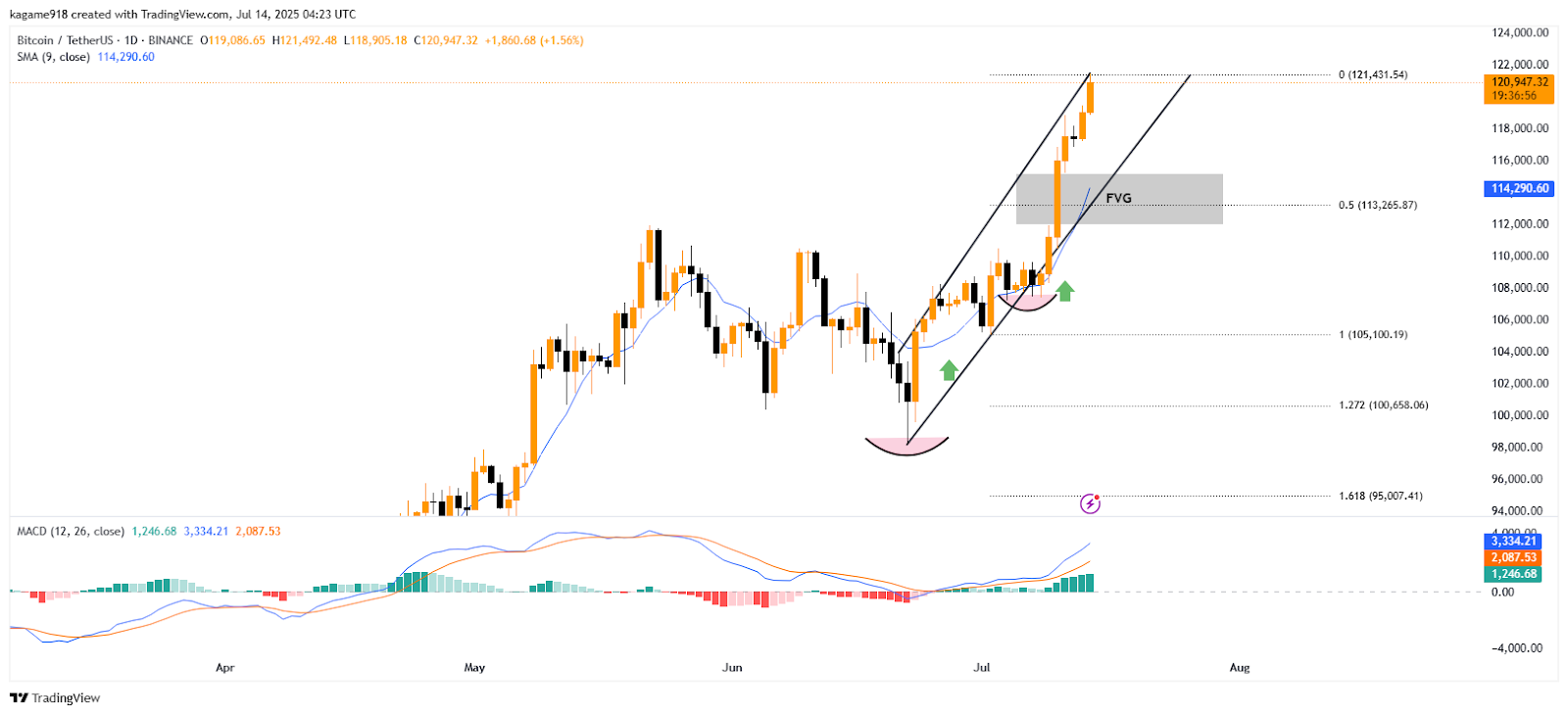
The cryptocurrency opened at $119,086.65, which hit an intraday high of $121,492, and marked its low at $118,90. This upward move positions BTC firmly within a rising channel, and now testing the $121,431.54 resistance level, with sustained bullish signals across technical and on-chain indicators.
Bitcoin’s Technical Structure
Bitcoin continues to trade above its 9-day Simple Moving Average, which is currently sitting at $114,290.60, and is reflecting firm bullish momentum. Beneath this level lies a visible Fair Value Gap (FVG) between $113,265 and $114,290, a potential short-term support zone should price reverse.
Source:
Two rounded bottom patterns—validated by successive bullish candlesticks—support the current trend. These formations align with previously established breakout zones, which now act as crucial accumulation and continuation areas.
The MACD indicator displays further bullish confluence. The MACD line stands at 3,334, far above the signal line at 2,087. This also results in a positive histogram of 1,246.68. This widening spread reflects rising buying pressure and increasing momentum.
The Fibonacci extension levels also provide a structured downside framework. Key correction zones appear at $105,100 (1.0), $100,658 (1.272), and $95,007 (1.618). These levels also serve as possible retracement points in case of market pullbacks.
Bitcoin’s On-Chain Metrics
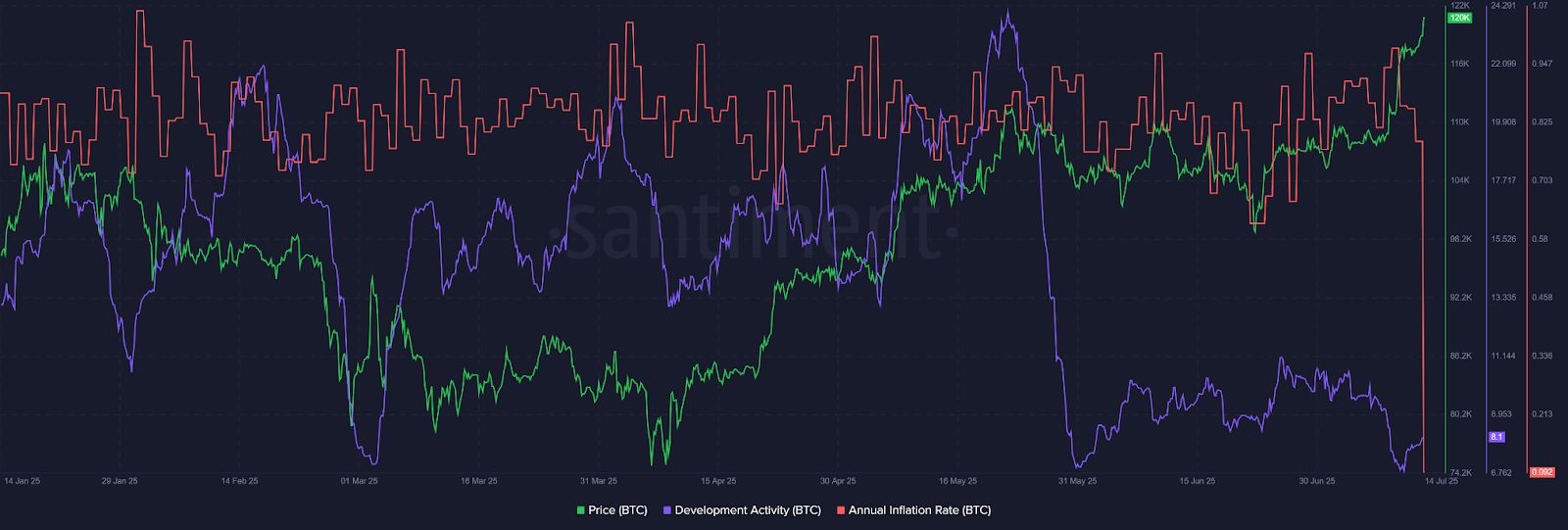
Data from Santiment reveals a sharp decline in Bitcoin’s annual inflation rate, now at just 0.092%—its lowest level year-to-date. In January, the rate hovered around 0.7%. Since then, it has steadily decreased, collapsing by over 86.8% by mid-July. This tightening in the circulating supply may partly explain the current price surge.
Source:
At the same time, Bitcoin’s development activity has seen a dramatic fall. From 24.291 on April 28, the metric has dropped to just 8.1 as of July 14. This 66.6% decrease over two and a half months marks a notable slowdown in GitHub submissions tied to the Bitcoin project. Despite the decline, market optimism remains unaffected, and the price trajectory continues to climb.
Price data indicates that BTC was trading around $93,000 in late April before rising above $104,000 in June. The rally has intensified into July, bringing it above $121,000 in mid-month trading.
Metaplanet Expands BTC Reserves With $93.6M Purchase
While Bitcoin was making history on the charts, Metaplanet, commonly referred to Japanese MicroStrategy, is accumulating BTC. The Japanese public firm Metaplanet disclosed the purchase of 797 BTC for approximately $93.6 million, at an average cost of $117,451 per coin. CEO Simon Gerovich announced the acquisition today.
The purchase increases Metaplanet’s total BTC holdings to 16,352 coins, which were acquired at an average cost of $100,191 each. This positions the company among the leading corporate holders of Bitcoin in Asia.
Related: Bitcoin Hits $118K, Defying Warnings from Top Critics
Market analyst Ken Thung spoke about the strategic distinction between the regulatory framework of Japan and that of the United States based on Bitcoin treasury policies. In the meantime, the response of the community to X was that it felt very strongly about the aggressive build-up approach of Metaplanet.
It is evident that one of the main factors that have highly contributed to Bitcoin’s breakthrough beyond 120,000 might include these large-scale purchases, macroeconomic signals, and limited supply.
The post Bitcoin Tops $122K After Inflation Drops and Bulls Stay in Control appeared first on Cryptotale.
Disclaimer: The content of this article solely reflects the author's opinion and does not represent the platform in any capacity. This article is not intended to serve as a reference for making investment decisions.
You may also like
1.7 Trillion Unlock V.S 1.7 Trillion Buyback: Goldman Sachs Bets on the Latter to Sustain the US Stock Market Bull Run
Goldman Sachs expects US companies to raise $600 billion in 2027, sets S&P target at 8,700 points, and states that buybacks and profits can withstand supply shocks.
Next target 8%? US mortgage rates soar to a three-year high as “higher for longer” trades sweep the real estate market
U.S. mortgage rates are experiencing a sharp upward surge. In just over a month, the average 30-year fixed mortgage rate has climbed by a full percentage point, reaching above 7.5%, the highest level in three years. As a result, homebuyer demand has plummeted, and existing home sales in September are expected to show a significant decline.
Bank of America Hartnett: Interest rate hikes become the biggest bullish factor, the logic of ending the bond bubble is spreading
Bank of America strategist Hartnett has made a counterintuitive assessment: the most favorable event for the stock market before the end of the year would be for the Federal Reserve to proactively raise interest rates in October—using a tightening move to curb the out-of-control long end. If the Fed proves its willingness to control inflation and term premium through an October rate hike, the market may actually stop worrying about the 10-year yield surging toward 6%, thereby easing pressure on stocks. Currently, while US stocks have not yet been brought down by interest rates, cracks are quietly spreading in South Korean brokers, French government bonds, and CCC-rated credit bonds.
Goldman Sachs chart: "Gasoline prices determine the US midterm election"! Prediction market shows "Democrats have a 65% chance of sweeping both chambers"
A recent report from Goldman Sachs shows that the Iran war caused oil prices to surge from $3 to $5 per gallon, while the Democratic Party's lead in the general ballot simultaneously expanded from 5 to 9 percentage points—two trends that closely align. Goldman Sachs believes that Hurricane Isaias, once again impacting 63% of offshore capacity in the Gulf of Mexico, has made oil prices a true "ballot decider." Bank of America warns that if the Senate sweeps both chambers, it will trigger significant risk aversion, potentially causing the stock market to plunge by over 10% and weakening the US dollar.

Crypto prices
More


