
Ethereum Faces $1.3 Billion Unstaking Wave — Here’s What It Could Mean for ETH

Ethereum's $3,600 rally prompts $1.3 billion in ETH unstaking, raising market questions. But soaring staking demand and whale buys suggest long-term strength.
As capital continues to flow strongly into Ethereum in 2025—pushing its price above $3,600—the amount of ETH queued for unstaking has also surged unexpectedly.
What could this mean for Ethereum’s price trend? Here are some expert insights.
Over 350,000 ETH Waiting to Be Unstaked—What’s the Implication?
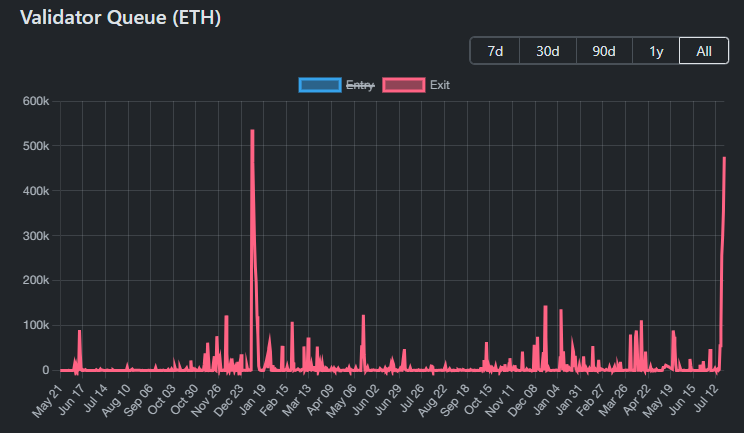
Udi Wertheimer, a prominent investor in the crypto community, raised concerns after discovering that more than 350,000 ETH—worth approximately $1.3 billion—are currently waiting in the unstaking queue.
 Ethereum Validator Queue. Source:
ValidatorQueue
Ethereum Validator Queue. Source:
ValidatorQueue
“There’s 350,000 ETH queued up to unstake. About $1.3 billion. The last time that much ETH was being unstaked was in January 2024, following a 25% rally in ETH/BTC in a single week. [price] went down only from there,” Udi Wertheimer said.
Unstaking allows users to withdraw their ETH from staking smart contracts, turning it back into freely usable assets.
A large wave of unstaking could signal potential selling pressure. This is especially true if investors are looking to take profits after ETH’s 160% rally since its April lows.
Earlier in 2024, more than 500,000 ETH were unstaked before ETH surged from $2,100 to over $4,000, and later dropped back to $2,100.
Where Might This Unstaked ETH Go?
Viktor Bunin, OG Protocol Specialist at Coinbase, suggested that this ETH might be moved into internal treasury funds. These funds could serve financial strategies like long-term investment or portfolio diversification.
If that’s the case, this isn’t a sign of panic selling—it’s more likely a form of asset management. This could actually help stabilize the market in the long term.
Meanwhile, a report from Lookonchain shows that on-chain data indicates around 23 whales or institutions have accumulated 681,103 ETH (worth $2.57 billion) since July 1.
And the accumulation hasn’t stopped. In the fourth week of July, more institutions continued to add billions of dollars worth of ETH.
“The new ETH treasury—The Ether Machine—announced $1.5 billion in ETH this morning. That’d be the biggest yet. But then last week, Tom Lee from Fundstrat Capital said he was going to buy $20 billion in ETH, and Joseph Lubin said he was in for at least another $5 billion. I have no idea who’ll end up as the biggest. But I do know this—there’s not enough ETH to go around,” crypto investor Ryan Sean Adams said.
What About ETH Being Staked?
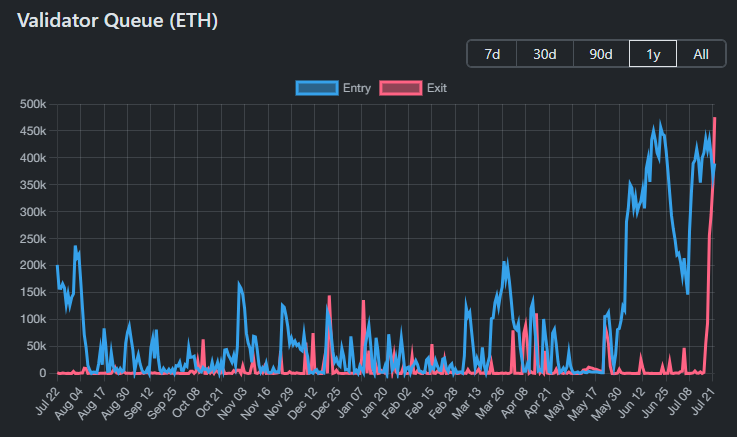
Udi Wertheimer’s concern may sound alarming, especially when compared to historical patterns. However, it lacks a key perspective: the amount of ETH currently waiting to be staked.
 Ethereum Validator Queue. Source:
ValidatorQueue
Ethereum Validator Queue. Source:
ValidatorQueue
Data from ValidatorQueue shows that the ETH queued for staking actually far exceeds the amount queued for unstaking. Since June, this queue has surged, with over 450,000 ETH waiting to be staked on certain days.
This reflects continued investor interest in participating in the Ethereum network through staking.
“Also, there’s a healthy amount of ETH queued up for staking at this time,” Wertheimer added.
Data from beaconcha.in shows that over 35.7 million ETH is currently staked across various protocols. This accounts for 29.5% of the circulating supply.
Ultimately, the balance between ETH entering and leaving staking protocols is a critical factor. It helps determine whether the market is facing real selling pressure or simply witnessing strategic reallocation by institutions and individual investors.
Disclaimer: The content of this article solely reflects the author's opinion and does not represent the platform in any capacity. This article is not intended to serve as a reference for making investment decisions.
You may also like
SOL Bulls Face a Challenge as Solana Rally Shows Signs of Exhaustion
Reshaping Keynesian Thought Recognized with Nobel Prize! American economists Hall and Woodford reveal the underlying logic of consumption decisions and central bank policies
The Royal Swedish Academy of Sciences announced on October 12 that the 2026 Nobel Prize in Economics will be awarded to American economists Robert Hall and Michael Woodford, in recognition of their outstanding contributions to foundational microeconomic research for macroeconomic stability policy.

TSMC Q3 Earnings Preview: 2nm Mass Production, Strong AI Demand, HSBC Raises Target to 3,800 TWD
According to Bloomberg's calculations, TSMC's revenue for the third quarter reached NT$1.49 trillion, mainly driven by strong volume growth in 2nm processes and high utilization rates for 3nm and 5nm processes. Bank of America and HSBC have both raised their target prices, with the highest projection reaching NT$3,800. The company is expected to maintain strong growth momentum in the fourth quarter due to price increases and migration to advanced processes. Capital expenditures will remain high to strengthen its core position in AI infrastructure.
The weakest borrowers can no longer hold on! Morgan Stanley: CCC-rated credit spreads have surpassed 1000 basis points, bank stocks experience the most extreme overselling in 33 years.
U.S. stock indices are only 0.2% away from all-time highs, but there is turbulence beneath the calm surface: CCC-rated bond spreads have exceeded 1,000 basis points, marking the widest level since 2023 and credit differentiation has reached historic extremes. The gap in RSI between bank stocks and the S&P 500 is the largest in 33 years, indicating deep overselling; 10-year U.S. Treasury yields have soared to 5.30%, a new high since 2002. The upcoming bank stock earnings season, kicking off this Tuesday, is viewed as a crucial moment to test whether the market can bridge the gap between "fundamental resilience and investor concerns."

Crypto prices
More


