
No OpenSea deal—Pudgy Penguins says it’s all about partnerships

Pudgy Penguins has denied rumors about buying OpenSea, with its head of security, Beau, dismissing acquisition speculation and redirecting attention to the project’s major partnership strategy.
- Pudgy Penguins deny rumors of buying OpenSea, calling speculation unnecessary
- CEO’s past comments sparked OpenSea rumors, but no acquisition has taken place
- Pudgy Penguins focus on global brand partnerships like Lufthansa and NASCAR
The clarification comes after community speculation linked the NFT project to the marketplace amid recent policy changes.
“Pudgy Penguins didn’t buy Opensea… chill,” Beau posted on X Saturday. “The scale of things planned for the Penguin is so large that you need not speculate on a single acquisition. Instead talk about partnering with Lufthansa and NASCAR, and go find the next great brand for us to proliferate with.”
Pudgy Penguins CEO had expressed interest
Speculation about a potential OpenSea purchase began circulating after multiple users referenced previous statements by Pudgy Penguins CEO Luca Netz, who had expressed interest in acquiring the marketplace.
Community members connected these comments to recent timing between Pudgy’s December announcements and OpenSea’s subsequent policy changes regarding token support.
The rumors showed the overall speculation about OpenSea’s strategic direction amid increased competition from platforms like Blur and Magic Eden.
However, Beau’s response definitively shut down acquisition theories while highlighting the project’s actual expansion plans.
Pengu NFT sales jump in 30 days
Pudgy Penguins has secured its position as the fifth-ranked NFT collection by 30-day sales volume with $23.09 million, posting growth of 336.17% in sales and 141.15% in transactions.
 Pudgy Penguins NFT sales: Data from CryptoSlam
The collection recorded 545 transactions across 285 buyers and 327 sellers as per data from CryptoSlam.
The PENGU ( PENGU ) token has delivered strong performance with gains of 34.9% over 7 days, 80.8% over 14 days, and 333.5% over 30 days.
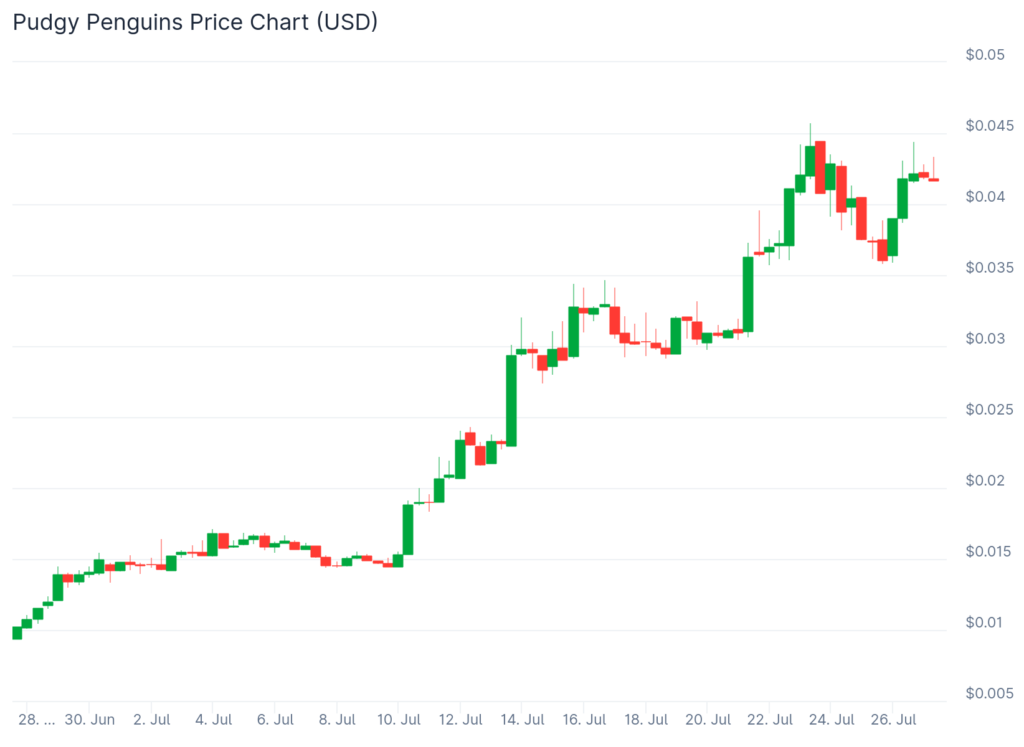 PENGU 30D price chart from CoinGecko
Beau’s response highlights Pudgy Penguins’ emphasis on brand partnerships over platform ownership, citing collaborations with major companies such as Lufthansa and NASCAR.
The partnership approach enables Pudgy Penguins to utilize existing infrastructure and reach a broader audience, rather than building competing platforms.
Beau’s call for community members to “find the next great brand for us to proliferate with” suggests an open approach to partnership development.
Disclaimer: The content of this article solely reflects the author's opinion and does not represent the platform in any capacity. This article is not intended to serve as a reference for making investment decisions.
You may also like
Tesla (TSLA.US) Robotaxi Faces Regulatory Challenges Again: Investigation into Speeding in School Zones, Cybercab Expansion Clouded
Tesla's Robotaxi business is once again under review by US regulatory agencies. The National Highway Traffic Safety Administration (NHTSA) is evaluating allegations regarding Tesla Cybercab and Model Y autonomous taxis speeding in school zones.
STRK, MAGIC, and W: Three Altcoins with 100%+ Moves — More Ahead?
Broadcom CEO: Many AI investors are like casino gamblers, and the biggest constraint on AI development is capital
Broadcom CEO Hock Tan warned that many AI investors lack understanding of the technologies they are betting on, yet have extremely high return expectations, likening them to gamblers in a casino. He believes that capital has now replaced shortages of chips, storage, and electricity as the biggest constraint on AI development. Intel CEO Pat Gelsinger also pointed out that rising financing costs and uncertainty in investment returns have become core challenges for the industry.
IonQ (IONQ.US) acquires Elisity in a $1.3 billion all-stock deal: Quantum computing valuation begins to materialize through the trending concept of cybersecurity
IonQ plans to acquire Elisity for up to $1.3 billion to strengthen its cybersecurity division.
Crypto prices
More


