
HBAR Bulls Get Burned as Long Liquidations Dominate Futures Market

HBAR is struggling with significant losses as long-position liquidations and smart money exits signal growing bearish momentum, pushing the token toward key support levels.
Hedera Hashgraph’s HBAR has noted a sharp downturn this week, with its price slipping by over 17% since Sunday.
As sentiment across the crypto sector remains muted, HBAR has not been spared. On-chain data shows that bullish traders are now bearing the brunt of its ongoing price decline.
HBAR Faces Long Liquidations as Bearish Pressure Climbs
In the past 24 hours, HBAR’s price has plunged by 9%, deepening the losses for bullish traders. Data from Coinglass shows that long liquidations alone accounted for $2.70 million of the total $2.94 million wiped from the HBAR futures market during this period.
For token TA and market updates: Want more token insights like this? Sign up for Editor Harsh Notariya’s Daily Crypto Newsletter .
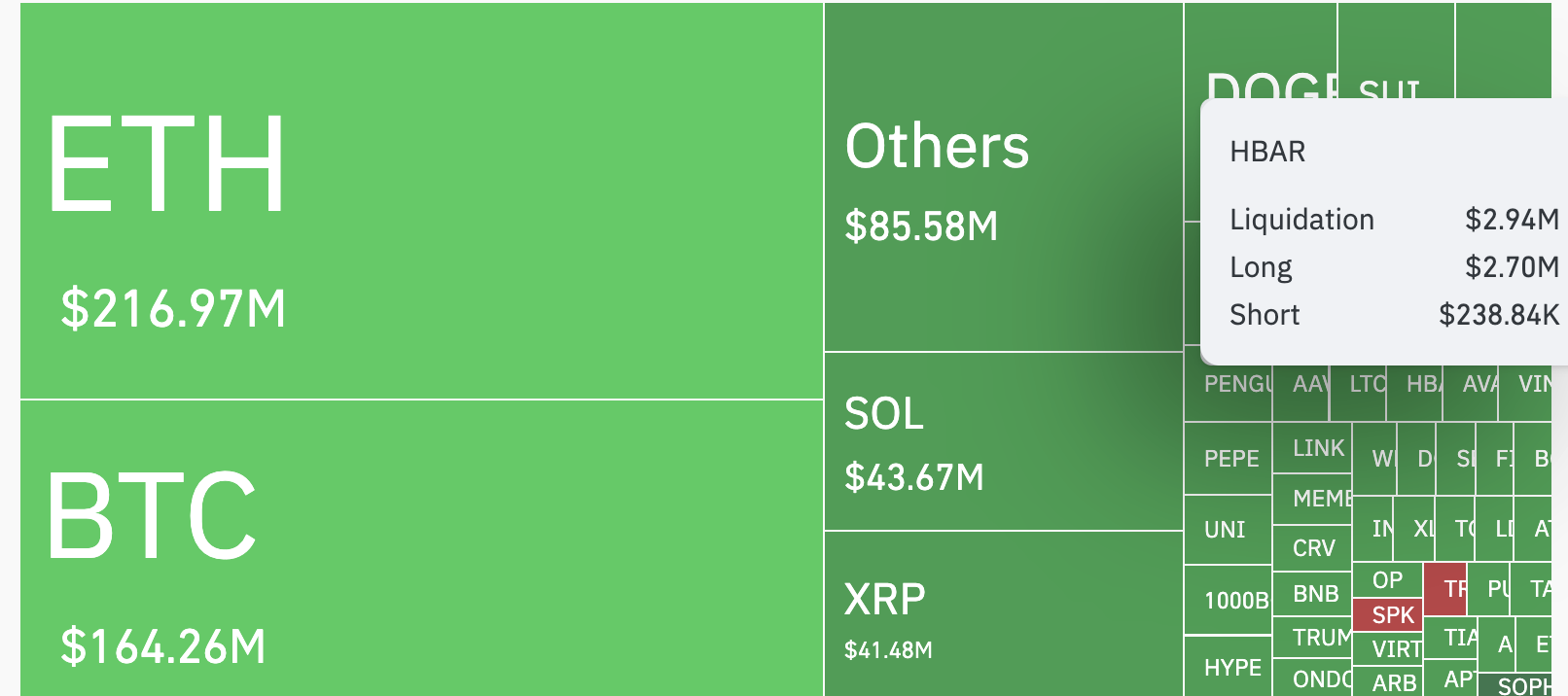 Crypto Liquidation Heatmap. Source:
Coinglass
Crypto Liquidation Heatmap. Source:
Coinglass
Long-position holders have faced a wave of liquidations as HBAR’s price continues to fall. According to Glassnode, the token’s Futures Long Liquidations Dominance surged past 88% on Thursday, marking another day of aggressive shakeouts for bullish traders this week.
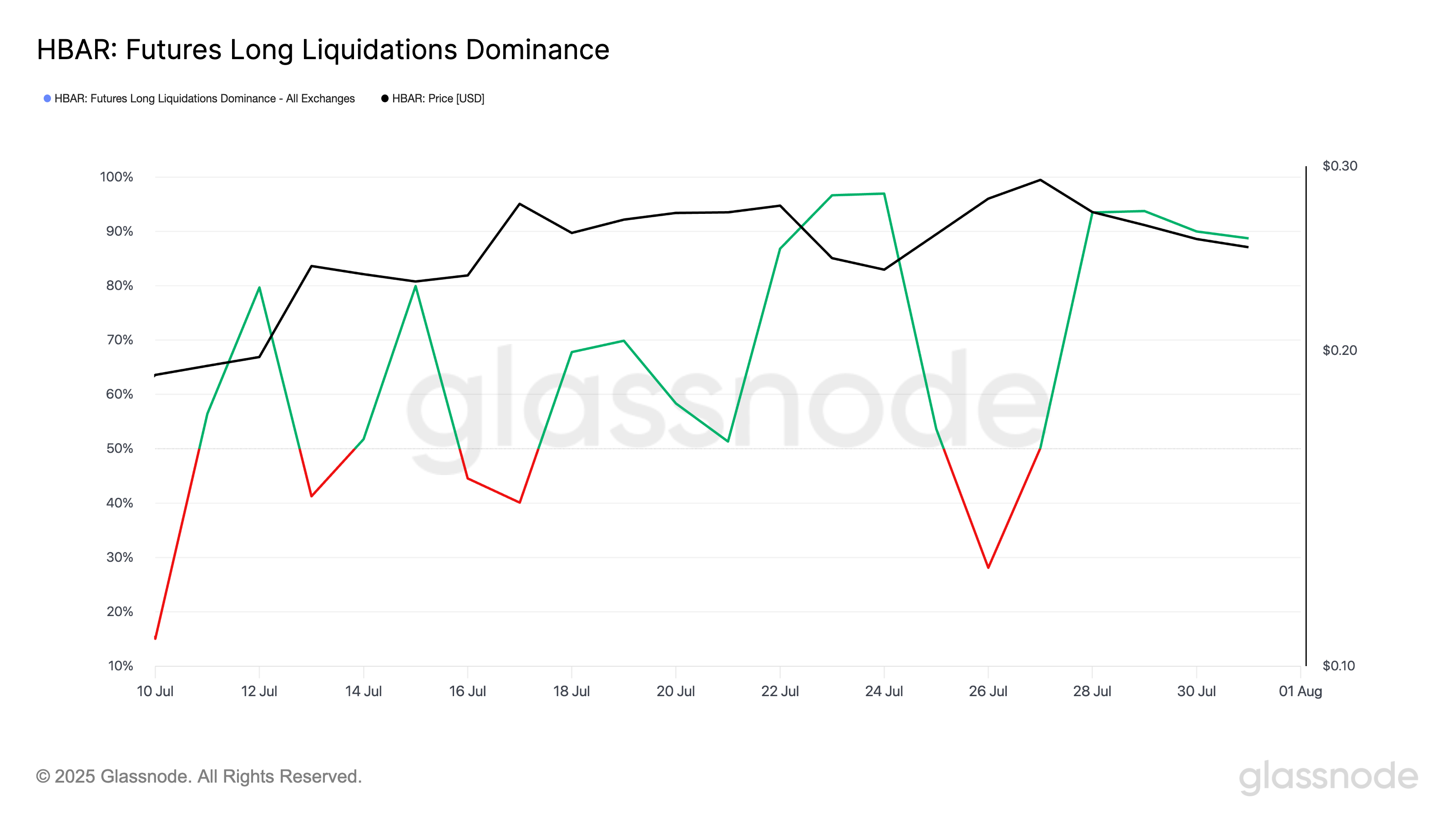 HBAR Futures Long Liquidations Dominance. Source:
Glassnode
HBAR Futures Long Liquidations Dominance. Source:
Glassnode
This metric measures the proportion of total futures liquidations that come from long positions. When it spikes, it indicates that most liquidations are coming from traders who bet on rising prices due to a downward price trend.
In HBAR’s case, the metric confirms that bearish momentum has overwhelmed bullish sentiment. This has triggered a cascade of forced sell-offs that could further pressure the token’s price.
HBAR’s Smart Holders Hit the Exit
Selling activity has also rocketed among HBAR “smart holders.” Readings from the token’s Smart Money Index (SMI) indicator reveal a steady decline in demand among these investors since Sunday. At press time, it stands at 0.98.
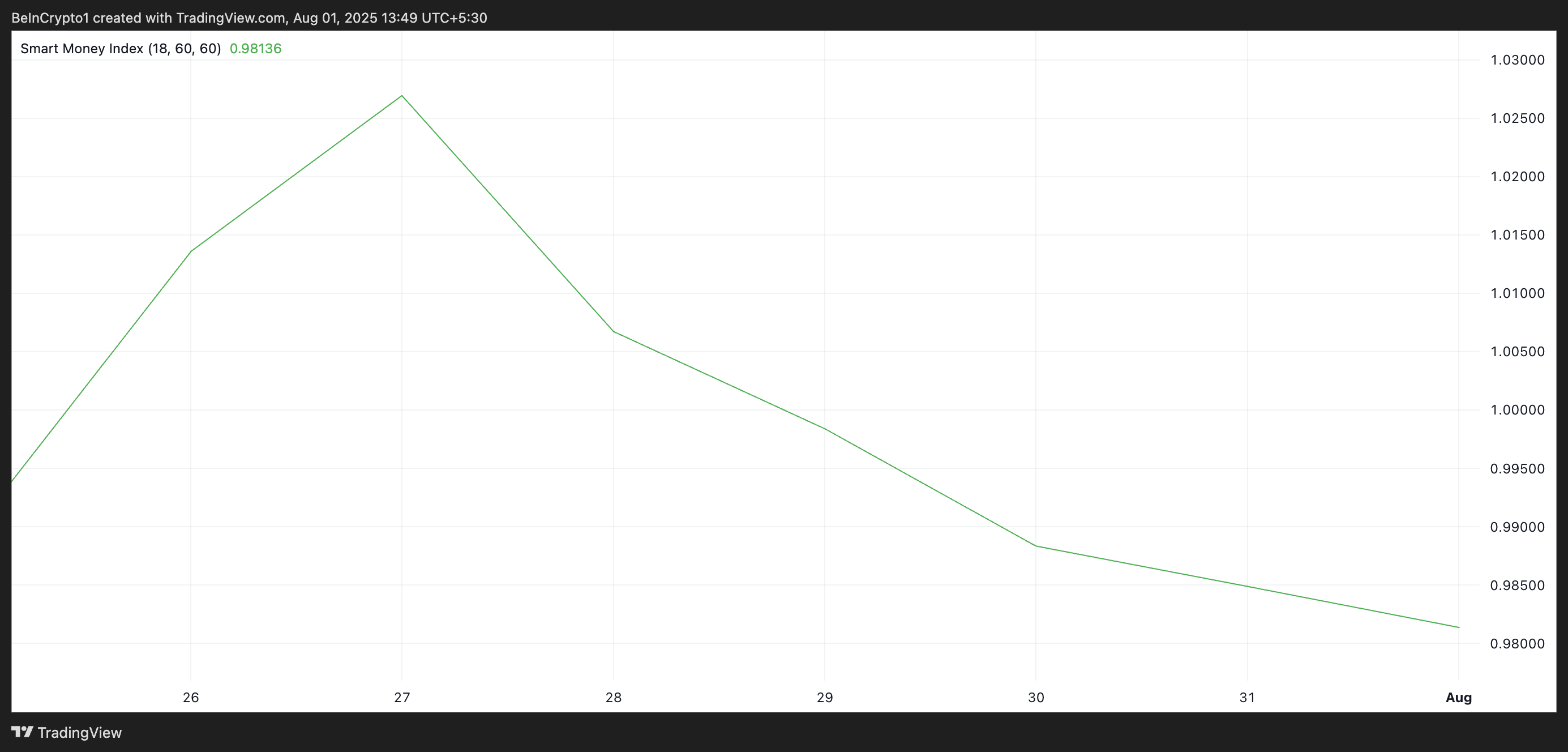 HBAR SMI. Source:
TradingView
HBAR SMI. Source:
TradingView
Smart money refers to capital controlled by institutional investors or experienced traders who understand market trends and timing more deeply. The SMI tracks the behavior of these investors by analyzing intraday price movements.
It measures selling in the morning (when retail traders dominate) versus buying in the afternoon (when institutions are more active).
A rising SMI signals that smart money is accumulating an asset, often ahead of major price moves.
However, when this momentum indicator falls, experienced traders are pulling back from the market. This trend signals weakening confidence in HBAR’s short-term price stability as the market enters a new trading month.
HBAR Holds the Line at $0.24 — But Will the $0.22 Floor Collapse?
HBAR trades at $0.24 at press time, holding just above a key support level at $0.22. If sell-side pressure intensifies, a drop below this floor could be imminent, potentially driving the token’s price down to $0.18.
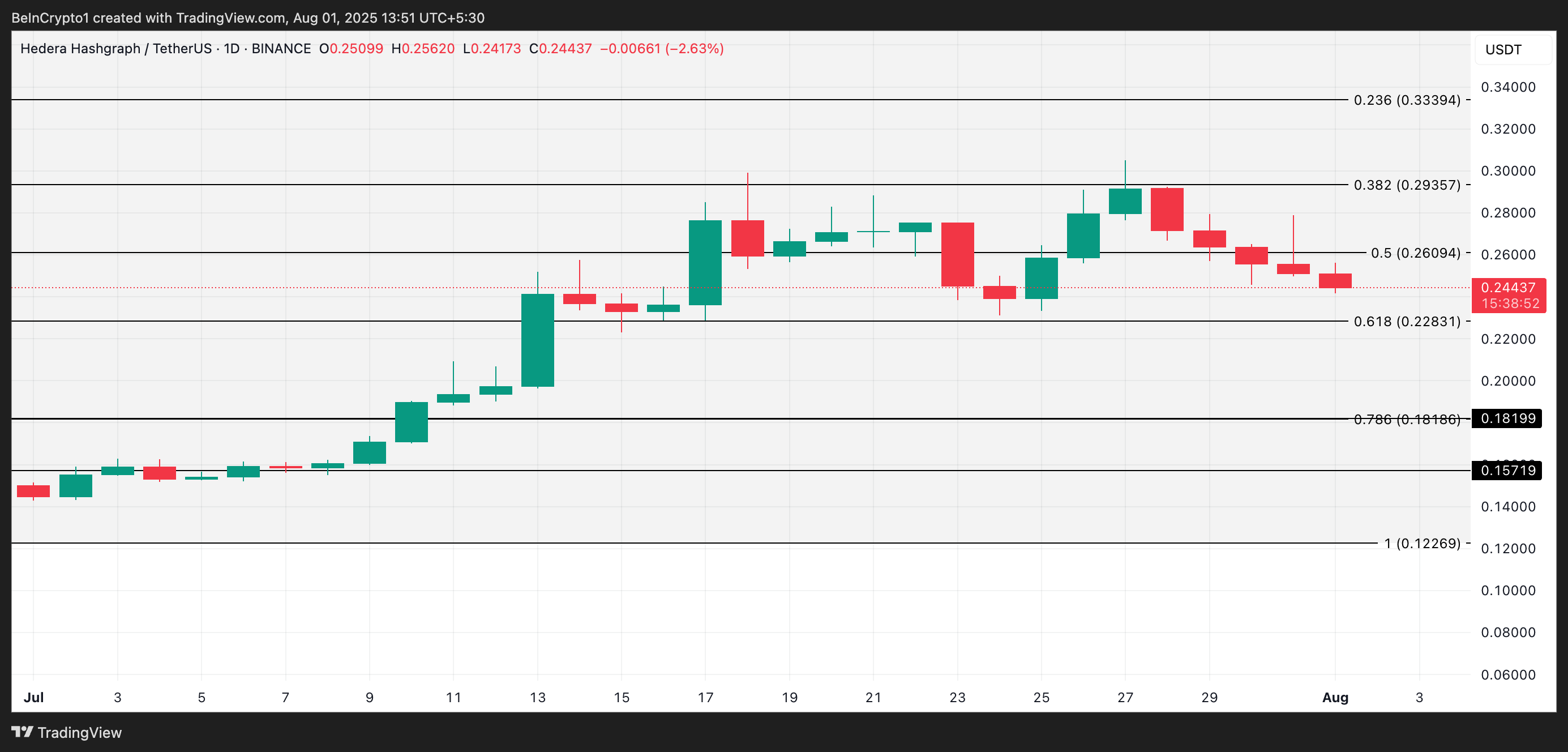 HBAR Price Analysis. Source:
TradingView
HBAR Price Analysis. Source:
TradingView
Conversely, a resurgence in buying interest could trigger a bullish reversal. HBAR may attempt to break above the $0.26 resistance level in that scenario.
Disclaimer: The content of this article solely reflects the author's opinion and does not represent the platform in any capacity. This article is not intended to serve as a reference for making investment decisions.
You may also like
Fed Voting Member Harker: Fighting Inflation Requires Faster, More Frequent Small Rate Adjustments, Be Vigilant Against Inflation Expectations Becoming Entrenched
Cleveland Federal Reserve President Loretta Mester believes that inflation pressures have spread beyond the energy sector, with AI investments and tariffs driving up costs. To prevent high inflation from becoming entrenched in the economy, she suggests that the Federal Reserve should consider smaller, quicker, and more frequent rate adjustments, rather than waiting for inflation pressures to accumulate and then taking larger actions. She did not explicitly support an interest rate hike in October, emphasizing policy transparency: explaining the response mechanism does not equate to committing to a specific rate path.
Will the US cancel 20-year Treasury bonds? BNP Paribas: It may trigger market panic; Citibank: Positioning 20-year bonds to outperform 10-year bonds
There are market rumors that the U.S. Treasury is considering cutting back or canceling the issuance of 20-year Treasury bonds, which were reinstated in 2020. The yield on 20-year bonds has long been higher than both 10-year and 30-year bonds, resulting in a "hump" in the yield curve and higher financing costs. The market is closely watching this Friday’s routine survey questionnaire, as well as whether a clear signal will be released in the quarterly refunding statement on November 4. Citi suggests positioning in advance, but BNP Paribas warns that such a move could be interpreted as a panic signal that policy tools have been exhausted.

Bitcoin price volatility accompanies a 6% drop as sentiment turns neutral
WF stock trades at $36, up 196.78%, with daily RSI at 97.86
Crypto prices
More


