
Stablecoins No Match for Visa and Mastercard’s Dominance

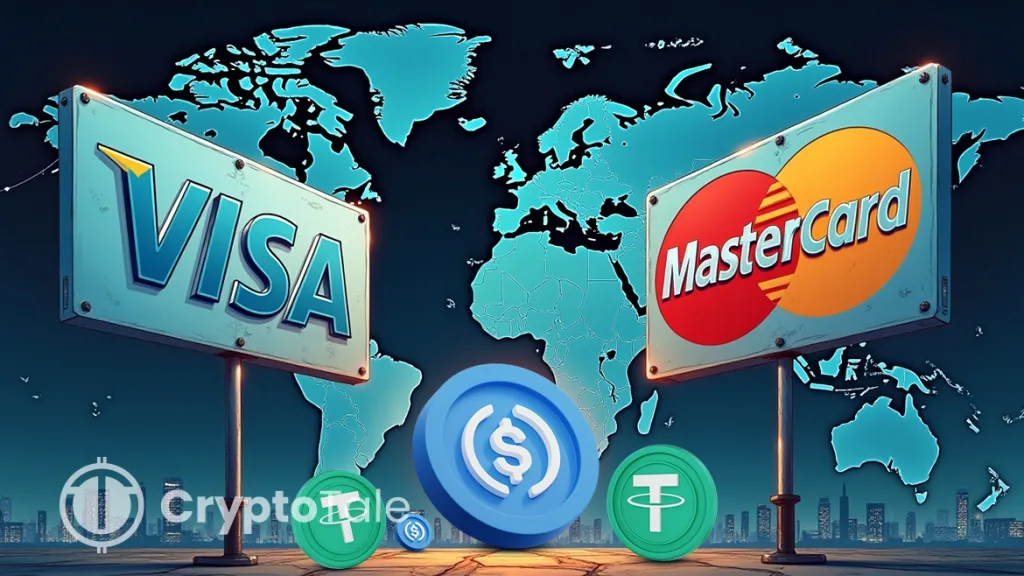
- Visa and Mastercard report that stablecoins still lack real-world payment utility and trust.
- Around 90% of stablecoin volume is tied to crypto trading, not consumer or retail spending.
- Despite crypto growth, card giants lead with $15T volume and strong fraud protection systems.
Visa and Mastercard have declared that stablecoin payments do not threaten their dominance in the global payments industry. This comes amid a significant rise in crypto adoption during 2025. Visa processed $15 trillion in transactions over the year. That figure remains far ahead of the entire stablecoin market, which is still considered niche.
According to Reuters, both companies said most stablecoin usage is limited to crypto trading. Around 90% of stablecoin volume flows through digital asset exchanges. They are often used for value storage or crypto speculation, not for day-to-day purchases. This restricts their role in the broader financial system.
Card Giants Lean on Strength, Scale, and Stability
Visa and Mastercard continue to rely on proven strengths. These include consistent performance, global reach, and strong security standards. Both networks offer predictable outcomes, unlike the still-developing stablecoin ecosystem. Fraud protection remains a key advantage traditional networks provide.
Financial results also support the card companies’ strong position.LSEG data shows Visa reported an 8% rise in quarterly earnings, reaching $5.3 billion. Mastercard posted a 14% increase, with profits totaling $3.7 billion.
Mastercard and Visa handle nearly 70% of U.S. consumer transactions, according to the Nilson Report. Their strong presence in the market makes it difficult for new competitors to gain traction. Previous challengers such as peer-to-peer apps failed to dent their market share.
Their stock prices reflect their continued dominance. Visa shares have climbed 31% over the past year. Mastercard’s stock rose by 24% in the same period. They currently trade at 28 and 32 times their expected earnings, respectively. Investors continue to back their long-term value.
Profits Hold, but Pressure Builds from Stablecoins
The companies remain profitable, but their fee margins are gradually shrinking. Together, they generated roughly $95 billion in swipe fees during the last fiscal year. Visa earned 6.6 cents per transaction in the recent quarter, a drop from nearly 9 cents ten years ago. Mastercard averaged 7.3 cents over the past year, marking a slight year-over-year decline.
Company executives acknowledged the advanced technology behind stablecoins. However, they emphasized that stablecoins lack scale and infrastructure. They also lack the fraud safeguards and consumer trust needed for mainstream use. These gaps leave stablecoins far behind traditional payment networks.
Both companies are investing in stablecoin-related infrastructure. They aim to support future integrations between digital assets and traditional finance. This is being done in response to regulatory developments. The recently introduced GENIUS Act has brought more clarity to stablecoin frameworks.
Stablecoins are gaining traction in unstable markets. In countries facing high inflation or weak national currencies, they serve as a digital store of value. They also offer faster and cheaper remittance solutions. These use cases are growing where fiat currencies are unreliable.
Related: Mastercard Moves on Stablecoins Post-GENIUS Act
In the developed markets, adoption is slower. In this case, regulatory uncertainty and low consumer demand exist. Disadvantages such as the advent of protections are significant stumbling blocks. Card networks are still at the forefront of these environments. Their risk and compliance systems are well established, and thus they have an upper hand.
Stablecoins lure other merchants due to cheaper costs and quicker settlement. Nonetheless, the majority of these digital assets are related to the crypto industry. In contrast, Visa and Mastercard are deeply embedded in the global financial system. The vast scale of their networks continues to limit stablecoins’ ability to gain widespread adoption.
Global payments pretty much still go through Visa and Mastercard. Their networks have been tested and trusted. Stablecoins are increasing, but are already at the edge. At the moment, the giants in the payment world remain in their positions of power.
The post Stablecoins No Match for Visa and Mastercard’s Dominance appeared first on Cryptotale.
Disclaimer: The content of this article solely reflects the author's opinion and does not represent the platform in any capacity. This article is not intended to serve as a reference for making investment decisions.
You may also like
AI trading cools down and storage chip competition intensifies, Korean stocks plunge over 5%, marking a second consecutive day of sharp decline; SK Hynix drops nearly 8%
On Tuesday, the Korea Composite Stock Index (KOSPI) dropped by as much as 5.1%, triggering the Sidecar circuit breaker mechanism on the exchange and suspending programmatic sell orders for five minutes. Both Samsung Electronics and SK Hynix fell more than 6%, marking five consecutive days of decline. Japan's SoftBank Group plunged over 8%, while AI industry-related stocks such as Tokyo Electron and Advantest also dropped by more than 5%.
Wall Street giants' financial reports tonight: With stock prices trapped in technical correction, even a 20% profit increase can hardly ease triple anxiety
Shares of major US banks hovered in a technical correction zone on Tuesday as the earnings season kicked off, with long-term borrowing costs rising to their highest levels in decades. This has heightened market attention on bank executives’ assessments of US consumer health and credit prospects.
UBS Earnings Season Preview: Strong Momentum from AI Spending, Favoring Lam Research (LRCX.US) and Texas Instruments (TXN.US), Remaining Cautious on Western Digital (WDC.US)
Lam Research (LRCX.US), Texas Instruments (TXN.US), and Western Digital (WDC.US) are set to release their quarterly earnings reports in the coming days. UBS believes that, with continued high spending on artificial intelligence, all three companies are likely to benefit from this trend.
Deutsche Bank (DB.US) upgrades AST (ASTS.US) rating: Has the SpaceX (SPCX.US) spectrum acquisition triggered an unjust sell-off?
Deutsche Bank has upgraded AST SpaceMobile to a "Buy" rating with a target price of $93. Despite stock price volatility triggered by SpaceX's spectrum acquisition, analysts believe that the cooperation potential with T-Mobile and government orders constitute core support. The recent short-term pullback may present a good opportunity to build positions.
Crypto prices
More


