
Curve Considers Pivot Away From Ethereum Layer 2 Networks After Poor Yield

Curve’s core team stated that the controversial proposal does not reflect their current roadmap or strategic direction.
A governance proposal within Curve Finance is causing a stir in the DeFi community, as one contributor calls for a pause in the protocol’s expansion into Ethereum Layer 2 networks.
On July 31, a CurveDAO member submitted a proposal arguing that Curve’s Layer 2 deployments generate little revenue and divert resources from more valuable initiatives like its native stablecoin, crvUSD. Layer 2 networks are designed to improve Ethereum’s scalability and have become increasingly popular over the years.
Curve Earns More From Ethereum in a Day Than 450 L2s Combined
The proposal highlighted Curve’s disappointing revenue generation across 24 Layer 2 networks. According to the proposal, the protocol earns approximately $1,500 daily across all these Layer 2 chains, equating to just $62 per network.
Considering this, the proposal stated that such returns do not justify the engineering costs and long-term upkeep required to support these fast-moving blockchain networks.
“Bringing Curve to L2s has been tried now, but the stats speak for themselves. Very little returns while consuming lots of developer time to develop, while also having mostly much higher maintenance cost due to their fast paste, short lived, nature,” the author noted.
In comparison, Curve’s Ethereum mainnet remains a far more lucrative source of income.
The protocol reportedly earns around $28,000 per day from its Ethereum pools—more than 18 times the combined daily revenue from its Layer 2 ventures.
“Curves’ Ethereum Pools generate on a slow day 28,000$ of revenue, the equivalent of approximately 450 L2s, given their average revenue,” he noted.
This is unsurprising considering over 90% of Curve’s total value locked (TVL) remains on the blockchain network, according to DeFiLlama data.
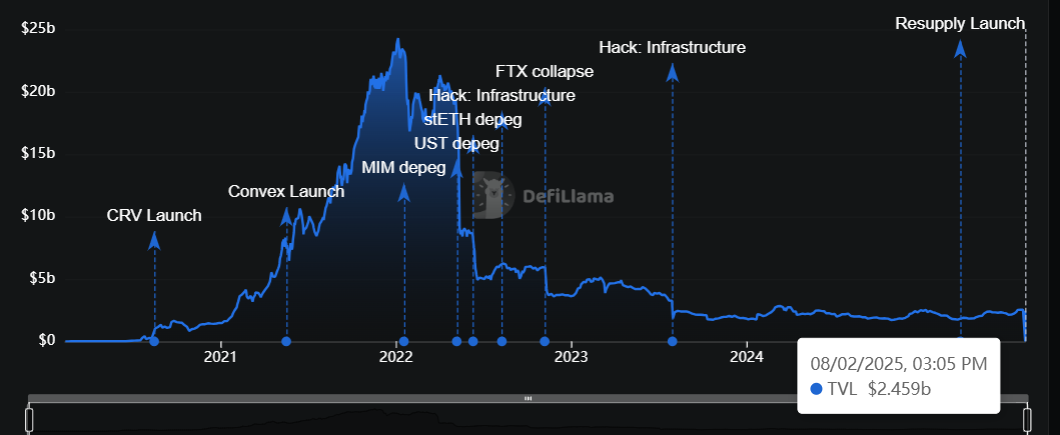 Curve’s DeFi TVL. Source:
DeFiLlama
Curve’s DeFi TVL. Source:
DeFiLlama
As such, the proposal urged the protocol to cut all development on layer-2 networks and focus on Ethereum.
“Each of those chains require at least the same care as Ethereum, while giving back only very little. By cutting all development in this direction, Curve can regain the head-space to push into more fruitful directions,” the author wrote.
Meanwhile, the proposal’s radical position has sparked discussion within the DeFi protocol’s community about the multi-chain expansion moves.
DeFi analyst Ignas noted that Aave, another prominent DeFi protocol, is experiencing similar challenges.
According to him, Aave’s expansion across multiple chains has proven unprofitable and reflects the difficulty many DeFi protocols face when deploying across numerous Layer 2 networks.
Ignas suggested that the challenges stem from a lack of user traction across most Layer 2 networks, indicating that the Ethereum Layer 2 ecosystem may be approaching saturation.
“We reached an L2 saturation point…Real tough time for undifferentiated L2s,” Ignas stated.
Data from L2Beats supports this viewpoint, revealing that only a handful of Ethereum Layer 2 networks—such as Polygon, Arbitrum, and Optimism—are seeing substantial activity.
Meanwhile, Curve’s core team distanced itself from the proposal, stating that it does not reflect their current roadmap.
“To be clear: this post does not come from the team currently working on Curve, and no one in the team agrees with it (so we probably will NOT take that direction),” the protocol stated.
Disclaimer: The content of this article solely reflects the author's opinion and does not represent the platform in any capacity. This article is not intended to serve as a reference for making investment decisions.
You may also like
Fed Voting Member Harker: Fighting Inflation Requires Faster, More Frequent Small Rate Adjustments, Be Vigilant Against Inflation Expectations Becoming Entrenched
Cleveland Federal Reserve President Loretta Mester believes that inflation pressures have spread beyond the energy sector, with AI investments and tariffs driving up costs. To prevent high inflation from becoming entrenched in the economy, she suggests that the Federal Reserve should consider smaller, quicker, and more frequent rate adjustments, rather than waiting for inflation pressures to accumulate and then taking larger actions. She did not explicitly support an interest rate hike in October, emphasizing policy transparency: explaining the response mechanism does not equate to committing to a specific rate path.
Will the US cancel 20-year Treasury bonds? BNP Paribas: It may trigger market panic; Citibank: Positioning 20-year bonds to outperform 10-year bonds
There are market rumors that the U.S. Treasury is considering cutting back or canceling the issuance of 20-year Treasury bonds, which were reinstated in 2020. The yield on 20-year bonds has long been higher than both 10-year and 30-year bonds, resulting in a "hump" in the yield curve and higher financing costs. The market is closely watching this Friday’s routine survey questionnaire, as well as whether a clear signal will be released in the quarterly refunding statement on November 4. Citi suggests positioning in advance, but BNP Paribas warns that such a move could be interpreted as a panic signal that policy tools have been exhausted.

Bitcoin price volatility accompanies a 6% drop as sentiment turns neutral
WF stock trades at $36, up 196.78%, with daily RSI at 97.86
Crypto prices
More


