
Crypto victim loses $908K in sophisticated phishing attack

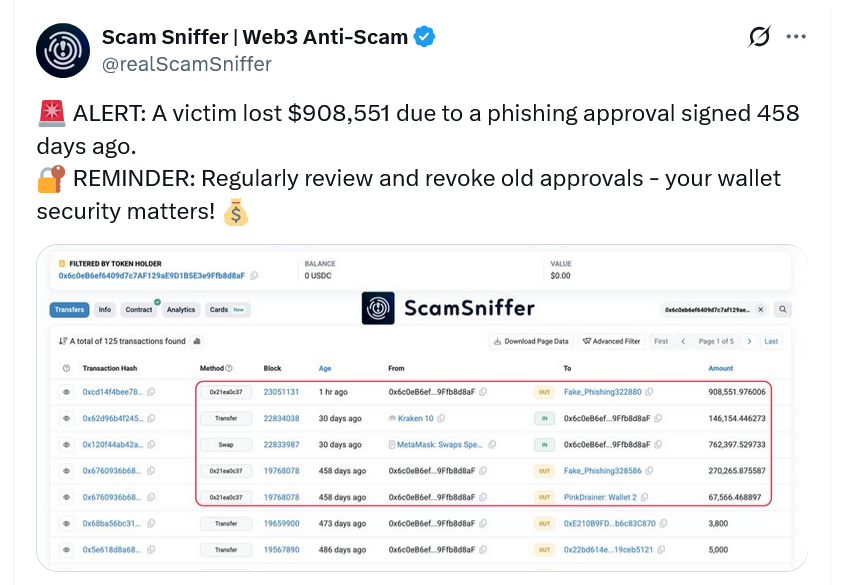
A crypto user lost $908,551 to a wallet-draining scam 458 days after unknowingly signing a malicious approval transaction, onchain data shows.
The attack originated from an ERC-20 approval transaction — likely signed via a phishing site or fake airdrop — that gave the scammer’s wallet, “0x67E5Ae,” ongoing permission to access the victim’s funds.
The scammer — linked to the notorious pink-drainer.eth wallet address — executed the theft on Aug. 2 at 4:57am UTC, stealing $908,551 worth of the USDC (USDC) stablecoin, Scam Sniffer pointed out on X. The theft came 458 days after the victim signed the phishing approval transaction on April 30, 2024.
The security incident prompted Scam Sniffer to remind crypto users to “regularly review and revoke old approvals,” or else, hard-earned funds may be at risk.
“Your wallet security matters,” it added.
The scammer’s patience paid off
Until a month ago, the victim’s compromised wallet had seen minimal transaction activity and held little value — giving the attacker no incentive to act.
That changed on July 2, when the victim deposited $762,397 into the tainted wallet address, “0x6c0eB6,” from a MetaMask wallet at 8:41pm UTC.
Ten minutes later, another $146,154 in USDC was transferred into the same wallet from a Kraken wallet.
Related: $3.5B Bitcoin heist from 2020 retroactively uncovered — Arkham Intel
The scammer likely monitored the wallet over the next month, waiting to see if more funds would flow into it before deciding to drain the funds in a single transaction on Aug. 2.
This delayed strike is a defining trait of phishing approval attacks: scammers wait around for months, striking only when the victim’s wallet balance makes it worthwhile.
Tools already exist to prevent these attacks
To help prevent such attacks, Ethereum users can use Etherscan’s Token Approval Checker to review and revoke unnecessary token approvals — though each revocation requires a gas fee.
Bad actors and scammers stole over $142 million from the crypto space in July across at least 17 separate attacks, with the exploit of crypto exchange CoinDCX accounting for the most significant loss.
Magazine: Inside a 30,000 phone bot farm stealing crypto airdrops from real users
Disclaimer: The content of this article solely reflects the author's opinion and does not represent the platform in any capacity. This article is not intended to serve as a reference for making investment decisions.
You may also like
Fed Voting Member Harker: Fighting Inflation Requires Faster, More Frequent Small Rate Adjustments, Be Vigilant Against Inflation Expectations Becoming Entrenched
Cleveland Federal Reserve President Loretta Mester believes that inflation pressures have spread beyond the energy sector, with AI investments and tariffs driving up costs. To prevent high inflation from becoming entrenched in the economy, she suggests that the Federal Reserve should consider smaller, quicker, and more frequent rate adjustments, rather than waiting for inflation pressures to accumulate and then taking larger actions. She did not explicitly support an interest rate hike in October, emphasizing policy transparency: explaining the response mechanism does not equate to committing to a specific rate path.
Will the US cancel 20-year Treasury bonds? BNP Paribas: It may trigger market panic; Citibank: Positioning 20-year bonds to outperform 10-year bonds
There are market rumors that the U.S. Treasury is considering cutting back or canceling the issuance of 20-year Treasury bonds, which were reinstated in 2020. The yield on 20-year bonds has long been higher than both 10-year and 30-year bonds, resulting in a "hump" in the yield curve and higher financing costs. The market is closely watching this Friday’s routine survey questionnaire, as well as whether a clear signal will be released in the quarterly refunding statement on November 4. Citi suggests positioning in advance, but BNP Paribas warns that such a move could be interpreted as a panic signal that policy tools have been exhausted.

Bitcoin price volatility accompanies a 6% drop as sentiment turns neutral
WF stock trades at $36, up 196.78%, with daily RSI at 97.86
Crypto prices
More


