
Meme Coin Dominance Falls to 18-Month Low – What’s Behind the Drop?

Meme coin dominance drops as Ethereum absorbs liquidity, but experts predict a rally in meme coins as part of a 4-phase market cycle, with Phase 4 driving altseason.
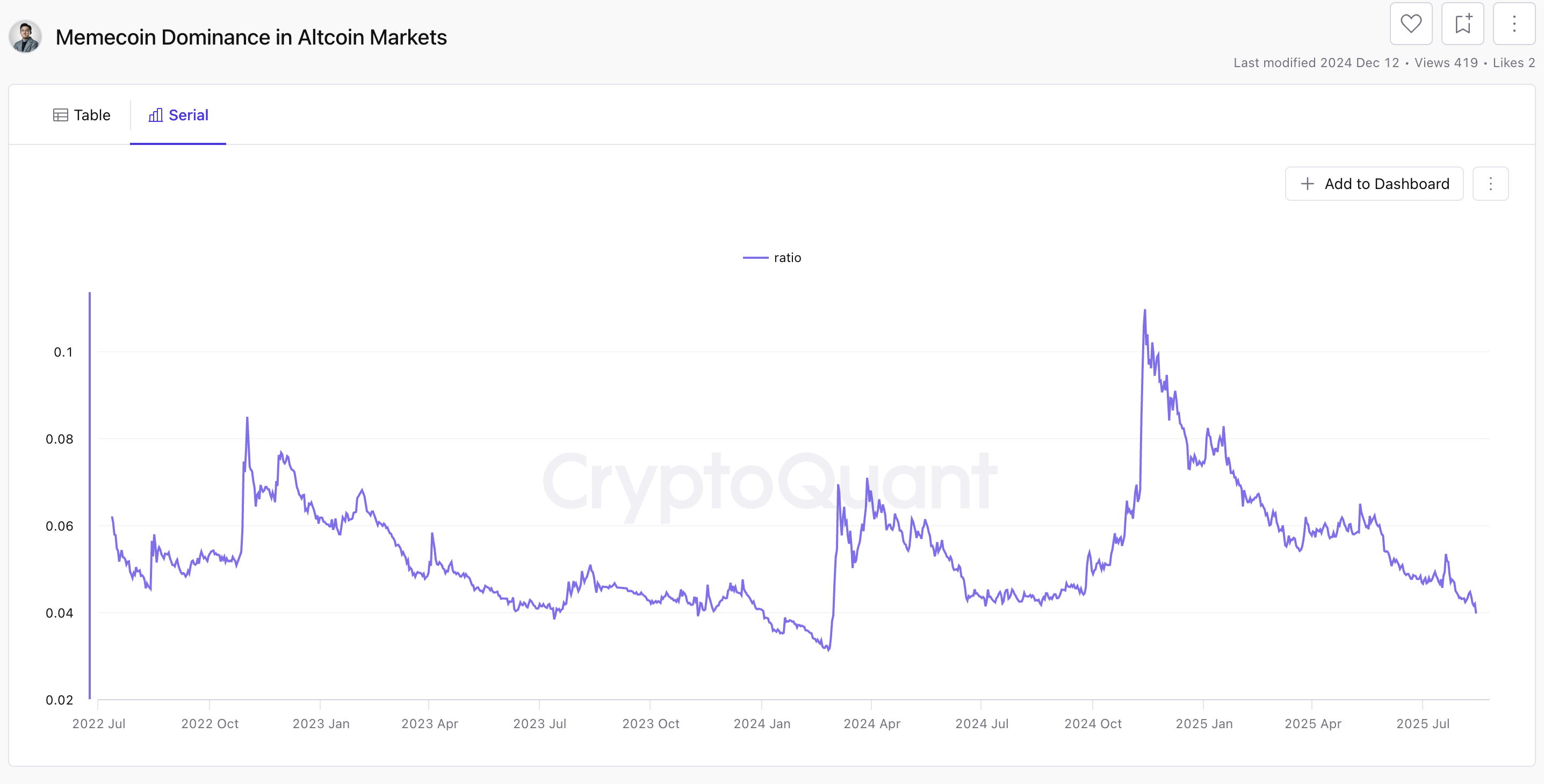
Meme coin dominance has reached its lowest level in 1.5 years, reflecting a shift in market dynamics amid what analysts describe as an ‘Ethereum season.’
Despite this, experts remain optimistic about meme coins’ prospects. They point to a 4-phase market cycle, which could lead to an explosive rally in meme coins as money trickles down.
Why is Meme Coin Dominance Dropping?
According to the latest data from CryptoQuant, meme coin dominance in the altcoin market dropped to 0.039, a level last seen in February 2024.
 Dropping Meme Coin Dominance in The Altcoin Market. Source:
CryptoQuant
Dropping Meme Coin Dominance in The Altcoin Market. Source:
CryptoQuant
In a recent post on X, an analyst pointed to Ethereum (ETH) as the key driver behind this dip. The analyst explained that ETH continues to dominate the altcoin market by absorbing a large portion of the liquidity.
This means that a significant amount of investment and capital is flowing into ETH, leaving less available for other altcoins, including meme coins.
“It’s clearly not meme coin season right now, and even though a few manage to perform, it remains very anecdotal,” the post read.
This shift aligns with observations from other market commentators who argue that the current cycle is characterized by an ‘Ethereum season’ rather than a full altcoin season, with Ethereum outperforming Bitcoin (BTC) and overshadowing other altcoin categories.
“We are in the Ethereum Season, as the majority of liquidity is flowing into ETH. For Altseason, we need more retail liquidity which won’t come until ETH hits a new ATH,” Cas Abbé noted.
The data support this narrative. While the meme coin market cap has surged 79.5% from April lows—rising from $39.93 billion to over $71 billion, the gains pale compared to Ethereum’s performance.
The second-largest cryptocurrency’s market value has jumped 215.91% in the same time frame from $177.49 billion to $560.7 billion. A similar trend emerges when comparing the performance of the top three meme coins to Ethereum in August.
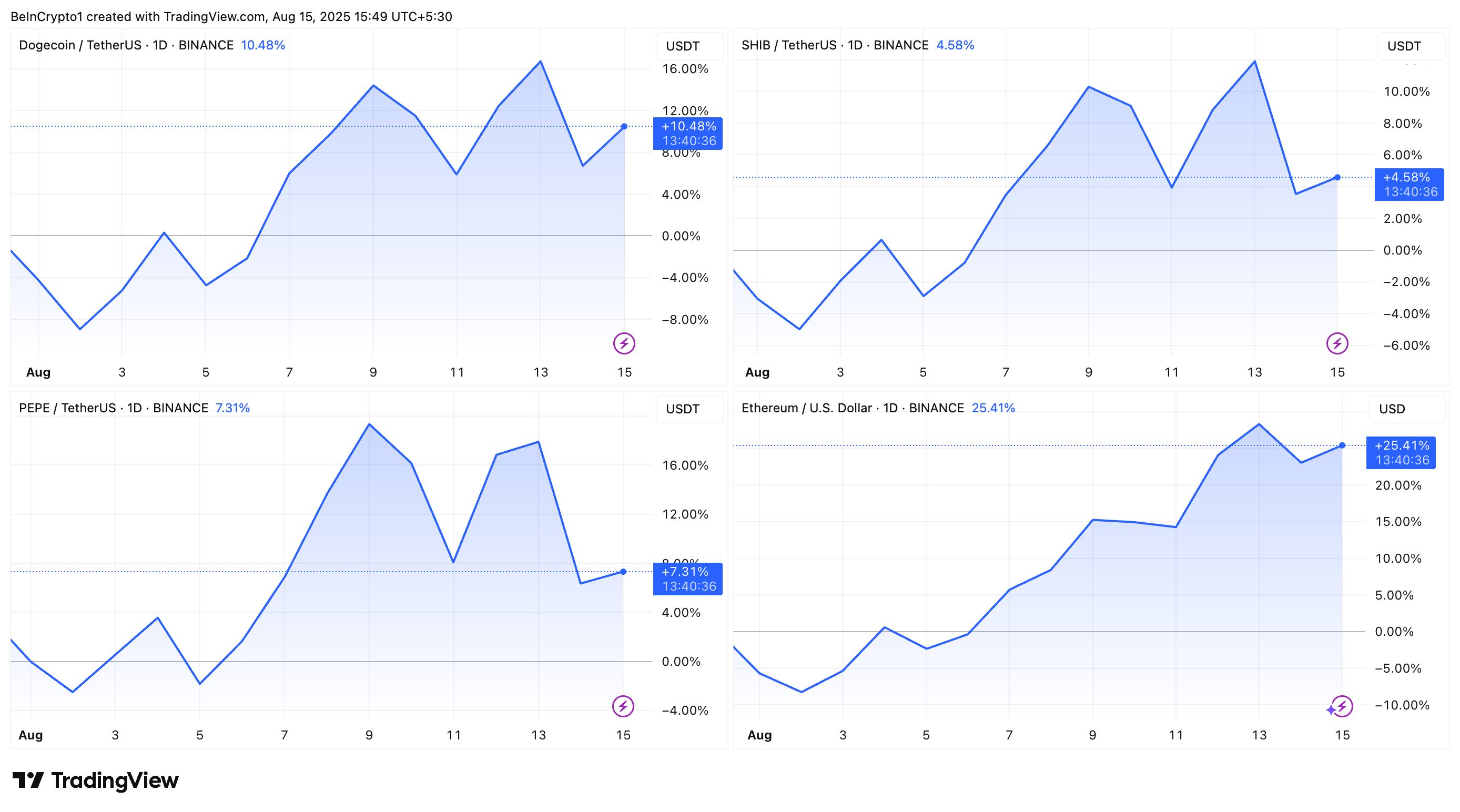
So far this month, Ethereum has recorded a 25.41% increase. Meanwhile, Dogecoin (DOGE) has risen by 10.48%, Shiba Inu (SHIB) by 4.58%, and Pepe (PEPE) by 7.31%.
This disparity suggests that Ethereum’s dominance is siphoning liquidity from meme coins, contributing to their reduced market share.
 Ethereum Vs. Top Three Meme Coins. Source:
TradingView
Ethereum Vs. Top Three Meme Coins. Source:
TradingView
Meme Coin Season: When Will It Start?
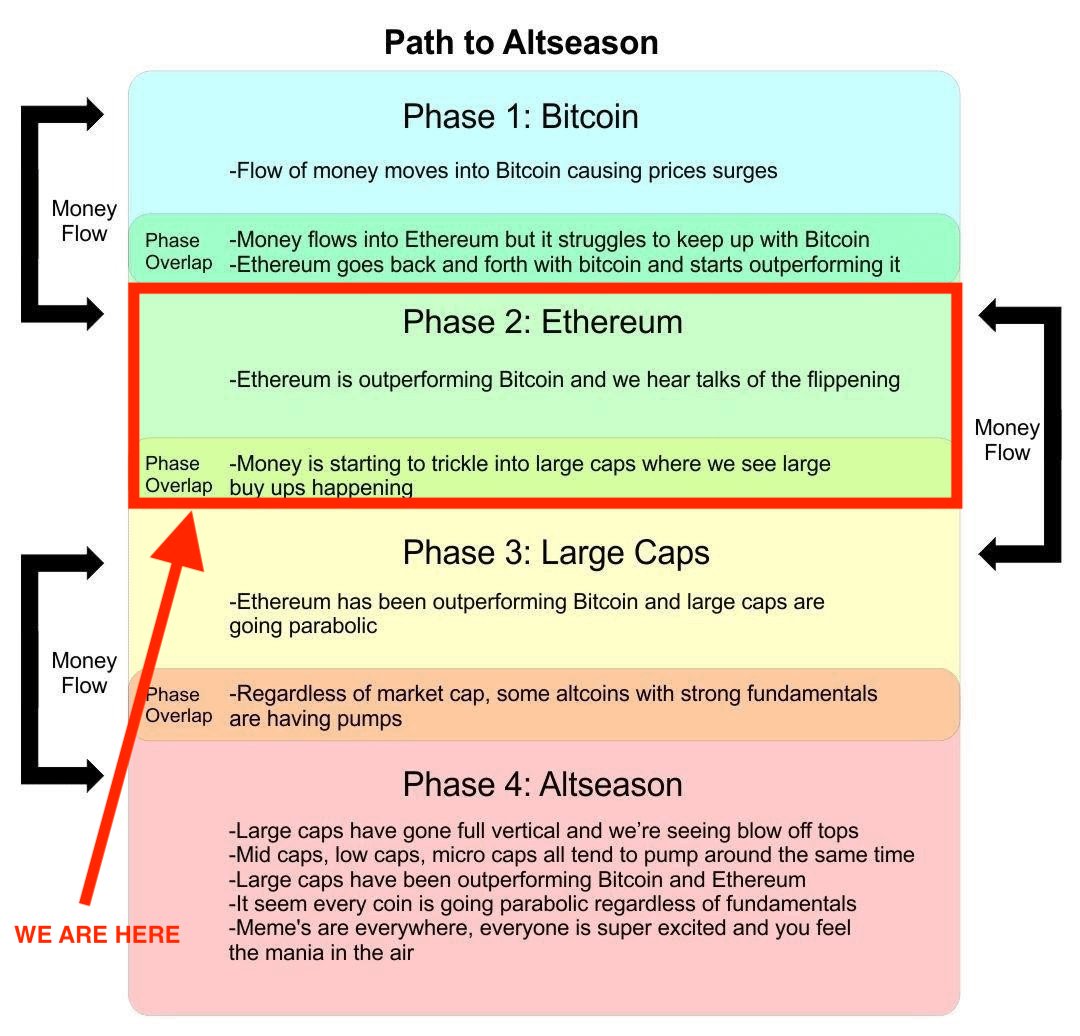
However, the story may not be over for meme coins. Experts have highlighted a four-phase cycle that could signal a future rally. According to them, the market is currently in Phase 2, where Ethereum dominates.
“We waited years for this moment. Now it’s here. ETH just entered Phase 2: Ethereum season. The best runs in history started right here,” Merlijn The Trader posted.
 Altcoin Season Cycle. Source:
X/0xNonceSense
Altcoin Season Cycle. Source:
X/0xNonceSense
This will be followed by Phase 3, during which Ethereum continues to outperform Bitcoin and large-cap altcoins start to experience significant growth.
Finally, Phase 4, termed ‘altseason,’ represents the peak of the market cycle. This features surges in large-cap altcoins, followed by mid, low, and micro-cap coins, including meme coins, fueled by widespread euphoria.
“Altcoins are just starting to take off, and meme coins always run last,” another analyst added.
Thus, despite the decline in dominance, the growth of the meme coin market and the cyclical nature of altcoin seasons indicate a potential for recovery. Whether this potential will materialize or if institutional involvement has fundamentally altered the market remains to be seen.
Disclaimer: The content of this article solely reflects the author's opinion and does not represent the platform in any capacity. This article is not intended to serve as a reference for making investment decisions.
You may also like
Musk on chip production: China's large-scale manufacturing capacity often exceeds the sum of all other regions worldwide
After ChangXin Memory Technologies announced a key breakthrough in DDR5 server memory, the Philadelphia Semiconductor Index in the US stock market fell 2.7% overnight, with shares such as Micron and SK Hynix ADR dropping collectively. Musk commented on this trend, saying that when China figures out the manufacturing method of a product, its ability to scale production often exceeds that of the rest of the world combined, and stated that "China seems to be rapidly conquering" general standard specifications such as LP5 and LP6.

IREN reports $702.6 million net loss despite $4 billion in AI cloud contracts
The current AI frenzy: featuring both "Tech and Internet" and "Real Estate" bubble characteristics, reminiscent of the 2008 global capital cycle
This wave of the AI boom exhibits dual characteristics: On a micro level, the heavy-asset nature of AI data centers is driving the industry toward "real estate-like" debt financing models, such as corporate bonds, private credit, and computing power ABS. On a macro level, nearly $2 trillion in overseas excess savings is flowing into core AI assets in the U.S. stock market through private institutions, reconstructing a transnational capital cycle reminiscent of the period before the 2008 subprime mortgage crisis. With nearly $3 trillion in off-balance sheet debt and rising interest rates, the industry is facing an impending major liquidity test.

AI Trading Faces a "Vulnerable Moment"! Japan and South Korea Stock Markets Experience "Black Tuesday" as SK Hynix, Samsung, and SoftBank Plunge Together
On Tuesday, Asian tech stocks faced a new round of systemic sell-off as the overnight weakness in the US semiconductor sector spread to the Asia-Pacific market. Concerns intensified over increasingly fierce competition due to the technological breakthrough by Chinese memory chip manufacturer ChangXin Memory Technologies, as well as worries about the returns on AI capital expenditure and the overall financing environment.
Crypto prices
More


