
US Sanctions Ruble Stablecoin A7A5: Potential Impact on Tether?

The US Treasury’s Office of Foreign Assets Control (OFAC) announced new sanctions against A7A5, a Russian ruble-pegged stablecoin, and its affiliates.
According to a press release on August 14, 2025, OFAC also added the stablecoin‘s creator, A7 LLC, to its Specially Designated Nationals list.
Ruble-Backed Stablecoin A7A5 Plummets; Will Tether Be Affected?
This move against A7A5 followed similar sanctions from the UK in May and the EU in July. It highlights a new front in the US effort to stop Russia from using cryptocurrencies to bypass financial sanctions.
After the announcement, the price of the A7A5 dropped by roughly 13%, from about $0.0124 to $0.0105.
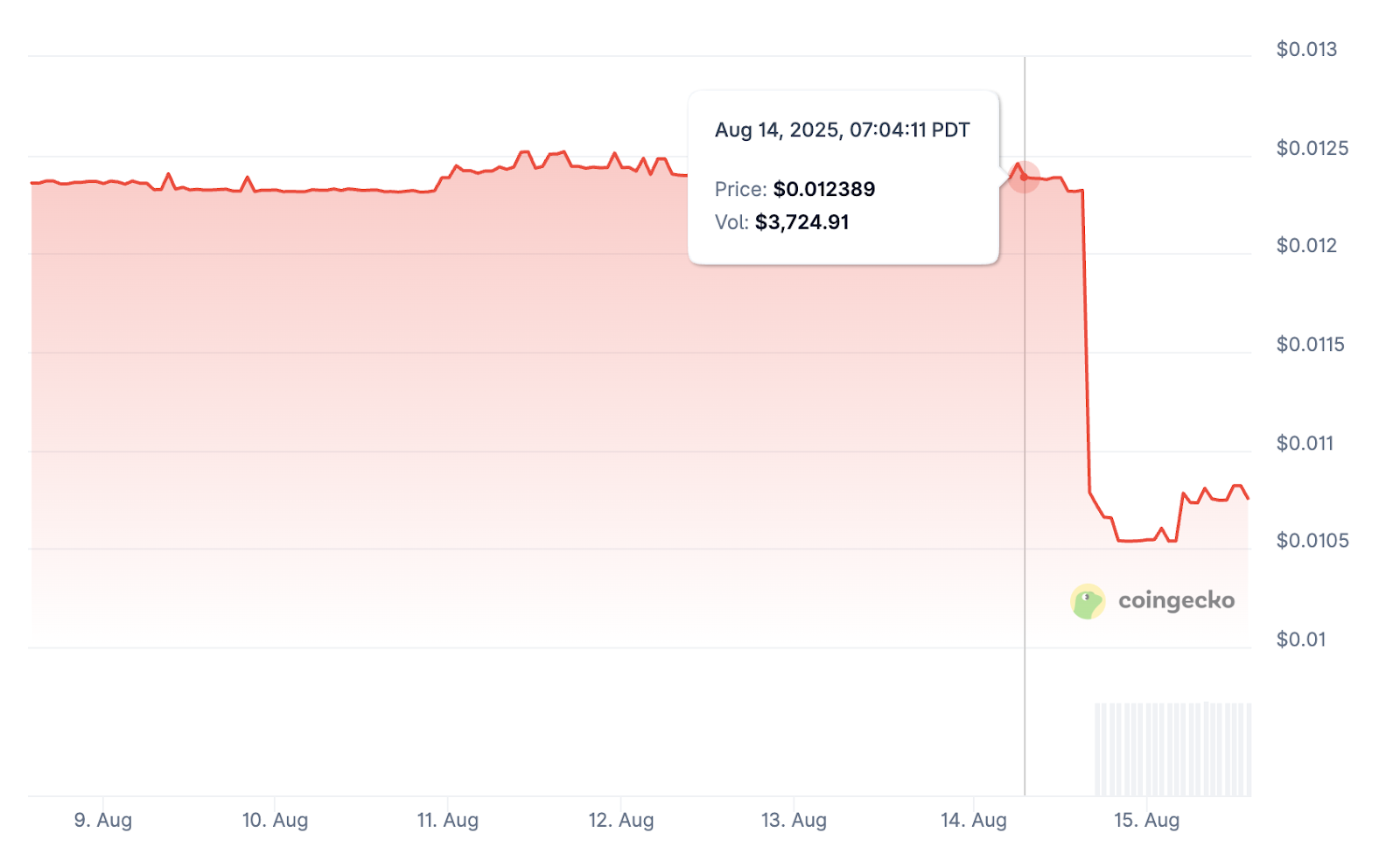
Despite an unusual drop in the value of a Russian ruble-backed stablecoin, confidence in other stablecoins has remained unshaken.
Even as transaction records linked to the recent incident showed extensive use of Tether (USDT), the stablecoin giant has not faced significant backlash.
The A7A5 Stablecoin: Origins and Operations
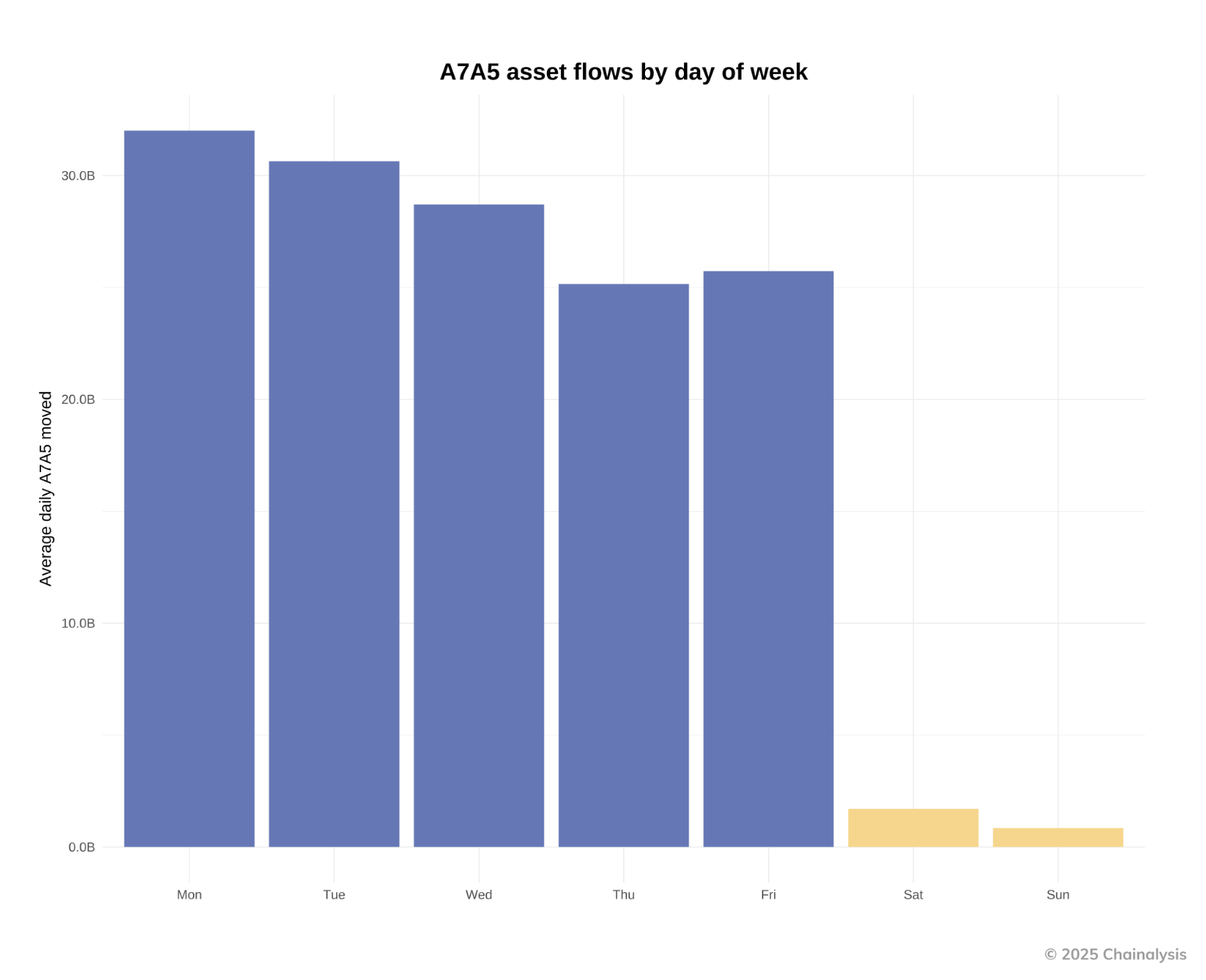
A7A5 launched in Kyrgyzstan in 2025 and quickly became the top ruble-backed stablecoin. On-chain analytics firm Elliptic reports that the token has handled up to $41.2 billion in transfers since its launch. Its daily trading volume exceeds $1 billion, and its market cap reached $521 million.
A7 LLC, the creator, co-owns the company with Russia’s state-owned bank, Promsvyazbank (PSB). Interestingly, PSB was already on the OFAC sanctions list. The token’s issuer, Old Vector LLC, is also based in Kyrgyzstan and is now facing sanctions.
A7 LLC co-owns the company with Russia’s state-owned Promsvyazbank (PSB), which already appears on OFAC’s sanctions list. Old Vector LLC, the token’s issuer in Kyrgyzstan, also faces sanctions.
A7 LLC has connections to Moldovan businessman Ilan Shor, who faced fraud and election interference charges. Exchanges linked to Russia, including Meer and Grinex, provide most of the token’s liquidity. A7A5 also trades on TRON and Ethereum blockchains.
The Rise of A7A5 After Garantex Takedown
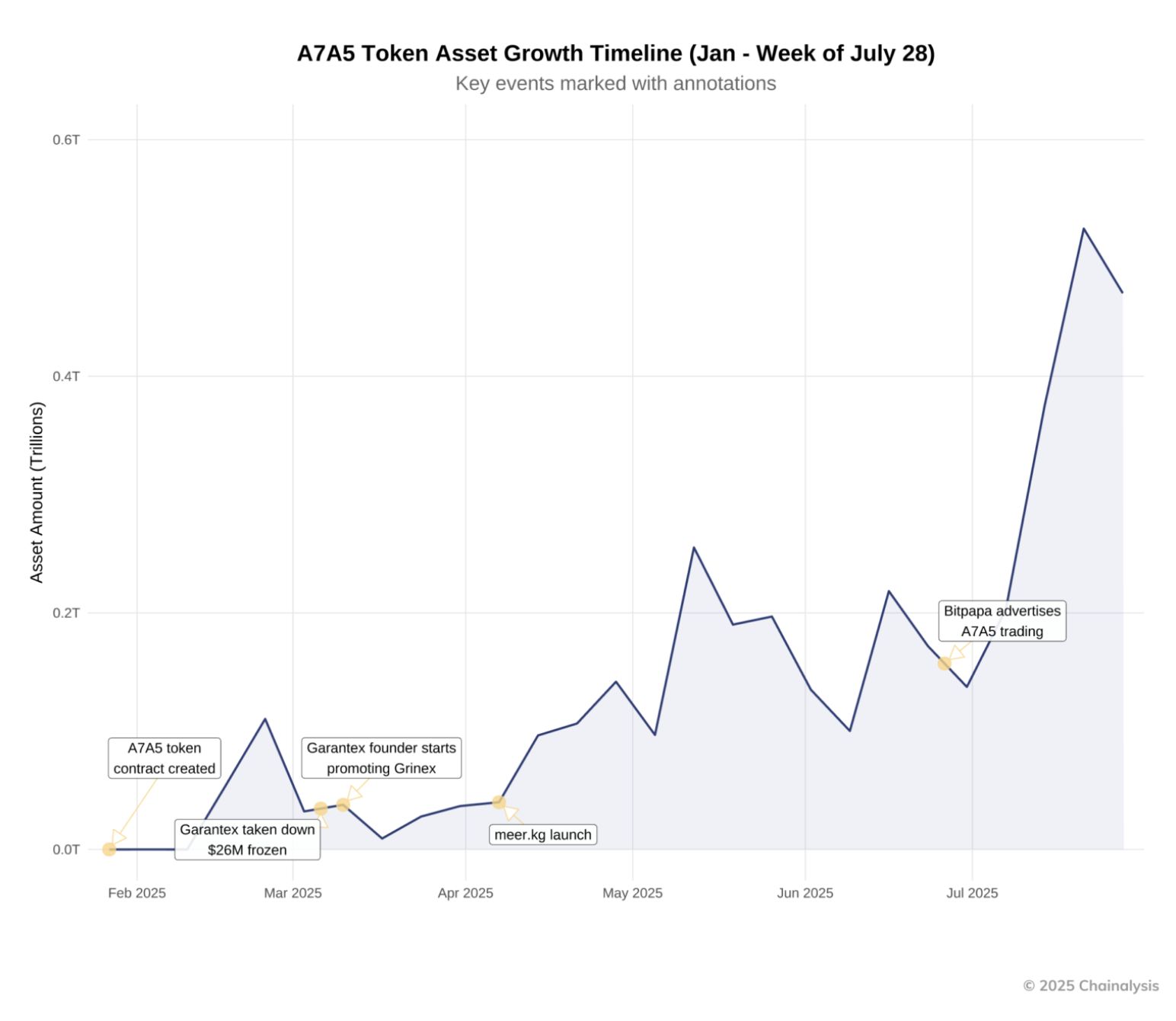
In March 2025, the US government and international law enforcement disrupted Garantex, a crypto exchange already on the OFAC list for facilitating illicit transactions.
Authorities seized the exchange’s website and froze $26 million in Tether (USDT). The Garantex takedown spurred the growth of A7A5. Many Russian users sought a more secure option than easily frozen USDT. Grinex, a crypto exchange believed to have replaced Garantex, became a key hub for A7A5 trading.
OFAC has also added Garantex co-founder Sergey Mendeleev to its sanctions list. Entities connected to Mendeleev also received sanctions. These include Exved, a cross-border payment platform for Russian importers and exporters.
Exved uses USDT to hide its ties to Russian users. Another sanctioned entity is Indefi Smartbank, a crypto service provider for Exved and Grinex.
Disclaimer: The content of this article solely reflects the author's opinion and does not represent the platform in any capacity. This article is not intended to serve as a reference for making investment decisions.
You may also like
Musk on chip production: China's large-scale manufacturing capacity often exceeds the sum of all other regions worldwide
After ChangXin Memory Technologies announced a key breakthrough in DDR5 server memory, the Philadelphia Semiconductor Index in the US stock market fell 2.7% overnight, with shares such as Micron and SK Hynix ADR dropping collectively. Musk commented on this trend, saying that when China figures out the manufacturing method of a product, its ability to scale production often exceeds that of the rest of the world combined, and stated that "China seems to be rapidly conquering" general standard specifications such as LP5 and LP6.

IREN reports $702.6 million net loss despite $4 billion in AI cloud contracts
The current AI frenzy: featuring both "Tech and Internet" and "Real Estate" bubble characteristics, reminiscent of the 2008 global capital cycle
This wave of the AI boom exhibits dual characteristics: On a micro level, the heavy-asset nature of AI data centers is driving the industry toward "real estate-like" debt financing models, such as corporate bonds, private credit, and computing power ABS. On a macro level, nearly $2 trillion in overseas excess savings is flowing into core AI assets in the U.S. stock market through private institutions, reconstructing a transnational capital cycle reminiscent of the period before the 2008 subprime mortgage crisis. With nearly $3 trillion in off-balance sheet debt and rising interest rates, the industry is facing an impending major liquidity test.

AI Trading Faces a "Vulnerable Moment"! Japan and South Korea Stock Markets Experience "Black Tuesday" as SK Hynix, Samsung, and SoftBank Plunge Together
On Tuesday, Asian tech stocks faced a new round of systemic sell-off as the overnight weakness in the US semiconductor sector spread to the Asia-Pacific market. Concerns intensified over increasingly fierce competition due to the technological breakthrough by Chinese memory chip manufacturer ChangXin Memory Technologies, as well as worries about the returns on AI capital expenditure and the overall financing environment.
Crypto prices
More


