

CoreWeave insiders and early backers have sold more than $1 billion of shares after the expiry of a post-IPO lock-up period, marking the first time major investors in the artificial intelligence data center group have been able to cash out since its blockbuster listing in March.
Among the sellers was director Jack Cogen, who offloaded stock worth nearly $300 million, according to regulatory filings.
Shares in CoreWeave, which leases computing power to technology companies building AI models, held steady around $100 in throughout the day on Friday. The muted reaction followed a sharp 35% decline over the previous two days, triggered by weaker-than-expected second-quarter earnings and concerns over its mounting costs and debt burden.
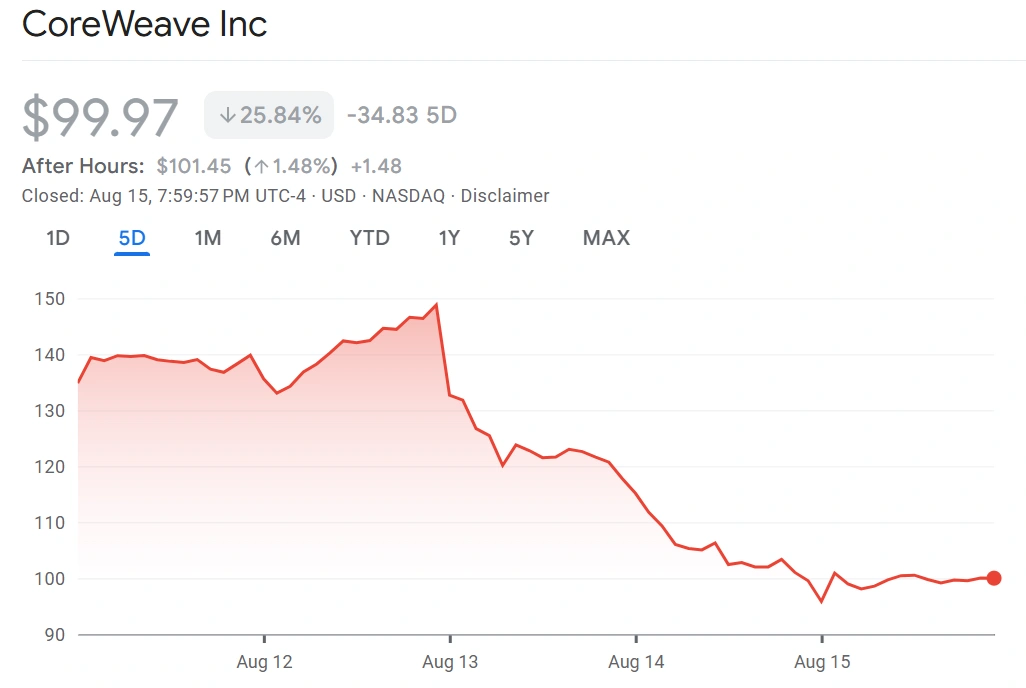 Corewaeave stock price. Source: Google Finance
Bankers familiar with the sales described a frenzied rush to package deals ahead of 84% of CoreWeave’s total shares becoming eligible for trading for the first time since the company went public. Blocks of up to six million shares changed hands, with Morgan Stanley at one point attempting to sell 8 million shares valued at about $740 million, people close to the trades said.
From IPO high to market jitters
CoreWeave went public in March at $40 a share, raising $1.5 billion in what was then the largest tech listing of the year, despite the deal being scaled back from earlier ambitions. Shares quickly became one of the hottest bets on AI infrastructure, soaring more than 300% to peak at $183 in June.
The company’s rise attracted heavyweight investors, including hedge funds Magnetar Capital and Coatue Management, asset manager Fidelity, high-frequency trader Jane Street, and chipmaker Nvidia, which holds a 6% stake. Magnetar, one of CoreWeave’s earliest backers, owns about 30% of its stock.
But the glow has faded. CoreWeave’s lock-up expiry came just two days after it reported a bigger-than-expected quarterly loss, with operating expenses in the second quarter surging to $1.2 billion, nearly quadrupling from a year earlier.
The company also revealed plans to use about $1 billion of its proceeds to repay a portion of its $8 billion debt pile as of the end of 2024.
Analysts have flagged the group’s heavy reliance on a small number of customers, high capital needs and expensive borrowings as key risks. Roughly 46% of CoreWeave’s tradable shares were being shorted by hedge funds betting on further declines, according to data provider S3 Partners.
Coreweave faces backlash over acquisition
CoreWeave is also contending with investor pushback over its planned $9 billion acquisition of Core Scientific, its largest landlord and a fellow AI-focused data center group.
Cryptoplitan previously reported that significant Core Scientific investors have threatened to vote against the transaction unless the price and conditions are improved. The deal is central to CoreWeave’s expansion strategy, aimed at securing additional capacity to meet rising demand from AI model developers.
The backlash adds to uncertainty at a time when the market is reassessing the sky-high valuations of companies tied to the AI build-out.
The selling spree by insiders does not necessarily mean an abrupt loss of confidence. However, it also shows the scale of gains early investors have enjoyed, and their willingness to take profits in a stock that has already been through sharp swings.
With nearly half of its float held short, CoreWeave faces the dual challenge of convincing the market it can turn surging demand into sustainable profits, while navigating skepticism over its spending plans and acquisition strategy.




