
Bitcoin to $144,000? BTC Faces Next Big Test at This Key Level

Bitcoin rose as high as $124,533 on Aug. 14 before taking a hit following July’s hotter-than-expected wholesale inflation data.
The July consumer price index was broadly in line with market expectations, though the core reading that excludes food and energy edged higher to 3.1%, slightly over Wall Street estimates. However, the July producer price index, which measures wholesale items, showed a surprise strong 0.9% monthly gain, the most in nearly three years.
Around the time of writing, BTC was trading down 0.77% in the last 24 hours to $117,741, following Friday's drop to a low of $116,859.
On what comes next, BTC’s average entry price for newer investors and its standard deviation bands can help to identify overheated zones.
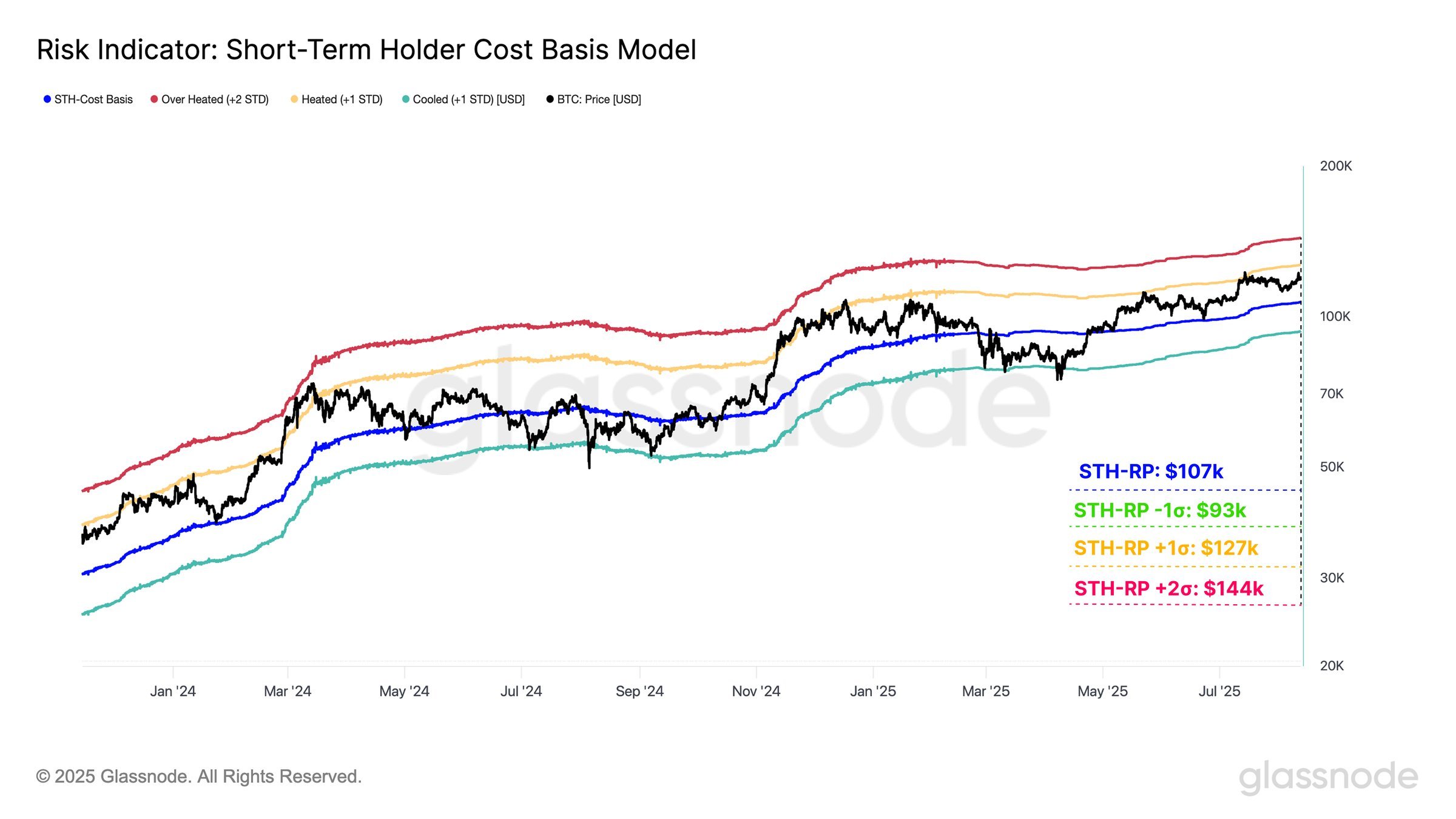
According to Glassnode data, the short-term holder realized price (STH RP) for Bitcoin (BTC) currently sits at $107,000, which represents the average on-chain acquisition price of Bitcoin (BTC).
The STH RP +1σ level is at $127,000, and it is a major key resistance for Bitcoin to surmount, with a breakout opening the path to $144,000, which coincides with the short-term holder realized price +2σ, a level where prior market tops saw increased selling pressure. Short-term holder realized price standard deviation bands +1σ and +2σ coincide with heated and overheated zones, respectively.
Bitcoin has not yet reached these levels, suggesting that the current rally might still have room to run.
Fed signals closely watched
Federal Reserve President Austan Goolsbee spoke on Friday about mixed inflation numbers, with the ongoing instability showing doubts for reduced rates.
The Fed’s annual meeting of the world’s central bankers in Jackson Hole, Wyoming, from Aug. 21-23, has historically been used for the Fed to signal policy shifts and will be watched closely by investors next week.
Markets expect the FOMC to vote to decrease the benchmark federal funds rate by a quarter percentage point in September, from 4.25% to 4.50%. However, there are concerns about what happens next, with 55% odds of another cut in October and only a 43% chance of a third move in December.
Disclaimer: The content of this article solely reflects the author's opinion and does not represent the platform in any capacity. This article is not intended to serve as a reference for making investment decisions.
You may also like
Musk on chip production: China's large-scale manufacturing capacity often exceeds the sum of all other regions worldwide
After ChangXin Memory Technologies announced a key breakthrough in DDR5 server memory, the Philadelphia Semiconductor Index in the US stock market fell 2.7% overnight, with shares such as Micron and SK Hynix ADR dropping collectively. Musk commented on this trend, saying that when China figures out the manufacturing method of a product, its ability to scale production often exceeds that of the rest of the world combined, and stated that "China seems to be rapidly conquering" general standard specifications such as LP5 and LP6.

IREN reports $702.6 million net loss despite $4 billion in AI cloud contracts
The current AI frenzy: featuring both "Tech and Internet" and "Real Estate" bubble characteristics, reminiscent of the 2008 global capital cycle
This wave of the AI boom exhibits dual characteristics: On a micro level, the heavy-asset nature of AI data centers is driving the industry toward "real estate-like" debt financing models, such as corporate bonds, private credit, and computing power ABS. On a macro level, nearly $2 trillion in overseas excess savings is flowing into core AI assets in the U.S. stock market through private institutions, reconstructing a transnational capital cycle reminiscent of the period before the 2008 subprime mortgage crisis. With nearly $3 trillion in off-balance sheet debt and rising interest rates, the industry is facing an impending major liquidity test.

AI Trading Faces a "Vulnerable Moment"! Japan and South Korea Stock Markets Experience "Black Tuesday" as SK Hynix, Samsung, and SoftBank Plunge Together
On Tuesday, Asian tech stocks faced a new round of systemic sell-off as the overnight weakness in the US semiconductor sector spread to the Asia-Pacific market. Concerns intensified over increasingly fierce competition due to the technological breakthrough by Chinese memory chip manufacturer ChangXin Memory Technologies, as well as worries about the returns on AI capital expenditure and the overall financing environment.
Crypto prices
More


