
Ethereum Rainbow Chart predicts ETH price for August 31, 2025

Ethereum’s (ETH) recent rally has cooled, with the asset slipping below the $4,500 mark.
However, the Ethereum Rainbow Chart suggests that higher levels could still be in play by the end of the month for the cryptocurrency.
The chart, which applies logarithmic growth curves to long-term valuation bands, categorizes Ethereum’s price into colored ranges. Notably, the model doesn’t predict short-term moves but helps investors gauge whether the asset is undervalued or overheated.
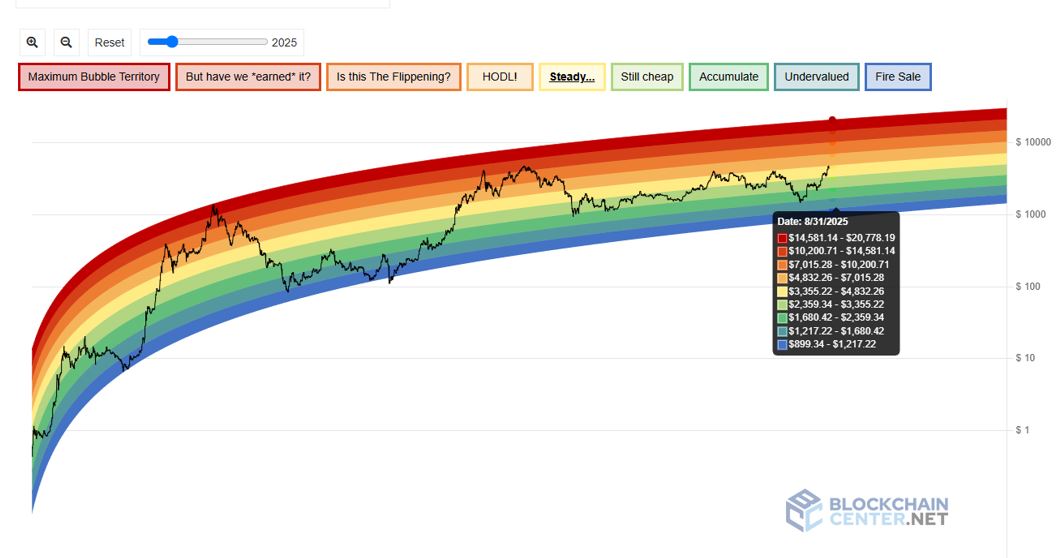
For August 31, 2025, the chart outlines nine possible valuation zones. At the bottom, the ‘Fire Sale’ band spans $899 to $1,217, followed by ‘Undervalued’ ($1,217–$1,680), ‘Accumulate’ ($1,680–$2,359), and ‘Still Cheap’ ($2,359–$3,355). The ‘Steady’ band, often viewed as fair value, ranges from $3,355–$4,832, close to Ethereum’s current trading level.
Above that, ‘HODL!’ covers $4,832–$7,015, ‘Is this The Flippening?’ spans $7,015–$10,200, and ‘But have we earned it?’ runs from $10,200–$14,581. At the very top, ‘Maximum Bubble Territory’ is between $14,581 and $20,778.
With Ethereum trading around $4,400, it sits within the ‘Steady’ zone. If it holds this band into the end of August, the model suggests a likely target between $3,355 and $4,832, indicating historical standards fairly value the asset.
Ethereum price analysis
By press time, Ethereum was priced at $4,442, down 0.15% over the past 24 hours but up 4.5% on the week.
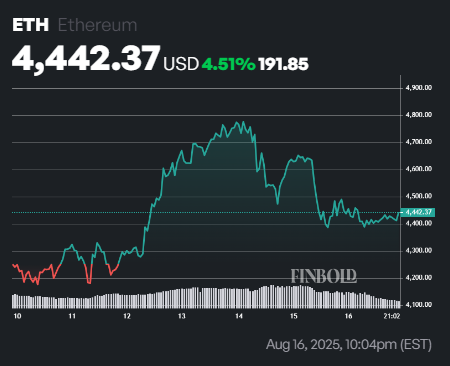
From a technical perspective, the 50-day Simple Moving Average (SMA) of $3,413.61 and the 200-day SMA of $2,596.84 remain well below current price levels, confirming strong upward momentum and a sustained bullish trend.
Meanwhile, the 14-day Relative Strength Index (RSI) at 66.86 signals strong buying pressure, nearing the overbought threshold of 70. This suggests further gains are possible for Ethereum, though momentum may cool or face minor corrections if buying becomes excessive.
Featured image via Shutterstock
Disclaimer: The content of this article solely reflects the author's opinion and does not represent the platform in any capacity. This article is not intended to serve as a reference for making investment decisions.
You may also like
From "Powering AI" to "Powering Everything"! Morgan Stanley: The electricity "super cycle" is underestimated by the market
Morgan Stanley believes that the drivers of electricity demand have expanded from AI to three major forces: industrial migration and air conditioning refrigeration. Global electricity consumption is projected to reach 36 trillion kWh by 2030, with an annual growth rate of 4.2%. Asia will absorb 64% of the newly generated electricity demand. Fossil fuels have unexpectedly regained market share and are expected to still account for about 50% of the global power structure in 2030. Pricing power is shifting from equipment manufacturers to power generation operators, with wholesale electricity prices in major markets expected to rise by about 20% year-over-year in 2026. These trends will create $500 billion in wealth, driving related companies’ earnings per share forecasts up by 14% by 2028, while the market has yet to fully price in these changes.
JPMorgan's Latest Macro Outlook: Continue Betting on U.S. Yield Curve Steepening and High-Yield Currencies, Beware of Oil Market Supply-Demand Divergence
JPMorgan recently released a research report providing an outlook on the macro environment, including global interest rates, foreign exchange, commodities, and emerging markets.
Euro remains on defensive below 1.1200 as USD stabilizes ahead of US midterm elections

Intel's stock price plunges 45% in one month; PCs still account for about half of the company's revenue, and foundry customers' confidence is shaken
The ongoing weakness in the Intel PC market and high costs for components such as memory are the main reasons, with the PC business still accounting for about half of total revenue. To alleviate the capacity shortage in data centers, Intel is shifting part of its Oregon factory production from the 18A process to the Intel 3 process, putting foundry trust to the test once again. Experts say that if Intel does not have excess capacity beyond meeting its own needs, it cannot be considered a reliable supplier.
Crypto prices
More


