
Tether: Quasi-sovereign allocator

Tether’s ascent as a top-10 foreign buyer of Treasurys signals stablecoin issuers are no longer just liquidity users
This is a segment from the 0xResearch newsletter. To read full editions, subscribe .
Tether was the seventh-largest net buyer of US Treasurys in Q2 2025. With ~$8 billion in incremental purchases, Tether is positioning its reserves as a quasi-sovereign allocator. This aligns with its business model: backing USDT with highly liquid, low-risk assets while capturing yield from elevated short-term rates. The move underscores two dynamics:
- Institutionalization of stablecoins: Tether is now functionally a material participant in global USD funding markets, alongside central banks and sovereign wealth funds.
- Liquidity concentration risk: Treasury bills are becoming the backbone of USDT collateral. Any regulatory, liquidity or market shock to this exposure could reverberate across crypto markets and short-term dollar funding channels.
Tether’s ascent as a top-10 foreign buyer signals a structural shift: Stablecoin issuers are no longer just liquidity users within crypto, but systemically relevant investors in global sovereign debt markets. For Treasurys, this is supportive in the near term, but the reliance on a private, opaque entity adds a new risk layer to the market’s stability profile.
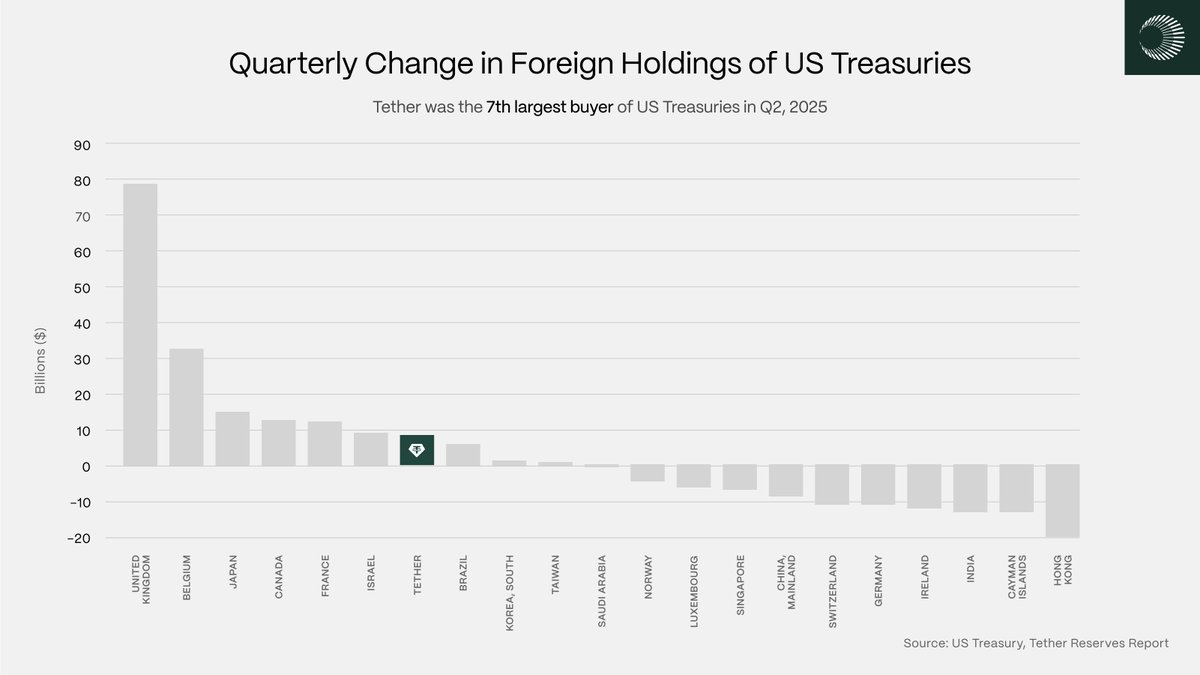 Source: Plasma
Continuing on the tokenized asset front, Figure Technology Solutions (hereafter “Figure”) formally filed for an IPO. It’s aiming for a Nasdaq listing under the ticker FIGR, with Goldman Sachs, Jefferies and BofA Securities serving as lead underwriters.
The company reported a 22% YoY increase in revenue to approximately $190.6 million for the first half of 2025. Even more compelling is Figure’s return to profitability: $29.1 million in net income, reversing a $15.6 million loss in the same period last year. Figure also disclosed that, since inception, it has originated over $16 billion in home equity loans, and counts more than 160 partners — including mortgage originators, banks, servicers and credit unions — utilizing its Provenance blockchain-powered lending platform.
In 2025, public markets have seen a vibrant “crypto IPO summer.” It was marked by standout debuts and filings from major players like Circle, Bullish, Gemini and others, driven by renewed regulatory clarity, investor enthusiasm and institutional backing. Figure Technology distinguishes itself within this wave by anchoring its strategy not around an exchange or stablecoin, but rather around tokenization of real-world, traditionally illiquid assets using public infrastructure (Provenance). With its profitability and healthy growth, Figure showcases a highly touted use case for blockchains in capital markets.
Get the news in your inbox. Explore Blockworks newsletters:
- The Breakdown : Decoding crypto and the markets. Daily.
- 0xResearch : Alpha in your inbox. Think like an analyst.
- Empire : Crypto news and analysis to start your day.
- Forward Guidance : The intersection of crypto, macro and policy.
- The Drop : Apps, games, memes and more.
- Lightspeed : All things Solana.
- Supply Shock : Bitcoin, bitcoin, bitcoin.
Disclaimer: The content of this article solely reflects the author's opinion and does not represent the platform in any capacity. This article is not intended to serve as a reference for making investment decisions.
You may also like
SoFi stock trades at $15.18 below all three daily EMAs
GME stock trades at $27.29 with daily RSI at 74.97 in overbought territory

Neither a breakout nor a reversal: What OCBC, Commerzbank and ING expect from the US Dollar

Iran claims U.S. military forces have significantly withdrawn from sea, six ships attacked in Hormuz in one day, Houthi forces declare Saudi Aramco oil facilities as "legitimate targets"
The Iranian Navy Deputy Commander stated on Monday that U.S. military vessels, including destroyers and aircraft carriers, have significantly withdrawn. On the same day, the Iranian Foreign Ministry stated that Iran is reviewing the U.S. proposals, but the conditions for reopening the Strait of Hormuz remain unchanged. According to reports, with the rotation of U.S. aircraft carriers, only the USS Washington is currently deployed in the Middle East. As of last Sunday, a total of 24 vessels were attacked in the Strait of Hormuz and surrounding waters within two weeks, marking the most severe wave of incidents since the onset of the Iran conflict—far surpassing the previous two-week peak of 13 ships. Oil exports through the strait have dropped by more than 80% compared to the average daily level in September.

Crypto prices
More


