
Bitcoin Fees Hit Satoshi-Era Levels as Blockspace Demand Evaporates

Analysts warn that Bitcoin's subdued fee market could undermine miner revenues and raise long-term questions about the network’s security model.
Bitcoin transaction fees have fallen to their lowest point in more than a decade, highlighting a major shift in how the network is being used.
Glassnode data shows that the 14-day simple moving average of daily fees now sits at 3.5 BTC, a level not seen since 2011 when the protocol was still in its early adoption phase.
Why is Bitcoin’s Network Fee Declining?
Weaker demand for blockspace has driven the decline, reflecting Bitcoin’s broader shift in purpose. Investors now hold the asset primarily as a store of value instead of using it as a payment rail.
On-chain data confirms this shift. Public companies such as Strategy have aggressively expanded their Bitcoin holdings in recent months, positioning the asset as digital capital rather than a medium for everyday transactions.
For context, Galaxy Digital noted that Bitcoin’s mempool activity is lacking as the percentage of not-full blocks has spiked to nearly 50% at times in the past few months.
“These blocks fail to reach the maximum weight limit (4,000,000 weight units) despite room to include additional transactions. In short, the mempool, Bitcoin’s waiting room for pending transactions, is frequently empty, and when it isn’t, it’s full of transactions that don’t need to pay high fees to get processed quickly,” Galaxy pointed out.
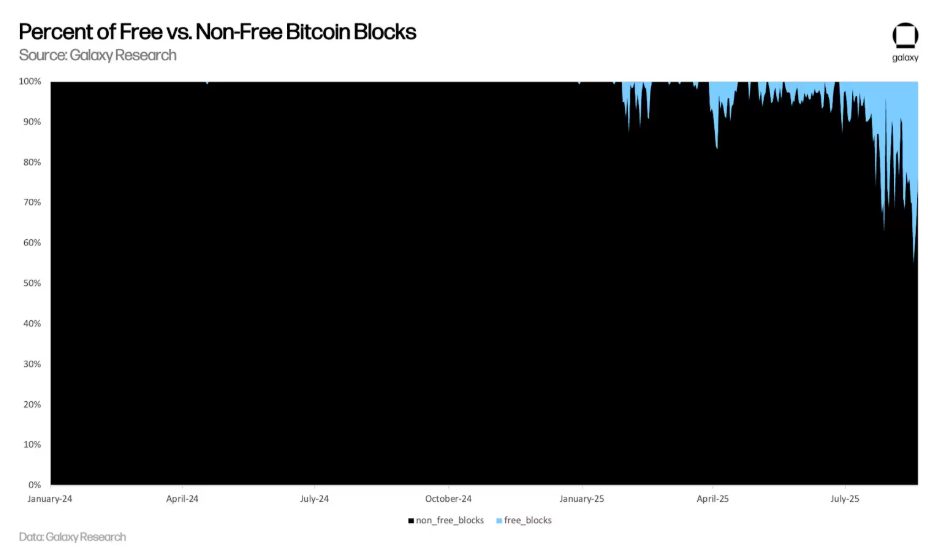 The Percentage of Free Bitcoin Blocks is Rising. Source: (
)
The Percentage of Free Bitcoin Blocks is Rising. Source: (
)
The firm continued that after the 2024 halving reduced block rewards to 3.125 BTC, miners had expected transaction fees to offset lost revenue. Instead, the opposite has happened.
According to the firm, a subdued fee market makes it harder for smaller operators to remain profitable. This trend raises questions about the long-term economics of Bitcoin’s security model.
Beyond these technical changes, the current market structure also plays a role in the Bitcoin network fees cut.
According to Galaxy, the growth of custodial products such as exchange-traded funds and institutional derivatives has reduced the need for investors to transact directly on-chain.
Moreover, retail traders seeking high-volume activity — particularly in meme coin markets — are moving to cheaper, faster blockchains like Solana. These networks offer smoother execution than Bitcoin’s Runes ecosystem.
“If more BTC volume continues to migrate to ETFs, custodians, and fast alt-L1s, the core network risks becoming a settlement layer without sufficient settlement activity,” Galaxy warned.
Meanwhile, this development arrives at an interesting time when the blockchain network is enjoying significant adoption from institutions and governments globally.
As a result, Bitcoin’s price has climbed to a new all-time high of more than $124,000. There are also now increased projections that its value could reach above $1 million.
Disclaimer: The content of this article solely reflects the author's opinion and does not represent the platform in any capacity. This article is not intended to serve as a reference for making investment decisions.
You may also like
SoFi stock trades at $15.18 below all three daily EMAs
GME stock trades at $27.29 with daily RSI at 74.97 in overbought territory

Neither a breakout nor a reversal: What OCBC, Commerzbank and ING expect from the US Dollar

Iran claims U.S. military forces have significantly withdrawn from sea, six ships attacked in Hormuz in one day, Houthi forces declare Saudi Aramco oil facilities as "legitimate targets"
The Iranian Navy Deputy Commander stated on Monday that U.S. military vessels, including destroyers and aircraft carriers, have significantly withdrawn. On the same day, the Iranian Foreign Ministry stated that Iran is reviewing the U.S. proposals, but the conditions for reopening the Strait of Hormuz remain unchanged. According to reports, with the rotation of U.S. aircraft carriers, only the USS Washington is currently deployed in the Middle East. As of last Sunday, a total of 24 vessels were attacked in the Strait of Hormuz and surrounding waters within two weeks, marking the most severe wave of incidents since the onset of the Iran conflict—far surpassing the previous two-week peak of 13 ships. Oil exports through the strait have dropped by more than 80% compared to the average daily level in September.

Crypto prices
More


