
Asia’s Financial Hub Race Accelerates Amid Stablecoin Expansion

Finance Minister Kato discussed Japan’s Web3 era financial reforms, crypto regulations, stablecoin adoption, tax measures, and public-private collaboration to strengthen global competitiveness and support innovation in the country’s evolving crypto ecosystem.
Last week, Osaka Governor Hirofumi Yoshimura highlighted the third-year results of the “Osaka International Financial City” initiative. The city has attracted 27 overseas financial institutions and 650 startups, signaling its ambition to position itself as a next-generation financial hub.
Once considered Asia’s financial hubs, Singapore and Hong Kong now face competition as the rise of stablecoins reshapes the region’s monetary order, raising the question of which country or city will lead.
Korea: Pivot Toward Private Stablecoins and Retail Payments
Once focused primarily on central bank digital currency (CBDC) initiatives, South Korea has accelerated a pivot toward private stablecoins. The Financial Services Commission is set to introduce a comprehensive regulatory bill to parliament in October 2025, encouraging the rollout of won-backed stablecoins. At the same time, the Bank of Korea has also launched a dedicated digital asset team, advancing oversight and market development.
 BeInCrypto’s Oihyun Kim(second from left) had the opportunity to contribute to the country’s digital asset policy discussions as part of the newly elected president’s Web3 advisory team.
Major players like KakaoBank are preparing to enter the market, with retail payments and cross-border remittances seen as key growth drivers. Korea’s advantage lies in its advanced digital infrastructure and widespread adoption of fintech. With mobile payments and online banking already ubiquitous, the country is well-positioned to scale consumer-oriented stablecoin usage once regulation is in place rapidly.
Japan: First Mover With a Comprehensive Legal Framework
Japan has established one of the world’s most comprehensive legal regimes for stablecoins. The revised Payment Services Act, enacted in June 2025, distinguishes stablecoins from cryptocurrencies by classifying them as “electronic payment instruments.” The Financial Services Agency (FSA) strictly oversees issuers, limiting them to banks, trust companies, and licensed money transfer firms.
JPYC registered as a money transfer operator and will launch a yen-pegged stablecoin in autumn 2025. The initial issuance target is $68 billion, with a long-term goal of $6.8 billion. Circle introduced USDC to Japan in March 2025 via SBI VC Trade. Mitsubishi UFJ Trust is preparing its Progmat Coin system.
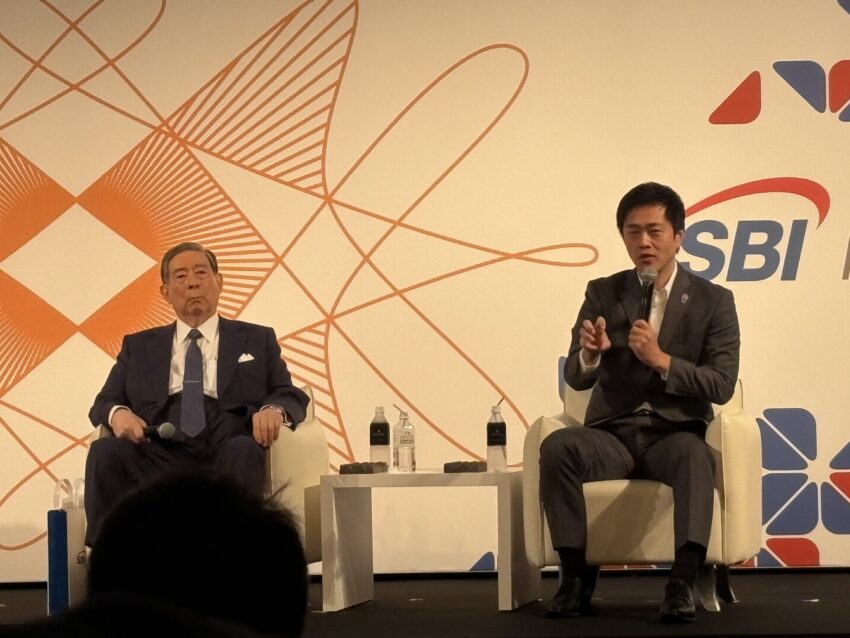 SBI Chairman Yoshitaka Kitao(left) and Osaka Prefectural Governor Hirofumi Yoshimura promote the Osaka International Financial City Initiative
Japan launched the world’s first yen-backed stablecoin, which is legally recognized as a payment instrument. Expected use cases include carbon credit trading, trade settlements, and cross-border payments. Osaka hosts a growing cluster of startups and international institutions. Japan aims to become Asia’s stablecoin hub through clear regulations and active market adoption.
Hong Kong and Singapore: Competing Through Licensing
Hong Kong implemented its Stablecoin Ordinance on August 1, 2025, introducing Asia’s first comprehensive licensing regime. Furthermore, issuers must maintain full reserves in high-quality liquid assets and comply with stringent anti–money laundering and know-your-customer requirements. Authorities plan to issue the first licenses in early 2026, while more than 40 firms prepare applications. Hong Kong focuses on transparency and institutional credibility. However, delays in practical adoption may slow its momentum compared with Japan and Korea.
Meanwhile, Singapore enacted its Digital Token Service Provider (DTSP) framework in June 2025, setting strict requirements and generally restricting overseas-focused issuers. While Paxos gained approval in 2024, the broader market remains under development. Singapore’s cautious stance underscores its preference for long-term stability over rapid expansion.
China: Eyeing Yuan Internationalization Through Stablecoins
In August 2025, a media report said Beijing began exploring a yuan-pegged stablecoin as part of its broader strategy to reduce reliance on the US dollar and accelerate renminbi internationalization. The government will also release a roadmap later this month and plan initial rollouts in Hong Kong and Shanghai.
China has already led the deployment of CBDC, raising questions about its overlap with private stablecoins. However, given its policy scale and market influence, a yuan-backed stablecoin could significantly reshape Asia’s financial landscape.
Outlook: Competing Models for Asia’s Next Financial Center
The stablecoin race is redefining what it means to be an Asian financial hub. Japan leads in legal frameworks and enterprise adoption, Korea in consumer infrastructure, Hong Kong in regulatory credibility, Singapore in cautious long-termism, and China in currency internationalization.
As Osaka’s efforts demonstrate, future financial leadership will hinge on capital concentration, regulatory clarity, real-world utility, and policy agility. The balance of these three elements may decide which city claims the mantle of Asia’s next financial hub.
Disclaimer: The content of this article solely reflects the author's opinion and does not represent the platform in any capacity. This article is not intended to serve as a reference for making investment decisions.
You may also like
ARK Invest doubles down on SpaceX: each Starship launch could add $700M a year
U.S. Treasury yields remain high! Elevated borrowing costs continue to impact the U.S. economy, AI investment boom intensifies the divergence from the real economy
As the yield on 10-year U.S. Treasury bonds remains above 5%, investors are turning their attention to a potentially more important issue than short-term market fluctuations: what impact will persistently high U.S. borrowing costs have on the economy and financial markets?
Overnight US Stocks | Cooling September Nonfarm Payrolls Support Fed's Rate Hike Pause; All Three Major Indexes Close Higher; SpaceX (SPCX.US) Up 7.35%
At the close, the Dow Jones Index rose by 250.88 points, or 0.49%, to 51,177.44 points; the S&P 500 Index gained 56.32 points, or 0.73%, to 7,722.77 points; and the Nasdaq Composite Index increased by 319.27 points, or 1.19%, to 27,190.86 points.
Waller downplays forward guidance on interest rates; speeches by two Federal Reserve officials still sway the market; expectations for a rate hike in October cool significantly
Although Federal Reserve Chairman Waller has clearly stated that he does not wish to send explicit signals to the market about the path of interest rates through forward guidance, the speeches by two senior Federal Reserve officials this week have still significantly influenced investor expectations.

Crypto prices
More


