
Bitcoin Price Eyes $100,000–$107,000 Support Zone Amid Heavy Liquidations

Bitcoin’s $100.000–107.000 support zone faces a major test amid mass liquidations, with $108.800 emerging as the short-term bull-bear threshold.
Over the past three months, the crypto market has witnessed a fierce “liquidity sweep,” with long and short positions using low to medium leverage being wiped out in succession.
This reflects the reality that the current market lacks a clear dominant force, and it is driven primarily by bidirectional liquidity hunts.
Mass Liquidations for Bitcoin
According to data from Alphractal, 94% of traders were liquidated during this period. When applying a 50% Liquidity Threshold filter, only densely concentrated liquidity zones remain. This indicates that price has actively “sought out” large order clusters to clear positions.
Ethereum has experienced a similar scenario, with both long and short positions heavily impacted over the past 30 days.
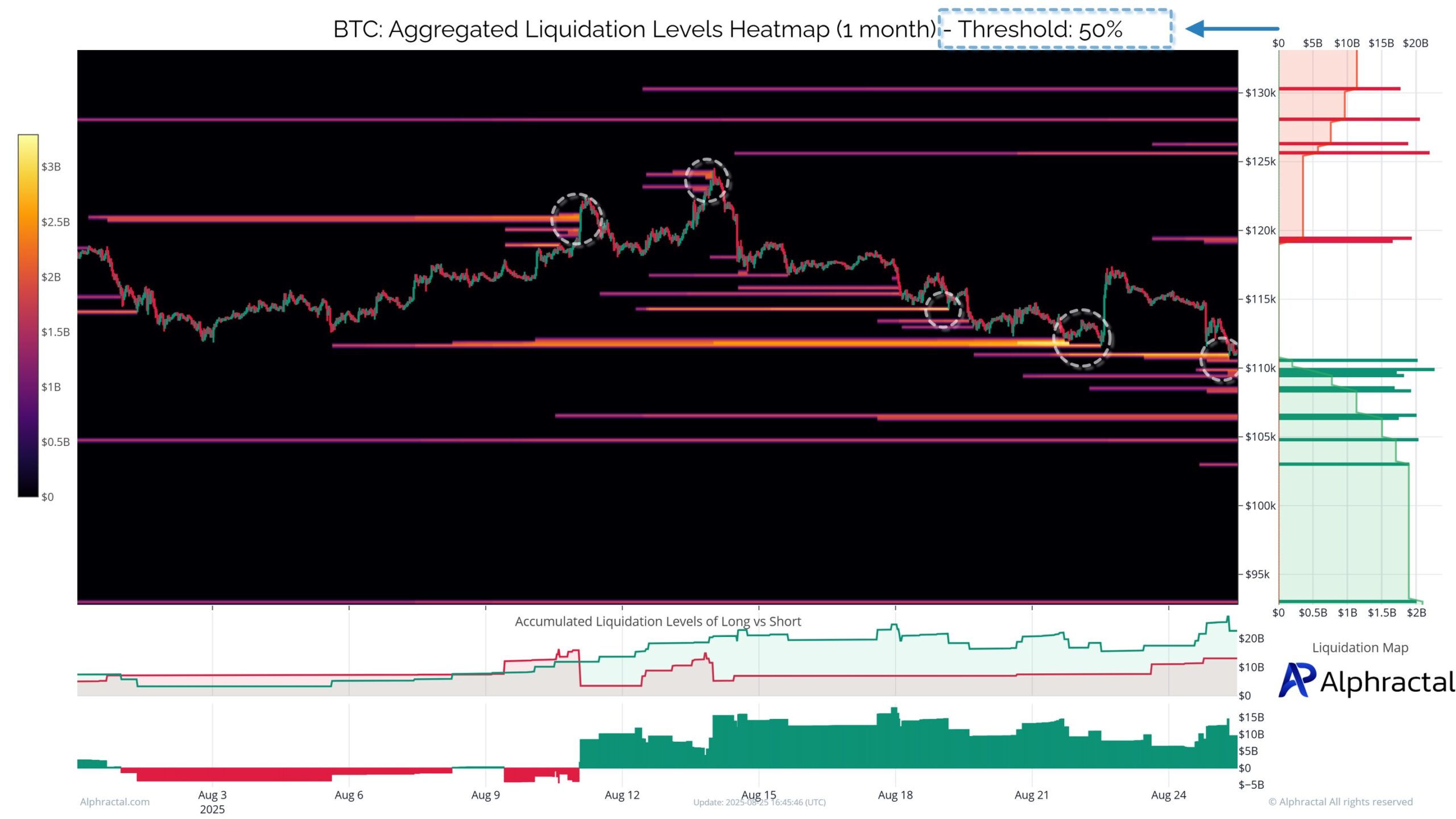 Bitcoin liquidation heatmap. Source:
Alphractal
Bitcoin liquidation heatmap. Source:
Alphractal
For Bitcoin, the most prominent feature is the formation of a massive long cluster around $104,000–$107,000. This concentrated liquidity zone aligns with the $100,000–$107,000 support zone, which Analyst Axel Adler Jr. identified based on on-chain data.
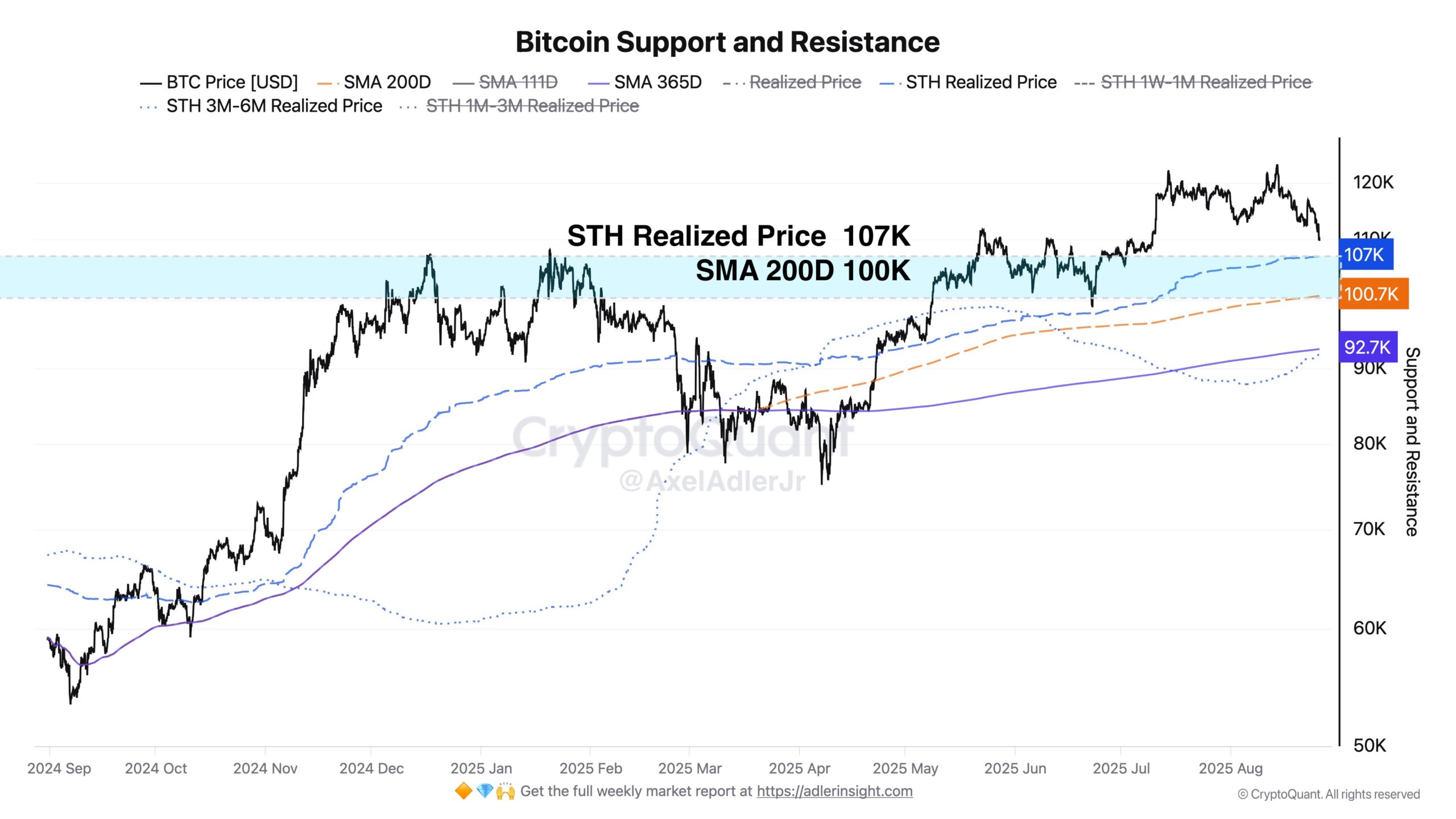 Bitcoin on-chain data. Source:
Axel Adler Jr
Bitcoin on-chain data. Source:
Axel Adler Jr
Specifically, this level marks the intersection of the Short-Term Holder Realized Price (the average cost basis for short-term investors) and the 200-day SMA. This factor bolsters the reliability of this support zone’s “defensive” role. Many experts predict that if this zone is breached, a deeper retreat to the $92,000–$93,000 range will occur.
“The nearest strong support zone is the 100K–107K range, where the STH Realized Price and SMA 200D intersect. Below that is additional support around 92–93K, a deeper support level reflecting the cost basis of short-term investors who held coins for 3 to 6 months. This will become a key second line of defense if the market loses the 100K–107K level.” Axel Adler Jr stated.
As BeInCrypto reported, Bitcoin’s spot taker activity has turned sell-dominant, highlighting fading buy-side demand and risk of a drop toward $107,557 support.
Conversely, the $108,800 level is the short-term dividing line between a bull and bear market. According to Murphy Chen, this represents the short-term cost basis for investors.
A stable close above this threshold signals a significant reduction in selling pressure. However, losing this level could trigger a short-term sell-off.
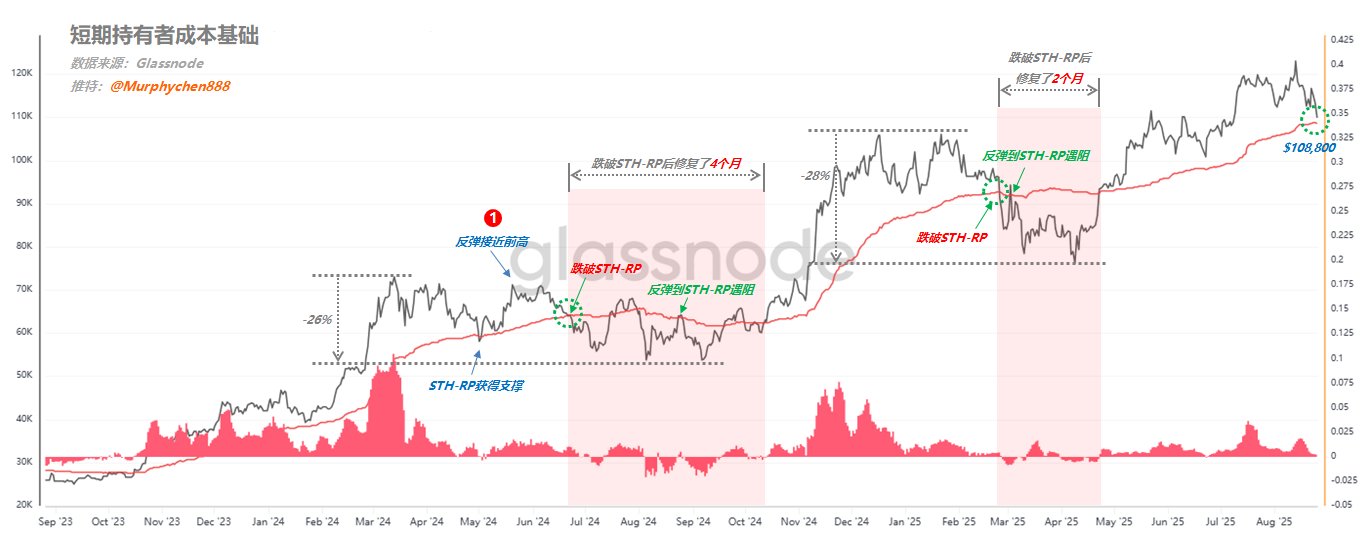 STH-RP’s bull-bear dividing line and price dynamics. Source:
Murphy Chen
STH-RP’s bull-bear dividing line and price dynamics. Source:
Murphy Chen
In other words, the $108,800 zone is the “gateway” that determines whether Bitcoin sustains its upward momentum or enters a deeper correction phase.
“Currently, at $108,000, it’s a 13% drop from the high. If STH-RP is breached, theoretically there would still be 10-15% downside space. Without the cooperation of negative events of the same magnitude, the correction amplitude may not exceed the previous two instances,” Murphy Chen stated.
The market has liquidated 94% of accounts over the past three months. This highlights the dangers of high-leverage trading during a market dominated by liquidity hunts.
As the 50% filter highlights, trading near large liquidity clusters often carries high risk. This makes defensive strategies, stop-loss placement, and position management more critical.
Disclaimer: The content of this article solely reflects the author's opinion and does not represent the platform in any capacity. This article is not intended to serve as a reference for making investment decisions.
You may also like
SUI Chart Projects a Rally Through Late 2027

AI Trading Logic Shifts! From Japan and Korea to the US, Global Chip Stocks Plummet, Star IPOs Stalled, Changxin Technology Breakthroughs Raise Repeated Alarms
Among AI-related stocks that have risen significantly this year, storage chip stocks are particularly prone to profit-taking; under crowded trading and high valuations, new signs of competition are enough to trigger concentrated selling. According to Wall Street sources, Changxin Technology's 4F² DRAM architecture has provided investors with an opportunity to take profits. While its technological advancements are indeed significant, they should not be directly regarded as an immediate threat to existing manufacturers. The AI rally has not ended and may be entering its next phase, with investors focusing more on realizing profits rather than purely betting on infrastructure expansion.
Crypto prices
More


