
Trump’s Sanctions Unintentionally Unite the BRICS

By seeking to isolate his rivals, Donald Trump could well get the opposite effect. Under the pressure of his trade sanctions, the countries of the BRICS bloc, long divided, are beginning an unprecedented strategic rapprochement. As tensions rise, China, India, Russia and their partners seem more willing than ever to cooperate economically and diplomatically.
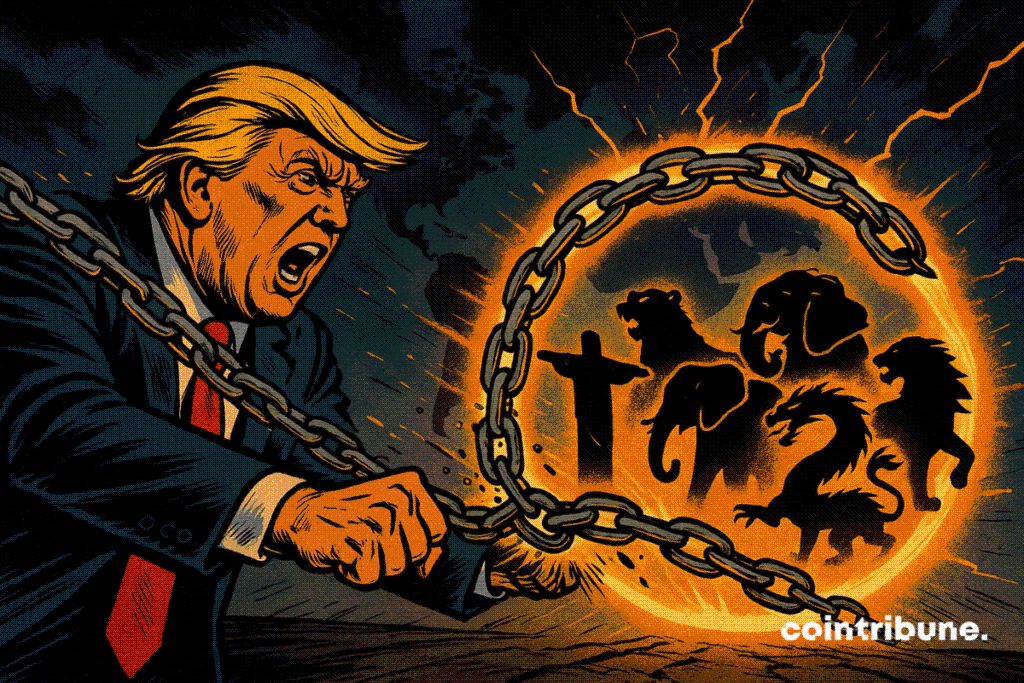
In brief
- Donald Trump imposes severe trade sanctions on BRICS countries, with record tariffs reaching up to 145% for China.
- These measures create common ground among BRICS members, who respond with a coordinated strategy to reduce their dependence on the dollar.
- China, India and Russia are preparing to hold an unprecedented trilateral summit in six years, amid rising tensions with the United States.
- Despite persistent disagreements, especially between India and China, BRICS is developing pragmatic cooperation in trade and strategic resources.
Tariff pressure that unites BRICS
Since his return to the White House, Donald Trump has chosen to confront the BRICS head-on through an aggressive trade policy , marked by unprecedented tariff increases. The figures speak for themselves and illustrate a resolutely punitive strategy:
- China was threatened with a 145% tariff if no compromise was found with Washington;
- India is hit by a 50% tariff, half of which is specifically related to the purchase of discounted Russian oil;
- Brazil is also subject to 50% customs duties on certain exports;
- South Africa suffers a 30% charge, despite its limited direct trade exposure to the United States;
- Egypt, a new entrant to the BRICS bloc, could see its taxes increase simply due to its participation in the group.
Ajay Srivastava, a former senior Indian trade official, points out that these sanctions only fuel a common front: “they give them a common incentive to reduce their dependence on the United States, even if their agendas differ”.
Faced with this external pressure, BRICS alliance countries are responding convergently. The group’s central banks have increased their gold purchases, and bilateral trade agreements in national currencies (yuan, rupee, ruble) are multiplying. This momentum, once sporadic, now takes the form of a deliberate strategy to reduce dependence on the US dollar.
Pragmatic cooperation despite internal tensions
As trade tensions with the United States intensify, leaders of the main BRICS members are preparing to display their unity at the Shanghai Cooperation Organization (SCO) summit, to be held in Tianjin, China.
For the first time in six years, a trilateral summit between China, India and Russia is planned. The Kremlin is pushing in this direction, hoping to “strengthen the core of the BRICS alliance” and ease historic tensions between New Delhi and Beijing. This is a deliberate attempt to consolidate the group’s hard core in the face of Western pressure.
This initiative is accompanied by bilateral détente signals. Beijing and New Delhi, long at odds over their 3,500-kilometer border, have reopened direct flights, facilitated visa access and engaged in discussions on rare earth supply, a sector in which China holds over 85% of the world’s processing capacity.
During an official visit, Chinese Foreign Minister Wang Yi confirmed that China is committed to increasing deliveries to India, essential for its defense industries and energy transition.
Nevertheless, mistrust persists, notably due to Beijing’s closeness to Islamabad and the controversial Chinese dam project on the Tibetan plateau, which worries New Delhi. This geopolitical complexity limits the scope of a true rapprochement, especially as India continues to rely heavily on the American market, with $77.5 billion in exports to the US in 2024, against much smaller volumes to China or Russia.
However, beyond tensions, a pragmatic logic seems to emerge. BRICS is no longer a mere ideological platform. The bloc becomes a variable geometry cooperation space, focused on trade, finance and supply chains. Thus, projects for settlement in local currencies, “Buy BRICS” campaigns, and ambitions to reform global governance (notably via the WTO) attest to this. While the BRICS single currency project is on hold , alternatives to the dollar are taking shape.
Disclaimer: The content of this article solely reflects the author's opinion and does not represent the platform in any capacity. This article is not intended to serve as a reference for making investment decisions.
You may also like
Siri AI integration: Apple bets on new smart home entry! First display “brain” HomeView debuts, complete smart home accessory set unveiled
The HomeView is priced at $299, featuring a 7-inch square screen and powered by the A18 chip. It comes in both desktop and wall-mounted versions, supports facial recognition linked to Siri AI, and can recognize up to six users. It will not be released in the EU for now, as Siri AI is not available locally. Apple has teamed up with LG and Schneider to launch an Apple Home Collection smart home accessory series, including indoor and outdoor floodlight cameras, video doorbells, thermostats, and door locks. The new generation Apple TV 4K is equipped with the A19 chip, supports Siri AI voice interaction, and is priced at $299. The second-generation HomePod mini is priced at $149, featuring new interactive lighting effects, with both products seeing price increases from previous models. Analysts are optimistic about Apple’s opportunities in expanding its home business, while the foldable iPhone set to begin pre-sale on Friday remains the recent highlight.
Lighter plunges 12% – $2.9M in long liquidations trigger panic exits
SUI Chart Projects a Rally Through Late 2027

AI Trading Logic Shifts! From Japan and Korea to the US, Global Chip Stocks Plummet, Star IPOs Stalled, Changxin Technology Breakthroughs Raise Repeated Alarms
Among AI-related stocks that have risen significantly this year, storage chip stocks are particularly prone to profit-taking; under crowded trading and high valuations, new signs of competition are enough to trigger concentrated selling. According to Wall Street sources, Changxin Technology's 4F² DRAM architecture has provided investors with an opportunity to take profits. While its technological advancements are indeed significant, they should not be directly regarded as an immediate threat to existing manufacturers. The AI rally has not ended and may be entering its next phase, with investors focusing more on realizing profits rather than purely betting on infrastructure expansion.
Crypto prices
More


