
XRP Max Pain Levels Show Both Bulls and Bears in Trouble

The XRP price continues to look more like a roller coaster than a $178.36 billion asset. Amid this mess of a price action, the most logical question that makes crypto traders scratch their heads is at what point the XRP market will bring the maximum pain.
Thanks to fresh liquidation data from CoinGlass, the answer becomes much less prosaic.
So, right now XRP is trading just around $3, while the so-called “max pain” levels for both longs and shorts are sitting almost within arm’s reach.

The short-side pain line is calculated at $3.387, where more than $17.9 million in contracts would be at risk if the price were to push higher. For context, that level is only about 13% away from spot, while Bitcoin and Ethereum show far broader cushions before short bets face liquidation pressure.
On the other end, XRP’s long-side pain is marked at $2.953, which is essentially right beneath the current level, just a few cents away. That means any slip lower immediately drags leveraged longs into danger equivalent to $11.35 million in liquidations.
XRP on thin ice
What makes this setup more tense is how it lines up with the recent price action of the third biggest cryptocurrency. Since its run to $3.60 earlier in August, XRP has cooled into a range between $2.80 and $3.20, and those same levels now overlap with the on-chain liquidation map.
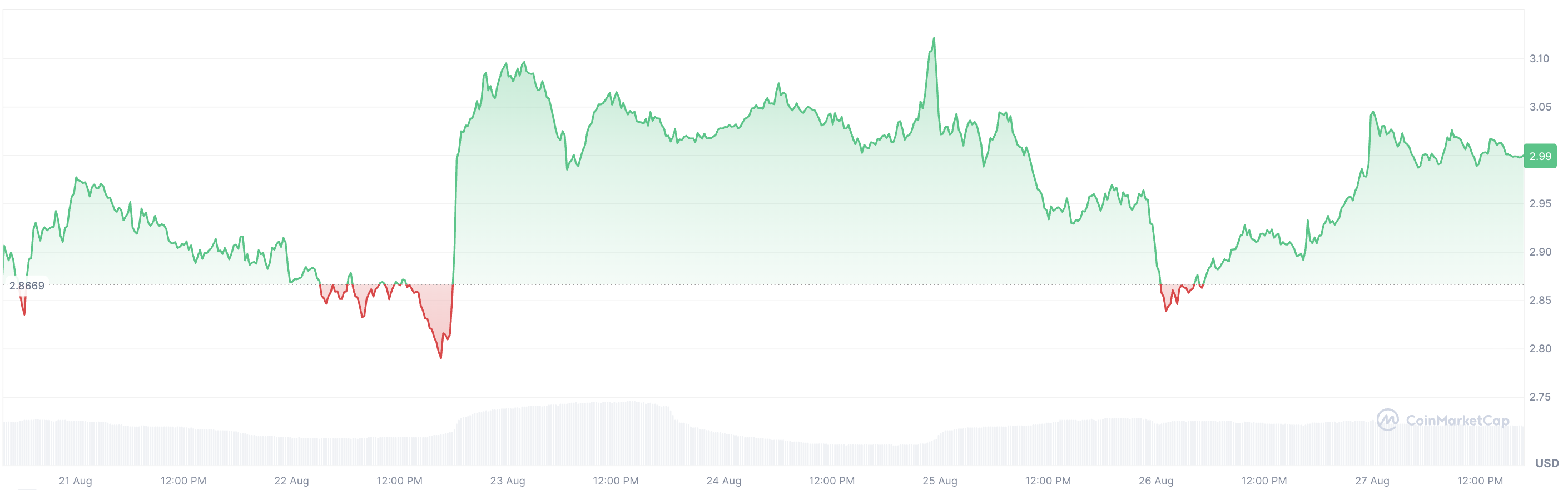
The band is so narrow that even routine intraday shifts can trigger forced exits, keeping volatility alive even when the chart looks flat at first glance.
In short, XRP is caught in a pocket where both sides are exposed, and the margin for error is thin. Whether price breaks lower toward $2.80 or tests the $3.30 ceiling again, the data suggests liquidations will be amassing quickly, making the coming weeks especially sensitive for anyone losing their heads going heavy on leverage.
Disclaimer: The content of this article solely reflects the author's opinion and does not represent the platform in any capacity. This article is not intended to serve as a reference for making investment decisions.
You may also like
Siri AI integration: Apple bets on new smart home entry! First display “brain” HomeView debuts, complete smart home accessory set unveiled
The HomeView is priced at $299, featuring a 7-inch square screen and powered by the A18 chip. It comes in both desktop and wall-mounted versions, supports facial recognition linked to Siri AI, and can recognize up to six users. It will not be released in the EU for now, as Siri AI is not available locally. Apple has teamed up with LG and Schneider to launch an Apple Home Collection smart home accessory series, including indoor and outdoor floodlight cameras, video doorbells, thermostats, and door locks. The new generation Apple TV 4K is equipped with the A19 chip, supports Siri AI voice interaction, and is priced at $299. The second-generation HomePod mini is priced at $149, featuring new interactive lighting effects, with both products seeing price increases from previous models. Analysts are optimistic about Apple’s opportunities in expanding its home business, while the foldable iPhone set to begin pre-sale on Friday remains the recent highlight.
Lighter plunges 12% – $2.9M in long liquidations trigger panic exits
SUI Chart Projects a Rally Through Late 2027

AI Trading Logic Shifts! From Japan and Korea to the US, Global Chip Stocks Plummet, Star IPOs Stalled, Changxin Technology Breakthroughs Raise Repeated Alarms
Among AI-related stocks that have risen significantly this year, storage chip stocks are particularly prone to profit-taking; under crowded trading and high valuations, new signs of competition are enough to trigger concentrated selling. According to Wall Street sources, Changxin Technology's 4F² DRAM architecture has provided investors with an opportunity to take profits. While its technological advancements are indeed significant, they should not be directly regarded as an immediate threat to existing manufacturers. The AI rally has not ended and may be entering its next phase, with investors focusing more on realizing profits rather than purely betting on infrastructure expansion.
Crypto prices
More


