
Sony’s Soneium Score Transforms On-Chain Actions Into Rewards

- Soneium Score rewards consistent blockchain use by turning activity into loyalty points.
- Leaderboards and Soulbound badges give users recognition for reaching higher scores.
- Projects gain a pool of actively engaged users, boosting retention and participation.
Sony’s Soneium blockchain has introduced Soneium Score, an Ethereum Layer 2 system that converts daily blockchain activity into gamified loyalty points. The initiative seeks to create an identity framework where on-chain participation is continuously recorded, tracked, and rewarded, reshaping how user engagement is measured across decentralized ecosystems.
Every onchain action should count
— Soneium
That’s why we built Soneium Score, a new way to reward your proof of contributions across the entire Soneium ecosystem.
One score. Multiple ways to earn.
Let’s understand how you can evolve your score(@soneium)


The proof-of-contribution model records regular actions, including staking, token swaps, and NFT minting, and allocates them with quantifiable points. Participation is recorded cumulatively on Soneium, but projects must integrate the system to verify users and award points.
By directly linking loyalty to blockchain actions, Sony is moving toward a future where consistent user activity becomes transparent, verifiable engagement within its digital ecosystem. This step raises a pivotal question: Can tokenised loyalty programmes redefine how corporations retain digital audiences across platforms?
Scoring System
Soneium Score measures engagement in four categories. Activity Score is awarded on frequent transactions and includes streaks of 28 days per season. The Liquidity Score is a reflection of protocols’ contributions to total value locked (TVL). NFT Score will award 12 to 18 points for holding approved collections. Lastly, the bonus score provides add-on points for rotating partner projects, which guarantees changing chances of involvement.
Contributors all play on seasonal leaderboards, and completing more than 80 points earns a Soulbound Token (SBT) badge. These non-transferable tokens leave permanent marks on the wallets of clients and can be viewed on OpenSea as a sign of present activity. Such SBTs may be reused later by developers to access control, curate projects, or other ecosystem incentives.
Authentic Engagement and Ecosystem Growth
Sony has identified the issues that Soneium Score aims to resolve in two main points. To begin with, actions such as swaps or staking rarely establish a continuity of transactions on blockchain ecosystems, resulting in an absence of persistent identity. To add to this, new ventures face an uphill battle in attracting loyal users without the use of overly complex incentives or technical hurdles.
The platform is incentivized to keep the user active and gives the developer a pool of actively engaged users by merging identity and activity. The system has better chances of being adopted in the future as an invaluable infrastructure tool within blockchain communities.
The initial phase of the program centres on Soneium’s internal ecosystem, including gaming, DeFi, and NFTs. Sony has, however, indicated their interest in future cross-chain integrations, which could facilitate greater reputation portability should the community’s interest persist.
Related:
Financial Metrics and Market Performance
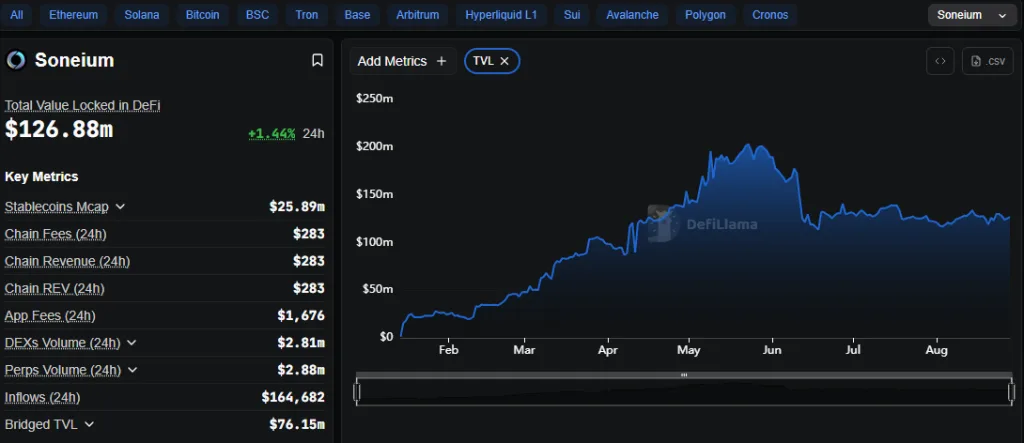
Current figures highlight Soneium’s resilience despite recent consolidation. The network’s total value locked stands at $126.88 million, a 1.46% increase in 24 hours. Its stablecoin market cap remains at $25.89 million, while chain fees and revenue both register $283 daily.
 Source:
DefiLlama
Source:
DefiLlama
Application fees stand at $1,676, DEX volume stands at $2.81, and perpetual volume stands at $2.88 million. The inflows are at $164.68K, which is backed by $76.15 million bridged TVL.
According to charts, the growth has been strongly observed since the beginning of 2025, with TVL values rising to over $200 million in May and then moderating. The liquidity and user participation are stable despite decreases, indicating a stable ecosystem demographic and well-established community interaction.
Disclaimer: The content of this article solely reflects the author's opinion and does not represent the platform in any capacity. This article is not intended to serve as a reference for making investment decisions.
You may also like
As tech stocks plummet, Goldman Sachs issued a bullish report on US stocks, but after reading it, people became even more worried...
Goldman Sachs strategist Tony Pasquariello released a bullish report, stating that market breadth is "not as bad as reported." However, the report references the internet bubble twice for comparison. Behind the tactical bullishness lie multiple concerns such as slowing profits, a surge in stock supply, and quarterly crowded positions among the "Magnificent Seven."
Apple (AAPL.US) launches wall-mounted hub HomeView to enter the smart home market; analysts: may generate new income for the services segment
Apple launches a wall-mounted hub to enter the smart home market. Analysts say it may bring new revenue to the services segment, and a paid Siri AI is on the horizon.
U.S. IPO Preview|Primagrove: Soaring Performance with a 17-Fold Increase, but the $17,000 Cash Pool Raises Concerns
From software outsourcing to integrated software and hardware.
60% of stocks have fallen into a bear market, the seven tech giants are holding up the S&P alone! BTIG: US stocks may be just a "gentle push" away from collapsing
The S&P 500 is just one step away from its all-time high, but under the surface, turbulence is brewing: 60% of its components have already entered a technical bear market, and only 30% have outperformed the index, the lowest since 1991. All of this is being supported solely by the seven major tech giants—which is, in fact, the biggest risk. With crowded positions and the semiconductor sector mirroring the path of the 2000 bubble burst, an accelerated decline could be triggered during the upcoming earnings season at the end of the month. When the market is standing on just one final leg, it doesn't take much force to topple it.

Crypto prices
More


