
Pence Signals Readiness as Trump's Executive Moves Spark Constitutional Concerns
- VP Pence states readiness to assume presidency if Trump becomes incapacitated, emphasizing administration continuity amid political tensions. - Trump's removal of Fed Governor Lisa Cook sparks legal challenges, with experts citing violations of the Federal Reserve Act's "removal for cause" provisions. - Concerns grow over politicization of independent institutions, as executive actions risk destabilizing economic policy and investor confidence. - Pence's public assurance aims to reassure markets, though
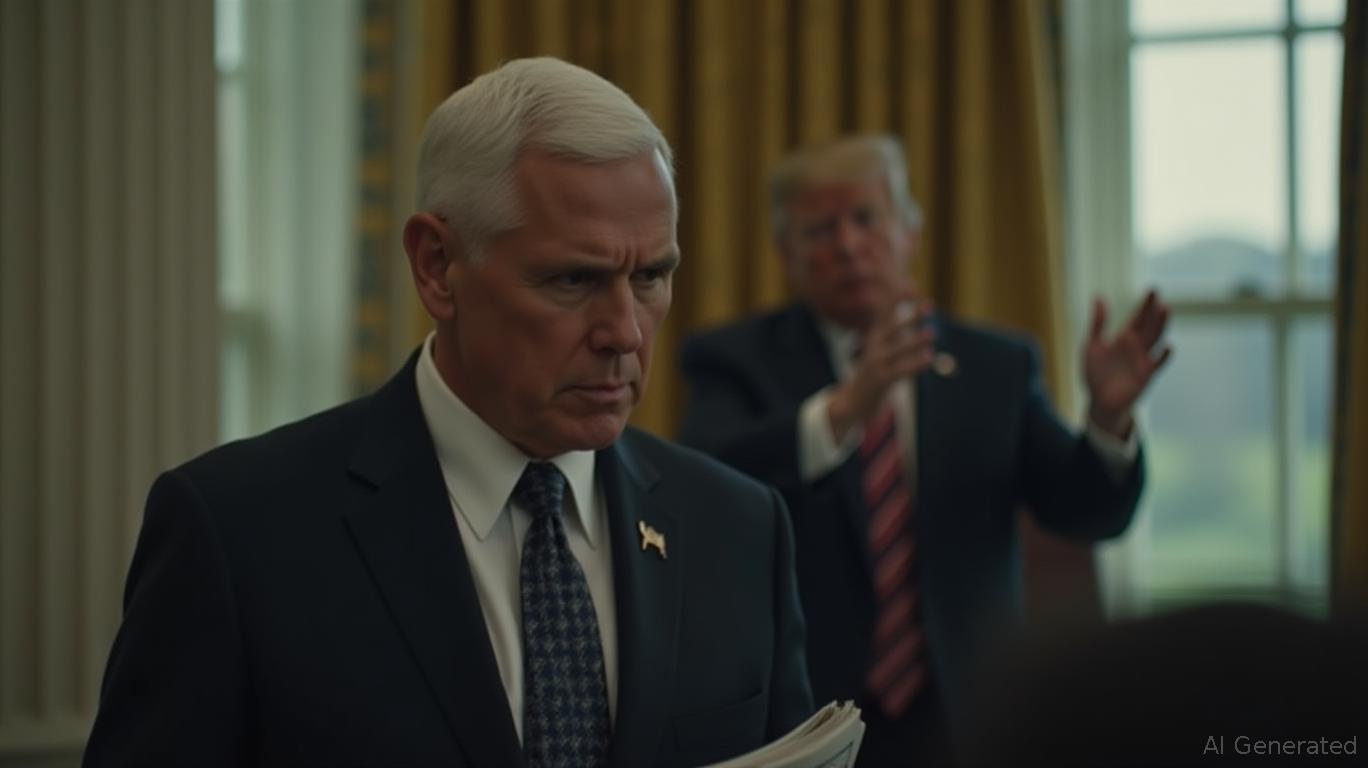
Vice President Mike Pence has indicated he is prepared to assume the presidency if President Donald Trump is unable to serve due to an accident or other incapacitation, according to recent public statements. The announcement comes amid ongoing scrutiny of Trump’s executive actions and their implications for U.S. governance and policy stability. Pence’s readiness to step into the role reflects the administration’s emphasis on continuity, particularly in light of the high-stakes political and economic environment.
The potential transition scenario highlights the constitutional framework for presidential succession, wherein the vice president is first in line to assume the presidency in case of the president’s incapacitation or removal. Pence’s preparedness underscores the administration’s preparedness for such an eventuality, although no official contingency plans have been made public. His statement was made in a context of increasing political tensions and executive decisions that have drawn both domestic and international attention.
The administration has faced recent turbulence following President Trump’s controversial removal of Federal Reserve Governor Lisa Cook, a move cited for alleged mortgage fraud. The removal, announced via the president’s social media platform, has been widely criticized as an overreach of executive authority. Legal experts have noted that the Federal Reserve Act mandates that Board members can only be removed for cause, such as gross misconduct or neglect of duty, not for policy disagreements. The action has raised questions about the potential politicization of independent institutions and the implications for economic policy stability.
Pence’s public readiness to assume the presidency is likely intended to reassure markets and international partners of the administration’s continuity and capacity to uphold policy commitments. Analysts have suggested that any abrupt change in leadership could introduce uncertainty into key policy areas, particularly those involving monetary and fiscal policies, international trade agreements, and regulatory oversight. The Fed’s independence is considered critical in maintaining investor confidence and macroeconomic stability, with any perceived politicization of the institution seen as a potential risk to market sentiment.
While Pence’s statement has not directly addressed concerns about Trump’s recent executive decisions, it aligns with the broader administration narrative of stability and preparedness. The move also comes amid heightened scrutiny of executive overreach and the legal challenges these actions may provoke. With the Fed now reportedly in legal discussions regarding the legitimacy of the removal, the broader implications for institutional governance and political accountability remain under observation by legal and financial analysts.
Disclaimer: The content of this article solely reflects the author's opinion and does not represent the platform in any capacity. This article is not intended to serve as a reference for making investment decisions.
You may also like
As Starlink challenges telecom operators' pricing power, AT&T (T.US) sells its Mexico business for $2 billion, shifting focus to AI connectivity demand.
AT&T has agreed to sell its Mexico operations to Televisa and Fintech for $2 billion. The transaction is expected to be completed in the first quarter of 2027, pending approval from Mexican regulators.


Dovish Signals Boost Markets: Asia-Pacific Stocks Rebound, South Korea Shares Jump Over 1% Ending Five-Day Slide, Taiyo Yuden Surges 7%
On Wednesday, the MSCI Asia-Pacific Index rose by 0.2%, making a slight rebound from the low point reached on Tuesday, the lowest since August. South Korea's Composite Index briefly rose by over 2%. SK Hynix and Samsung Electronics both surged more than 3% during trading, then fell back. The Nikkei 225 expanded its gains to 0.53%. MLCC giant Taiyo Yuden led the AI hardware sector, while Fujikura rose nearly 4%. The yield on 10-year US Treasury futures remained at 5.21%, up 0.5 basis points from Tuesday.

Apple (AAPL.US) is the “ultimate answer” for AI investments? Amid a semiconductor crash, it hits $5 trillion again; foldable iPhone and AI home devices ignite growth imagination
While the Philadelphia Semiconductor Index has fallen for five consecutive days with a cumulative drawdown of over 8%, Apple hit a historic intraday high of $348.15 on October 13, with its market capitalization surpassing $5 trillion again; it closed at $341.27, with a market value of approximately $4.98 trillion.

Crypto prices
More


