Bitget App
Trade smarter
Buy cryptoMarketsTradeFuturesStocksEarnInstitutionAI & More
Bitcoin Handover – How Retail is Selling to Wall Street ETFs

Bitcoin Handover – How Retail is Selling to Wall Street ETFs

CoinEditionCoinEdition2025/08/28 16:00
By:Coin Edition

While retail investors still hold the majority, institutions and ETFs now control over 14% of all BTC This shift from early adopters to Wall Street creates a new dynamic of persistent, price-agnostic buying On-chain data shows Satoshi holds 4.6% of the supply, while another 7.6% of Bitcoin is lost forever

  • While retail investors still hold the majority, institutions and ETFs now control over 14% of all BTC
  • This shift from early adopters to Wall Street creates a new dynamic of persistent, price-agnostic buying
  • On-chain data shows Satoshi holds 4.6% of the supply, while another 7.6% of Bitcoin is lost forever

Bitcoin is moving from early believers to Wall Street. As the asset matures, a new class of owner is taking control, and this shift in who holds BTC is the most important trend for its future price. On-chain data shows exactly where the 21 million coins are.

Who Actually Holds the Most Bitcoin Today?

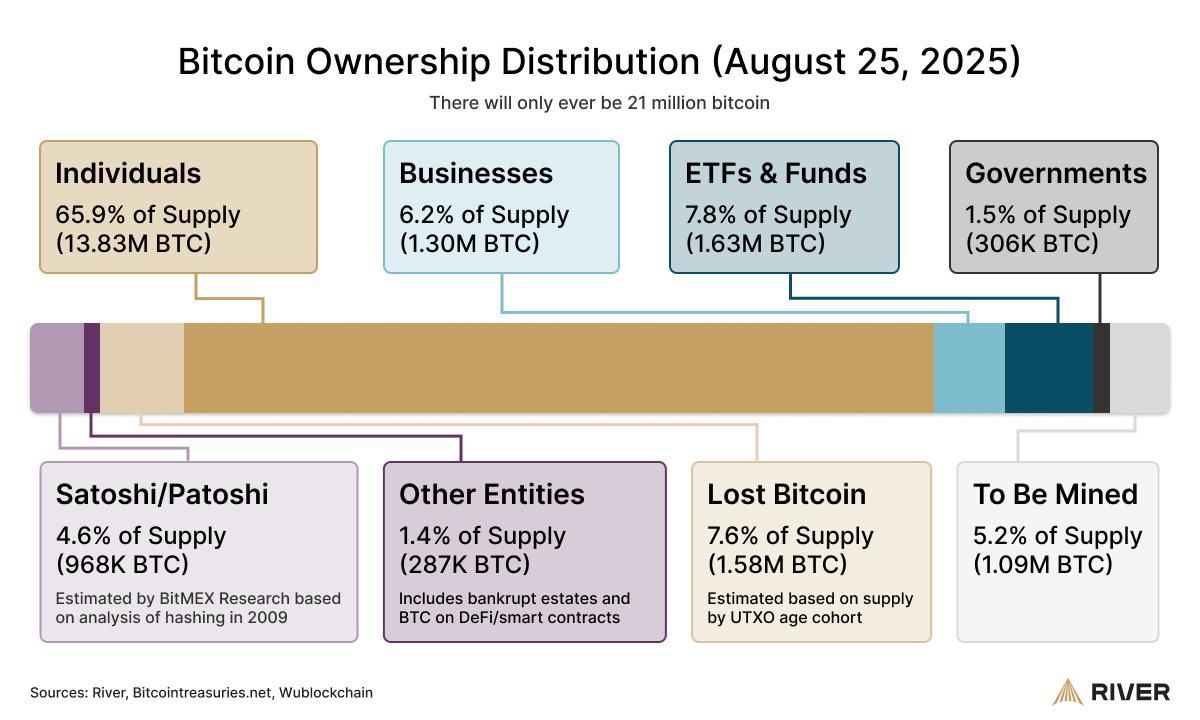
Most of the Bitcoin supply, nearly 13.83 million BTC (65.9%), is still in the hands of individual retail investors. This group, valued at over $1.52 trillion, represents the largest single slice of the ownership pie.

However, Wall Street and corporate America now control a combined 14% of all Bitcoin, and their share is growing rapidly:

  • The new U.S. spot Bitcoin ETFs, led by BlackRock, have already bought 1.63 million BTC (7.8%).
  • Corporate treasuries, with Michael Saylor’s MicroStrategy leading the charge, hold another 1.3 million BTC (6.2%).

This institutional embrace is reinforced by major banks like JPMorgan, who now argue Bitcoin is a better inflation hedge than gold .
Bitcoin Handover – How Retail is Selling to Wall Street ETFs image 0 Bitcoin Handover – How Retail is Selling to Wall Street ETFs image 1 Source: X

What About Satoshi, Governments, and ‘Lost’ Coins?

Beyond the active market, several massive pools of Bitcoin are either off-limits or held by unique entities:

  • Lost Forever: An estimated 1.58 million BTC (7.6%) are considered permanently lost.
  • Satoshi Nakamoto: The creator’s wallets hold an estimated 968,000 BTC (4.6%).
  • Governments: The U.S. and other governments have seized a combined 360,000 BTC (1.5%).
  • Locked/Bankrupt: About 287,000 BTC (1.4%) are tied up in contracts or bankruptcies.
  • Unmined Supply: Just 5.2% of all Bitcoin is left to be mined over the next 100 years.

Why Does This Ownership Shift Matter for Bitcoin’s Price?

This shift from retail to institutions fundamentally changes Bitcoin’s market cycles. The old cycle was defined by whales selling to retail investors at the market top. The new cycle is completely different.

On-chain data from the past year shows that businesses and ETFs are now accumulating Bitcoin constantly, regardless of price. This persistent, price-agnostic buying creates a powerful demand floor. 

It’s the primary reason why analysts like Fundstrat’s Tom Lee now project Bitcoin could hit $1 million , as a growing wave of institutional capital chases a shrinking supply of available coins.


0
0

Disclaimer: The content of this article solely reflects the author's opinion and does not represent the platform in any capacity. This article is not intended to serve as a reference for making investment decisions.

Understand the market, then trade.
Bitget offers one-stop trading for cryptocurrencies, stocks, and gold.
Trade now!

You may also like

The Reserve Bank of India’s Efforts to Save the Rupee Deplete Reserves: $50 Billion Plunge in Forex Holdings, $200 Billion Forward Dollar Liabilities Become a Ticking Time Bomb

Foreign investors have made net sales of $31 billion in Indian stocks this year, and administrative controls are accelerating hedging demand towards the offshore NDF market, with the effectiveness of interventions continuously diminishing. The most critical risk lies in the fact that the yield spread between Indian and US 10-year government bonds has sharply dropped from 600 basis points in 2013 to just 200 basis points, with the traditional interest rate defense line nearly breached. India faces a dilemma: persisting on the current path will exhaust policy space, while relying on rate hikes to rebuild the yield spread would directly stifle economic growth.

华尔街见闻•2026/10/14 04:22
The Reserve Bank of India’s Efforts to Save the Rupee Deplete Reserves: $50 Billion Plunge in Forex Holdings, $200 Billion Forward Dollar Liabilities Become a Ticking Time Bomb

As Starlink challenges telecom operators' pricing power, AT&T (T.US) sells its Mexico business for $2 billion, shifting focus to AI connectivity demand.

AT&T has agreed to sell its Mexico operations to Televisa and Fintech for $2 billion. The transaction is expected to be completed in the first quarter of 2027, pending approval from Mexican regulators.

智通财经•2026/10/14 03:32
As Starlink challenges telecom operators' pricing power, AT&T (T.US) sells its Mexico business for $2 billion, shifting focus to AI connectivity demand.

Dovish Signals Boost Markets: Asia-Pacific Stocks Rebound, South Korea Shares Jump Over 1% Ending Five-Day Slide, Taiyo Yuden Surges 7%

On Wednesday, the MSCI Asia-Pacific Index rose by 0.2%, making a slight rebound from the low point reached on Tuesday, the lowest since August. South Korea's Composite Index briefly rose by over 2%. SK Hynix and Samsung Electronics both surged more than 3% during trading, then fell back. The Nikkei 225 expanded its gains to 0.53%. MLCC giant Taiyo Yuden led the AI hardware sector, while Fujikura rose nearly 4%. The yield on 10-year US Treasury futures remained at 5.21%, up 0.5 basis points from Tuesday.

华尔街见闻•2026/10/14 03:02
Dovish Signals Boost Markets: Asia-Pacific Stocks Rebound, South Korea Shares Jump Over 1% Ending Five-Day Slide, Taiyo Yuden Surges 7%

