
Solana lobby group adds $500K to Roman Storm’s defense war chest

The Solana Policy Institute, a nonprofit Solana advocacy group, has pledged $500,000 toward the legal defense of Tornado Cash co-founders Roman Storm and Alexey Pertsev, adding to growing financial support from the crypto community.
Storm was found guilty of operating an unlicensed money-transmitting business on Aug. 6, while Pertsev was found guilty in 2024 of money laundering in connection with developing Tornado Cash, a protocol allowing users to mask the origin and destination of their crypto.
The Solana Policy Institute said in a statement on Thursday that its $500,000 donation will help Storm (who is in post-trial motions seeking to overturn his conviction) and Pertsev’s appeal.
Through community fundraising, the Free Roman Storm fund has raised $5.5 million to aid with his legal defense, about $1.5 million away from its goal.
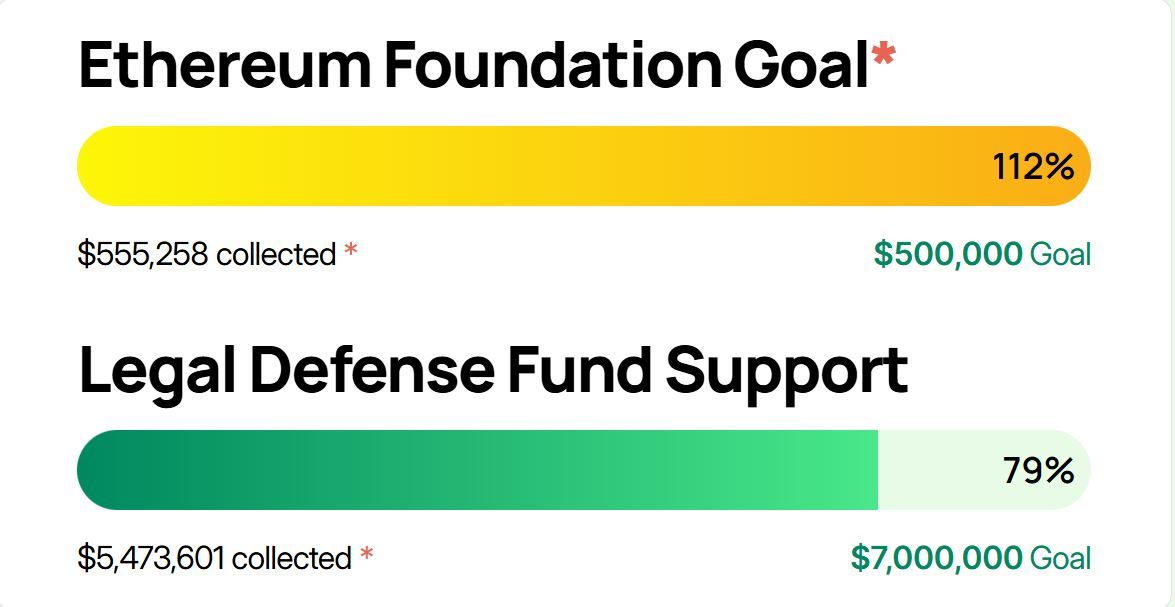 So far, a Free Roman Storm defense fund has raised over $5 million. Source: Roman Storm defense fund
Ethereum heavyweights come out swinging
In a call for support back in July, Storm asked in an X statement for $1.5 million to help with mounting legal costs.
Ethereum core developer Federico Carrone said he would contribute $500,000 on Aug. 11, after he was detained by Turkish authorities over alleged links to an Ethereum privacy protocol.
The Ethereum Foundation also pledged to match up to $500,000 in donations to Storm’s defense fund following his conviction.
The Foundation had already donated $500,000 in June and promised to match up to an additional $750,000 in donations from the crypto community.
Ethereum co-founder Vitalik Buterin has also contributed to the cause, with two donations totalling 150 Ether, worth over $673,000 at current prices.
Other community members donate to Storm’s cause
In July, Bill Warren, a developer and contributor to Meta Cartel DAO, said the group’s entire treasury, an unspecified amount, had been cleared out to support Storm’s legal cause.
Julian Zawistowski, founder of the Golem project, confirmed that his team had donated 50 Ether in July as well, worth more than $224,000 at current prices.
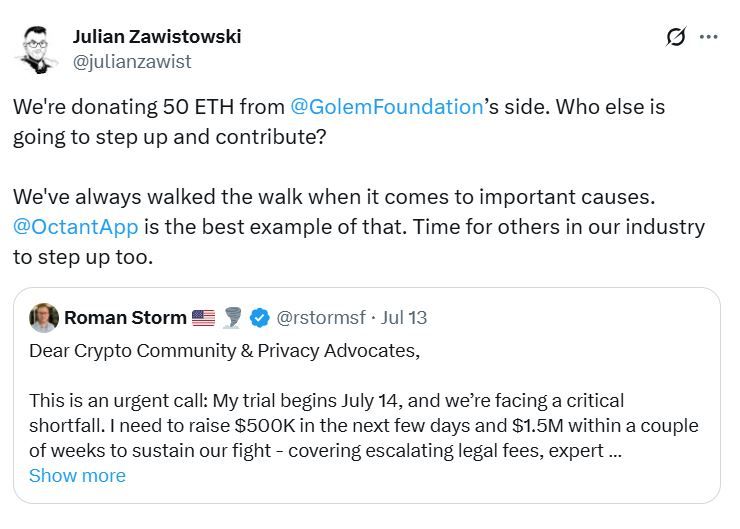 Source: Julian Zawistowski
Another sizable donation came from investment firm Paradigm, which pledged $1.25 million in January, with co-founder Matt Huang saying at the time, “Holding software developers’ liability for how third parties use the product would have a chilling effect in crypto and beyond.”
Storm’s case changes developers’ “risk calculus”
Legal professionals and industry observers have condemned the convictions of the Torndao Cash developers, arguing that it sets a dangerous precedent for open-source developers and has implications for user privacy.
After its donation, the Solana Policy Institute argued that the allegations behind the convictions are based on a misunderstanding of how blockchain technology works.
“The government’s logic is simple but dangerous: If you write open-source code that anyone can use — for good or for ill — you’re responsible for its misuse — even without any ongoing control over, or ability to control, the code at issue,” they said.
“If the government can prosecute developers for creating neutral tools that others misuse, it fundamentally changes developers’ risk calculus.”
The Blockchain Association, a crypto industry lobby group in Washington, made a similar statement after Storm was convicted, and said the ruling “sets a dangerous precedent for open-source software developers.”
Disclaimer: The content of this article solely reflects the author's opinion and does not represent the platform in any capacity. This article is not intended to serve as a reference for making investment decisions.
You may also like
The Reserve Bank of India’s Efforts to Save the Rupee Deplete Reserves: $50 Billion Plunge in Forex Holdings, $200 Billion Forward Dollar Liabilities Become a Ticking Time Bomb
Foreign investors have made net sales of $31 billion in Indian stocks this year, and administrative controls are accelerating hedging demand towards the offshore NDF market, with the effectiveness of interventions continuously diminishing. The most critical risk lies in the fact that the yield spread between Indian and US 10-year government bonds has sharply dropped from 600 basis points in 2013 to just 200 basis points, with the traditional interest rate defense line nearly breached. India faces a dilemma: persisting on the current path will exhaust policy space, while relying on rate hikes to rebuild the yield spread would directly stifle economic growth.

As Starlink challenges telecom operators' pricing power, AT&T (T.US) sells its Mexico business for $2 billion, shifting focus to AI connectivity demand.
AT&T has agreed to sell its Mexico operations to Televisa and Fintech for $2 billion. The transaction is expected to be completed in the first quarter of 2027, pending approval from Mexican regulators.


Dovish Signals Boost Markets: Asia-Pacific Stocks Rebound, South Korea Shares Jump Over 1% Ending Five-Day Slide, Taiyo Yuden Surges 7%
On Wednesday, the MSCI Asia-Pacific Index rose by 0.2%, making a slight rebound from the low point reached on Tuesday, the lowest since August. South Korea's Composite Index briefly rose by over 2%. SK Hynix and Samsung Electronics both surged more than 3% during trading, then fell back. The Nikkei 225 expanded its gains to 0.53%. MLCC giant Taiyo Yuden led the AI hardware sector, while Fujikura rose nearly 4%. The yield on 10-year US Treasury futures remained at 5.21%, up 0.5 basis points from Tuesday.

Crypto prices
More


