
Alibaba surges strongly after earnings, Group CEO says AI investments are starting to show results

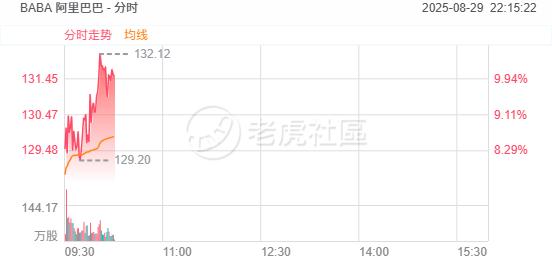
On Friday, Alibaba performed strongly after its earnings release, surging over 10% as of press time. In terms of news, the company’s Q2 fiscal revenue grew by 2% year-on-year, lower than expected, while net profit soared by 76% to 42.4 billion yuan, mainly due to gains from changes in the fair value of equity investments. Instant retail business revenue grew by 12% year-on-year in the first half of 2025. Alibaba Cloud revenue increased by 26% year-on-year, and AI-related product revenue achieved triple-digit year-on-year growth for eight consecutive quarters. Capital expenditure surged from about 11.9 billion yuan in the same period last year to about 38.7 billion yuan this quarter.
During tonight’s conference call, Alibaba Group CEO Wu Yongming stated that Alibaba owns the world’s fourth and Asia’s top cloud, and possesses full-stack technical capabilities from AI computing power, AI cloud platforms, AI models, open-source ecosystems to AI applications. This quarter, Alibaba’s Capex investment in AI+cloud reached 38.6 billion yuan. Over the past four quarters, more than 100 billion yuan has been invested in AI infrastructure and AI product R&D. Alibaba’s investment in AI has begun to show results. Whether it’s Alibaba Cloud’s rapid growth driven by customers’ AI demand or the AI experience upgrades in a wide range of to-C and to-B scenarios, the AI-driven path for Alibaba’s rapid growth has become even clearer.
Alibaba stated during the conference call that Taobao Flash Sale’s monthly active users have reached 300 million, a 200% increase from April, and that flash sales and instant retail are expected to bring 1 trillion yuan in new transactions over the next three years.
In addition, there are reports that Alibaba has developed a new AI chip to fill the gap left by Nvidia in the Chinese market. According to sources, this new chip is currently being tested and is designed to serve a broader range of AI inference tasks, and is compatible with Nvidia. The new chip is no longer manufactured by TSMC, but instead by a domestic company.
Disclaimer: The content of this article solely reflects the author's opinion and does not represent the platform in any capacity. This article is not intended to serve as a reference for making investment decisions.
You may also like
As Starlink challenges telecom operators' pricing power, AT&T (T.US) sells its Mexico business for $2 billion, shifting focus to AI connectivity demand.
AT&T has agreed to sell its Mexico operations to Televisa and Fintech for $2 billion. The transaction is expected to be completed in the first quarter of 2027, pending approval from Mexican regulators.


Dovish Signals Boost Markets: Asia-Pacific Stocks Rebound, South Korea Shares Jump Over 1% Ending Five-Day Slide, Taiyo Yuden Surges 7%
On Wednesday, the MSCI Asia-Pacific Index rose by 0.2%, making a slight rebound from the low point reached on Tuesday, the lowest since August. South Korea's Composite Index briefly rose by over 2%. SK Hynix and Samsung Electronics both surged more than 3% during trading, then fell back. The Nikkei 225 expanded its gains to 0.53%. MLCC giant Taiyo Yuden led the AI hardware sector, while Fujikura rose nearly 4%. The yield on 10-year US Treasury futures remained at 5.21%, up 0.5 basis points from Tuesday.

Apple (AAPL.US) is the “ultimate answer” for AI investments? Amid a semiconductor crash, it hits $5 trillion again; foldable iPhone and AI home devices ignite growth imagination
While the Philadelphia Semiconductor Index has fallen for five consecutive days with a cumulative drawdown of over 8%, Apple hit a historic intraday high of $348.15 on October 13, with its market capitalization surpassing $5 trillion again; it closed at $341.27, with a market value of approximately $4.98 trillion.

Crypto prices
More


