
Pre-market | PCE data meets expectations, Alibaba rises 5% after earnings, Marvell Technology plunges over 13%

US July Core PCE Price Index YoY increased by 2.9%, expected 2.9%, previous value 2.8%.
US July Core PCE Price Index MoM increased by 0.3%, expected 0.30%, previous value 0.30%.
US July PCE Price Index YoY increased by 2.6%, expected 2.60%, previous value 2.60%.
US July PCE Price Index MoM increased by 0.2%, expected 0.20%, previous value 0.30%.
US July personal spending MoM recorded 0.5%, the highest since March 2025.
Interpretation: US consumer spending grew steadily in July, and core PCE saw an uptick as import tariffs pushed up prices of some goods. However, amid a softening labor market, this data may not prevent the Federal Reserve from cutting rates next month. Low layoff rates support robust wage growth, which in turn supports consumption. But President Trump’s comprehensive tariffs on imported goods are increasing business costs, intensifying corporate caution and making employers reluctant to hire more staff. Government reports this month show that in the three months ending July, employment increased by an average of 35,000 per month, compared to 123,000 in the same period in 2024.
After the data release, short-term interest rate futures narrowed earlier losses; traders still expect the Federal Reserve to cut rates in September.
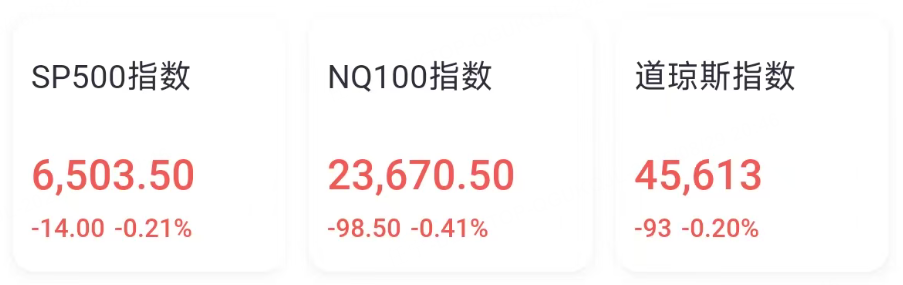
The three major US stock index futures all fell collectively.
Pre-market Movements of Individual Stocks
Alibaba rose 5%. Fiscal year 2026 Q1 revenue was 247.652 billion yuan, up 2% year-on-year; net profit was 42.382 billion yuan, up 76% year-on-year; non-GAAP net profit was 33.51 billion yuan, down 18% year-on-year. This quarter, Alibaba’s AI+Cloud business performed strongly, with Alibaba Cloud revenue growth accelerating to 26%, a three-year high, and AI-related product revenue achieving triple-digit year-on-year growth for eight consecutive quarters.

Nvidia fell nearly 1%. Reports indicate that Alibaba has developed more advanced chips to fill the gap left by Nvidia’s sales obstacles in China.

Marvell Technology plunged over 13%. Q2 revenue grew 58% year-on-year, but Q3 revenue guidance missed market expectations.

Dell fell over 6%. Dell’s Q2 AI server orders dropped sharply from $12.1 billion in the previous quarter to $5.6 billion, a decline of more than 50%. The company expects Q3 adjusted EPS of $2.45, below analysts’ average expectation of $2.55.
Ambarella rose over 18%. Q2 adjusted EPS was $0.15, three times the consensus estimate of $0.05. Revenue jumped to $95.5 million, exceeding the expected $90 million and up 49.9% year-on-year from $63.7 million a year ago. The company expects Q3 revenue to be between $100 million and $108 million, higher than the market consensus of $91.13 million.

“US Huabei” Affirm rose over 17%. Fiscal year 2025 Q4 adjusted EPS was $0.20, far above the analysts’ average estimate of $0.11. Revenue grew 33% year-on-year to $876 million, also beating analysts’ expectations of $837 million. The company also achieved positive operating profit on both GAAP and adjusted bases for the first time, marking an important step toward sustainable profitability.

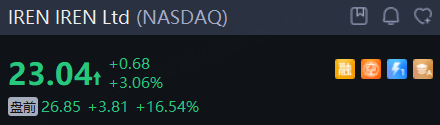
IREN rose over 16%. Q4 adjusted EBITDA exceeded expectations, and annual bitcoin mining revenue is expected to surpass $1 billion.
Elastic NV rose over 7%. Q1 results beat market expectations, and full-year revenue guidance was raised.
Autodesk rose over 11%. Q2 revenue increased 17% year-on-year, and operating income surged 36%.
SentinelOne rose over 8%. Q2 revenue increased 22% year-on-year, and full-year revenue guidance was raised.
Celsius rose over 7%. PepsiCo spent $585 million to increase its stake in Celsius.
Ulta Beauty rose over 3%. Q2 revenue beat market expectations, and full-year revenue guidance was raised.
CHAGEE fell 5%. Q2 net income was 3.3319 billion yuan, up 10.2% year-on-year; adjusted net profit was 629.8 million yuan.

Disclaimer: The content of this article solely reflects the author's opinion and does not represent the platform in any capacity. This article is not intended to serve as a reference for making investment decisions.
You may also like
As Starlink challenges telecom operators' pricing power, AT&T (T.US) sells its Mexico business for $2 billion, shifting focus to AI connectivity demand.
AT&T has agreed to sell its Mexico operations to Televisa and Fintech for $2 billion. The transaction is expected to be completed in the first quarter of 2027, pending approval from Mexican regulators.


Dovish Signals Boost Markets: Asia-Pacific Stocks Rebound, South Korea Shares Jump Over 1% Ending Five-Day Slide, Taiyo Yuden Surges 7%
On Wednesday, the MSCI Asia-Pacific Index rose by 0.2%, making a slight rebound from the low point reached on Tuesday, the lowest since August. South Korea's Composite Index briefly rose by over 2%. SK Hynix and Samsung Electronics both surged more than 3% during trading, then fell back. The Nikkei 225 expanded its gains to 0.53%. MLCC giant Taiyo Yuden led the AI hardware sector, while Fujikura rose nearly 4%. The yield on 10-year US Treasury futures remained at 5.21%, up 0.5 basis points from Tuesday.

Apple (AAPL.US) is the “ultimate answer” for AI investments? Amid a semiconductor crash, it hits $5 trillion again; foldable iPhone and AI home devices ignite growth imagination
While the Philadelphia Semiconductor Index has fallen for five consecutive days with a cumulative drawdown of over 8%, Apple hit a historic intraday high of $348.15 on October 13, with its market capitalization surpassing $5 trillion again; it closed at $341.27, with a market value of approximately $4.98 trillion.

Crypto prices
More


