
Tether’s grip on stablecoins slips below 60% for first time since 2023

USDT dominance is eroding as Circle and other stablecoin competitors fight for a share of the pie.
- USDT dominance fell below 60% for the first time since 2023
- Circle’s USDC is its primary competitor, nearing 30% dominance
- The passage of the US GENIUS Act is making the market more competitive
Competition among stablecoin issuers is growing. On Friday, August 29, USDT dominance fell to 59.45%, according to data from DeFiLlama. This was the first time the key figure fell to these levels since March 2023, indicating that Tether may be losing its grip on the market.
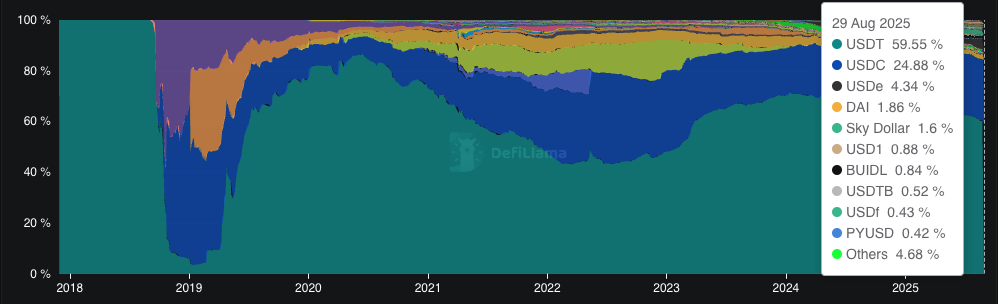
Notably, in the first half of 2024, USDT dominance hovered around 70%. At the same time, Tether’s main competitor, Circle’s USDC, controlled just 18% of the market, a figure which is now close to 30%. On the other hand, DAI’s dominance fell in that period, from around 3.5% to its current level of 1.86%.
One standout performer this year is Ethena’s USDe. Launched in December 2024, already reached 4.34% in dominance and a market cap of $12.275 billion. On the other hand, Trump World Liberty Financial’s USD1 controls 0.88% of the market.
Tether faces regulatory issues in Europe, the U.S.
Tether is not just facing increased competition. With more countries issuing stricter rules on stablecoins, its USDT is at a disadvantage. So far, Tether has declined to comply with Europe’s MiCA stablecoin framework, leading to its delisting on major exchanges.
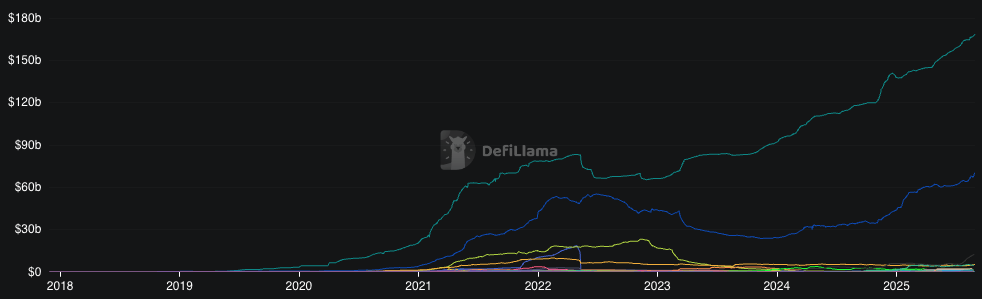
Tether may soon face the same issue in the United States, which recently passed the GENIUS Act, which requires more transparency from stablecoin issuers. Still, despite a shift in market positioning, major players, including Tether, are on the rise. Both USDT and USDC are at record levels, at $168.43 billion and $70.378 billion, respectively.
Disclaimer: The content of this article solely reflects the author's opinion and does not represent the platform in any capacity. This article is not intended to serve as a reference for making investment decisions.
You may also like
The Reserve Bank of India’s Efforts to Save the Rupee Deplete Reserves: $50 Billion Plunge in Forex Holdings, $200 Billion Forward Dollar Liabilities Become a Ticking Time Bomb
Foreign investors have made net sales of $31 billion in Indian stocks this year, and administrative controls are accelerating hedging demand towards the offshore NDF market, with the effectiveness of interventions continuously diminishing. The most critical risk lies in the fact that the yield spread between Indian and US 10-year government bonds has sharply dropped from 600 basis points in 2013 to just 200 basis points, with the traditional interest rate defense line nearly breached. India faces a dilemma: persisting on the current path will exhaust policy space, while relying on rate hikes to rebuild the yield spread would directly stifle economic growth.

As Starlink challenges telecom operators' pricing power, AT&T (T.US) sells its Mexico business for $2 billion, shifting focus to AI connectivity demand.
AT&T has agreed to sell its Mexico operations to Televisa and Fintech for $2 billion. The transaction is expected to be completed in the first quarter of 2027, pending approval from Mexican regulators.


Dovish Signals Boost Markets: Asia-Pacific Stocks Rebound, South Korea Shares Jump Over 1% Ending Five-Day Slide, Taiyo Yuden Surges 7%
On Wednesday, the MSCI Asia-Pacific Index rose by 0.2%, making a slight rebound from the low point reached on Tuesday, the lowest since August. South Korea's Composite Index briefly rose by over 2%. SK Hynix and Samsung Electronics both surged more than 3% during trading, then fell back. The Nikkei 225 expanded its gains to 0.53%. MLCC giant Taiyo Yuden led the AI hardware sector, while Fujikura rose nearly 4%. The yield on 10-year US Treasury futures remained at 5.21%, up 0.5 basis points from Tuesday.

Crypto prices
More


