
Spot Ethereum ETF trading is booming, with inflows over the past five trading days more than ten times those of Bitcoin.

The U.S. spot Ethereum ETF has recently attracted significantly more capital than Bitcoin, with inflows over the past five days exceeding those of Bitcoin by more than ten times. Market momentum is shifting due to Ethereum's advantages in stablecoins and asset tokenization, drawing the attention of major institutional investors such as Goldman Sachs.
Spot Ethereum ETFs are trading briskly in the United States, with capital inflows over the past five trading days exceeding those of spot Bitcoin ETFs by more than tenfold. According to CoinGlass data, since August 21, spot Ethereum ETFs have recorded inflows as high as $1.83 billion, while Bitcoin ETFs have seen only $171 million in the same period, less than one-tenth of Ethereum's figure.
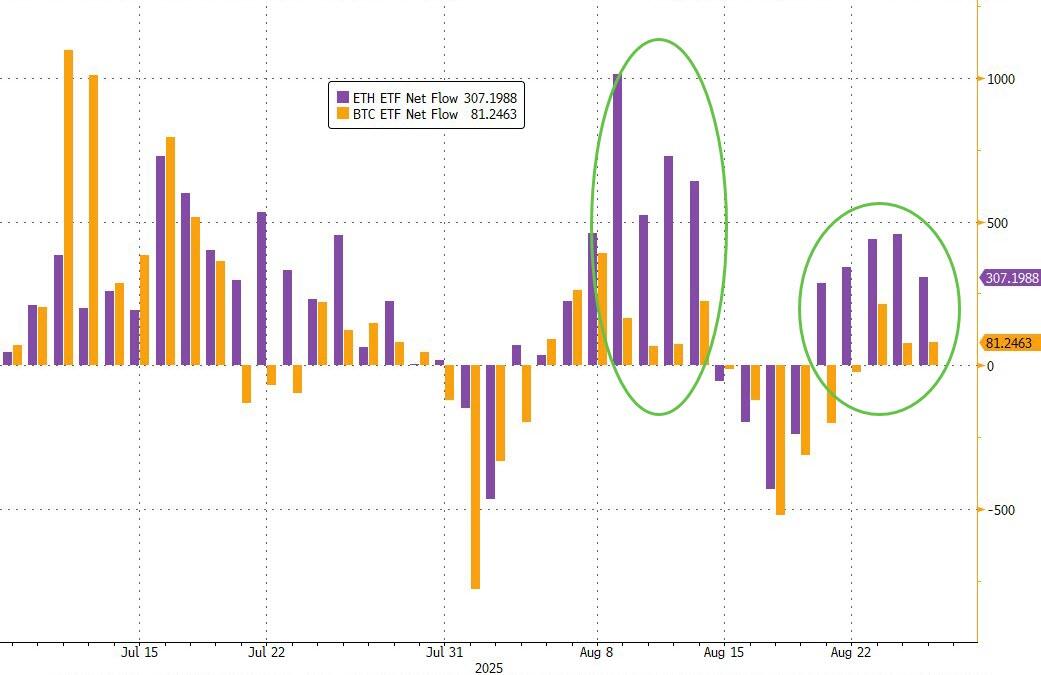
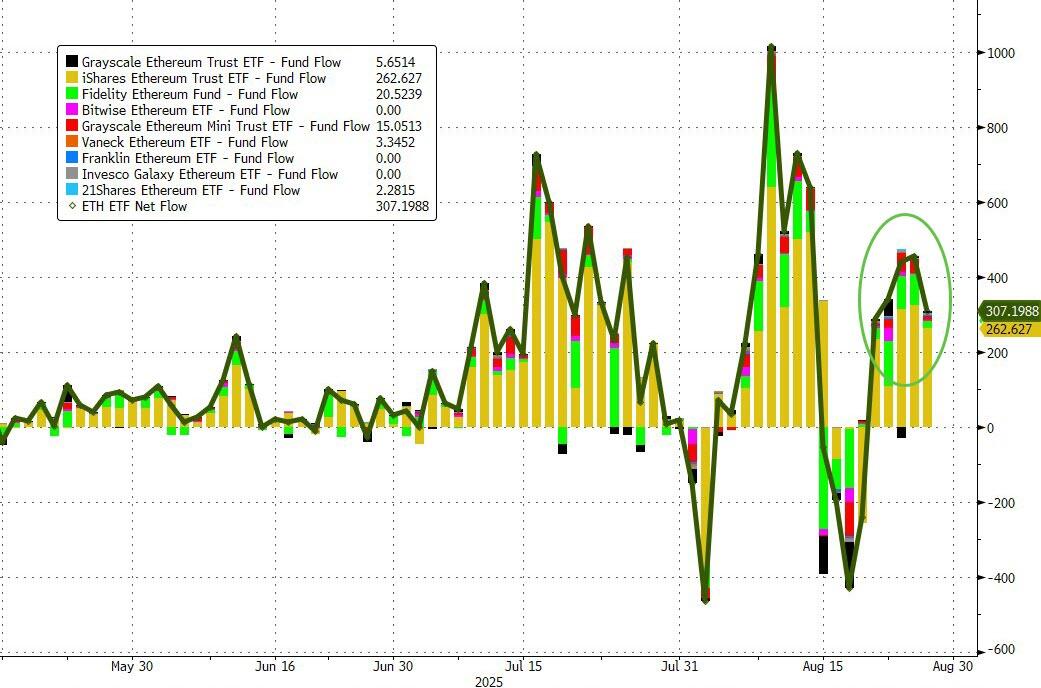
This trend continued on Wednesday: nine Ethereum ETFs saw inflows of $310.3 million, while eleven spot Bitcoin ETFs recorded only $81.1 million.
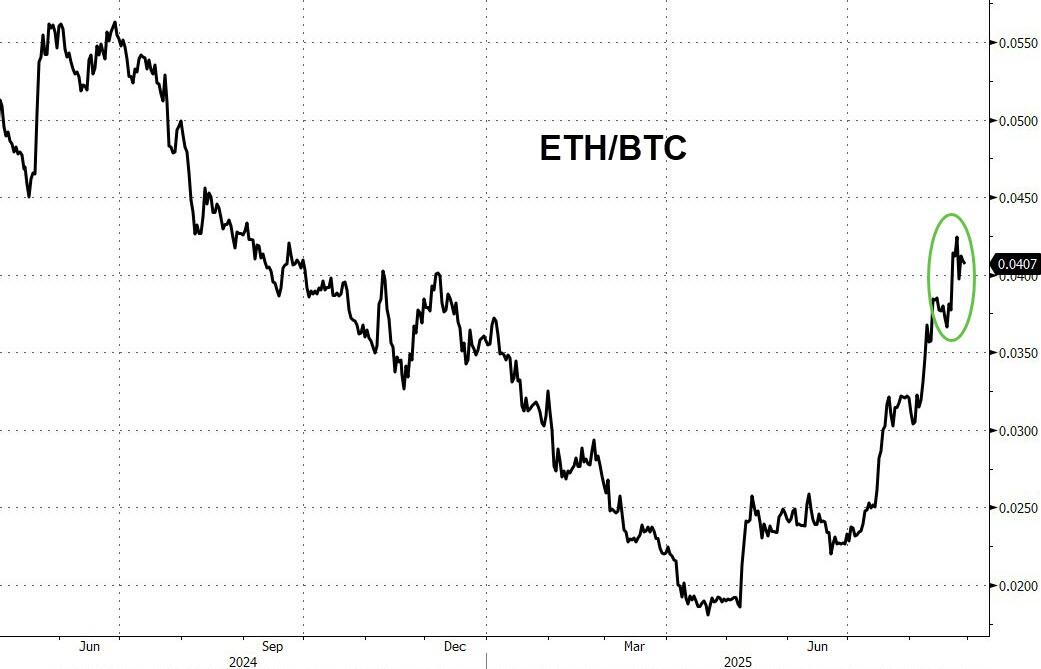
Since the start of this week, Ethereum's price rebound has also outpaced that of Bitcoin.
This large-scale shift of capital toward Ethereum has drawn the attention of industry observers. Insiders describe this change as extremely intense. Since early July, capital inflows into spot Ethereum ETFs have approached $10 billion.
Spot Ethereum ETFs have been trading for 13 months, with cumulative inflows reaching $13.6 billion, most of which has come in the past few months. In comparison, spot Bitcoin ETFs have been listed for a longer period, trading for 20 months, with total assets under management (AUM) of $54 billion.
Since the passage of the GENIUS Stablecoin Act in July, market momentum appears to be shifting toward Ethereum. The reason is that the Ethereum network holds the largest share of the stablecoin and real-world asset tokenization market. VanEck CEO Jan van Eck stated this week, "This fits perfectly with what I call Wall Street tokens."
According to a report by Bloomberg ETF analyst James Seyffart, investment advisors are the largest holders of Ethereum ETFs, with holdings reaching $1.3 billion. According to SEC filings, Goldman Sachs is among the top holders, with holdings of $712 million.
The scale of digital currency ETFs is growing rapidly. Looking only at the largest Bitcoin ETF, IBIT, its AUM is quickly approaching that of the world's largest gold ETF, GLD.
Disclaimer: The content of this article solely reflects the author's opinion and does not represent the platform in any capacity. This article is not intended to serve as a reference for making investment decisions.
You may also like
The Reserve Bank of India’s Efforts to Save the Rupee Deplete Reserves: $50 Billion Plunge in Forex Holdings, $200 Billion Forward Dollar Liabilities Become a Ticking Time Bomb
Foreign investors have made net sales of $31 billion in Indian stocks this year, and administrative controls are accelerating hedging demand towards the offshore NDF market, with the effectiveness of interventions continuously diminishing. The most critical risk lies in the fact that the yield spread between Indian and US 10-year government bonds has sharply dropped from 600 basis points in 2013 to just 200 basis points, with the traditional interest rate defense line nearly breached. India faces a dilemma: persisting on the current path will exhaust policy space, while relying on rate hikes to rebuild the yield spread would directly stifle economic growth.

As Starlink challenges telecom operators' pricing power, AT&T (T.US) sells its Mexico business for $2 billion, shifting focus to AI connectivity demand.
AT&T has agreed to sell its Mexico operations to Televisa and Fintech for $2 billion. The transaction is expected to be completed in the first quarter of 2027, pending approval from Mexican regulators.


Dovish Signals Boost Markets: Asia-Pacific Stocks Rebound, South Korea Shares Jump Over 1% Ending Five-Day Slide, Taiyo Yuden Surges 7%
On Wednesday, the MSCI Asia-Pacific Index rose by 0.2%, making a slight rebound from the low point reached on Tuesday, the lowest since August. South Korea's Composite Index briefly rose by over 2%. SK Hynix and Samsung Electronics both surged more than 3% during trading, then fell back. The Nikkei 225 expanded its gains to 0.53%. MLCC giant Taiyo Yuden led the AI hardware sector, while Fujikura rose nearly 4%. The yield on 10-year US Treasury futures remained at 5.21%, up 0.5 basis points from Tuesday.

Crypto prices
More


