
3,276.05% Solana Liquidation Imbalance Bulls Out Amid Crypto Bloodbath - U.Today

The crypto market is facing high price volatilities, and traders betting longs in major altcoins have been aggressively wiped out. Solana (SOL) traders have been mostly affected by this trend, as data from Coinglass reveals massive one-sided liquidation on SOL in the last hour.
The negative price trend has extended to the Solana derivatives market, with traders opening long positions on the sixth-largest cryptocurrency by market capitalization suffering massive losses.
Solana bulls lose $6.77 million
Notably, the data shows that Solana traders betting on the asset’s potential surge have been liquidated by a massive $6.77 million in minutes, compared to just $200,530 liquidated in shorts.
Notably, Solana saw its 1-hour liquidation trend put traders in a total loss of $6.97 million, suffered majorly by traders betting on the bullish side, thereby resulting in a massive 3,276.05% liquidation imbalance. This highlights significant bias in investor sentiments as market uncertainty continues to linger amid the prolonged crypto market bloodbath.
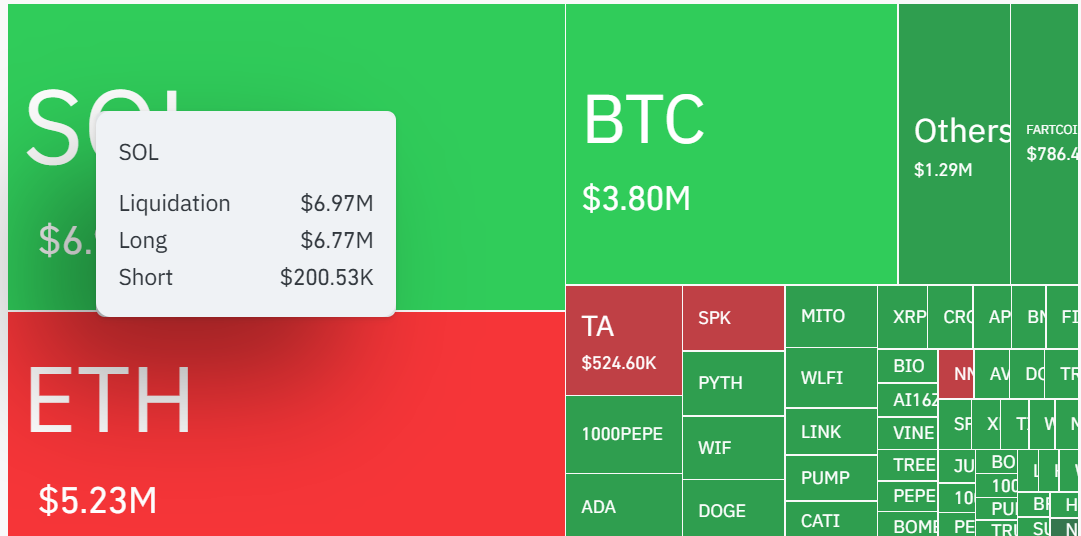
While recent price movements from leading cryptocurrencies including ETH, XRP, SOL, etc. have seen the derivatives market favor bear traders as bulls continue to get massively wiped out, it is usually observed that voluminous one-sided positions like this can leave the concerned cryptocurrency vulnerable to sudden liquidation reversals if prices move against the majority. Hence, the liquidation trend might flip against the short positions in the next minutes, causing them to suffer higher losses.
However, traders have formed the habit of watching the market closely in situations like this to see if the aggressive liquidation imbalance could set the stage for more volatility or if there could be a reversal in market sentiments.
SOL breakout still possible?
While SOL has joined the negative price trend witnessed across the broad crypto market, with its price declining lower beyond key resistance zones, it appears that Solana has retained optimism from traders as speculations suggest a rebound may be near.
Amid the growing institutional interest spurred by the potential launch of the Solana ETF and ecosystem development witnessed in the Solana ecosystem, analysts have predicted that SOL could still break out to a massive $350 in 2025 despite hitting a low of $201.55 on August 29.
While investors are bullish on SOL’s price potential in the long term, it is not certain if the current price correction will wrap up anytime soon. Hence, traders are cautiously betting on the asset to hedge against sudden losses.
Disclaimer: The content of this article solely reflects the author's opinion and does not represent the platform in any capacity. This article is not intended to serve as a reference for making investment decisions.
You may also like
US September CPI Preview: High Oil Prices Expected to Push Up Overall Inflation, Moderate Core Inflation May Ease Urgency for Rate Hikes
Driven by rising gasoline and food prices, U.S. consumer prices are likely to surge significantly in September.

Inflation remains high! ECB Governing Council member warns: Another rate hike may be necessary, but timing remains uncertain
Pierre Wunsch, a member of the ECB Governing Council and Governor of the National Bank of Belgium, stated that the European Central Bank may need to further raise interest rates.

Will Bitmine outperform expected crypto bull market after acquiring another 12,532 ETH?

The Reserve Bank of India’s Efforts to Save the Rupee Deplete Reserves: $50 Billion Plunge in Forex Holdings, $200 Billion Forward Dollar Liabilities Become a Ticking Time Bomb
Foreign investors have made net sales of $31 billion in Indian stocks this year, and administrative controls are accelerating hedging demand towards the offshore NDF market, with the effectiveness of interventions continuously diminishing. The most critical risk lies in the fact that the yield spread between Indian and US 10-year government bonds has sharply dropped from 600 basis points in 2013 to just 200 basis points, with the traditional interest rate defense line nearly breached. India faces a dilemma: persisting on the current path will exhaust policy space, while relying on rate hikes to rebuild the yield spread would directly stifle economic growth.

Crypto prices
More


