
Chicago mayor signs executive order to respond to crackdown threatened by Trump

On Saturday in August, Chicago Mayor Brandon Johnson signed an executive order prohibiting federal law enforcement officers from wearing masks or disguises; this move aims to counter President Donald Trump's threat to expand anti-crime operations to Chicago.
Trump called this Democrat-run city "a mess" and threatened to send the National Guard to the city to fight crime and clear homeless encampments, just as he did in Washington, D.C. Currently, federal agents have been conducting immigration raids in several cities across the United States, which has drawn strong criticism from Democratic mayors and governors.
Johnson stated that this new executive order is intended to protect the constitutional rights of Chicago residents, adding that the city will use all legal means to resist unilateral deployments by the federal government.
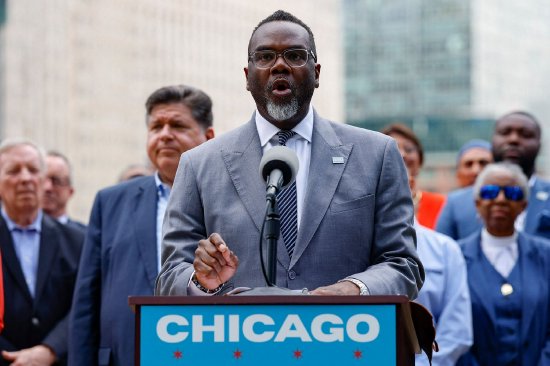
In a press statement, Johnson said: "We do not want to see military checkpoints or armored vehicles on our streets, nor do we want to see families torn apart. We will take all necessary actions to protect the rights of all Chicagoans."
Currently, Chicago's crime rate is on a downward trend. Police data shows that in the first half of this year, the number of homicides in the city dropped by 32% to 188 cases, the lowest level for the same period since 2014; violent crime cases fell by 23%, and vehicle theft cases dropped by 28%.
In addition, California lawmakers and Los Angeles County officials are considering new regulations to prohibit law enforcement officers (including federal immigration agents) from wearing masks. In June this year, Trump sent thousands of troops to the Los Angeles area to quell protests against the deportation of immigrants and to assist with raids by U.S. Immigration and Customs Enforcement.
Disclaimer: The content of this article solely reflects the author's opinion and does not represent the platform in any capacity. This article is not intended to serve as a reference for making investment decisions.
You may also like
US September CPI Preview: High Oil Prices Expected to Push Up Overall Inflation, Moderate Core Inflation May Ease Urgency for Rate Hikes
Driven by rising gasoline and food prices, U.S. consumer prices are likely to surge significantly in September.

Inflation remains high! ECB Governing Council member warns: Another rate hike may be necessary, but timing remains uncertain
Pierre Wunsch, a member of the ECB Governing Council and Governor of the National Bank of Belgium, stated that the European Central Bank may need to further raise interest rates.

Will Bitmine outperform expected crypto bull market after acquiring another 12,532 ETH?

The Reserve Bank of India’s Efforts to Save the Rupee Deplete Reserves: $50 Billion Plunge in Forex Holdings, $200 Billion Forward Dollar Liabilities Become a Ticking Time Bomb
Foreign investors have made net sales of $31 billion in Indian stocks this year, and administrative controls are accelerating hedging demand towards the offshore NDF market, with the effectiveness of interventions continuously diminishing. The most critical risk lies in the fact that the yield spread between Indian and US 10-year government bonds has sharply dropped from 600 basis points in 2013 to just 200 basis points, with the traditional interest rate defense line nearly breached. India faces a dilemma: persisting on the current path will exhaust policy space, while relying on rate hikes to rebuild the yield spread would directly stifle economic growth.

Crypto prices
More


