
Ethereum Community Foundation Rolls Out BETH to Make Token Burns Visible

BETH provides a tangible representation that can be used in governance, incentive models, and decentralized applications.
The Ethereum Community Foundation (ECF) has rolled out a new token, BETH, which serves as a verifiable record of Ether permanently removed from circulation.
The launch underscores the foundation’s mission to restore Ethereum’s focus on ETH as a core asset. It also aims to strengthen Ethereum’s monetary design at a time when debates about scarcity remain unresolved
What is the BETH Token?
Unveiled on August 28, the program operates through a smart contract that accepts ETH and forwards it to an irretrievable burn address. It then issues an equal amount of BETH back to the contributor.
The foundation argued that Ethereum’s existing system, introduced with EIP-1559, already eliminates a portion of fees with every transaction. However, those removals remain largely abstract.
BETH, by contrast, offers a tangible representation that can circulate in applications and protocols.
The ECF described the token as a building block for proof-of-burn. It makes the mechanism usable in governance frameworks, incentive models, and new forms of decentralized coordination.
“As Ethereum continues to evolve, BETH highlights the role of scarcity and destruction as equally powerful forces alongside creation and issuance,” the foundation stated.
Ethereum core developer and ECF founder Zak Cole compared the design to wrapped Ether. He explained that just as WETH standardizes ETH for smart contracts, BETH provides a clean layer for tracking burns.
He suggested that the token could enable mechanics such as burn-based voting and auctions where bids are denominated in destruction rather than revenue.
It could also support namespaces that expire unless sustained by continued burning.
At the same time, Cole warned that users should treat BETH strictly as a receipt system, not as a new asset with intrinsic value.
The introduction of BETH comes as Ethereum’s monetary policy continues to attract debate.
Since the 2021 London upgrade, the network has burned roughly 4.6 million ETH while issuing more than 8 million new tokens over the same period.
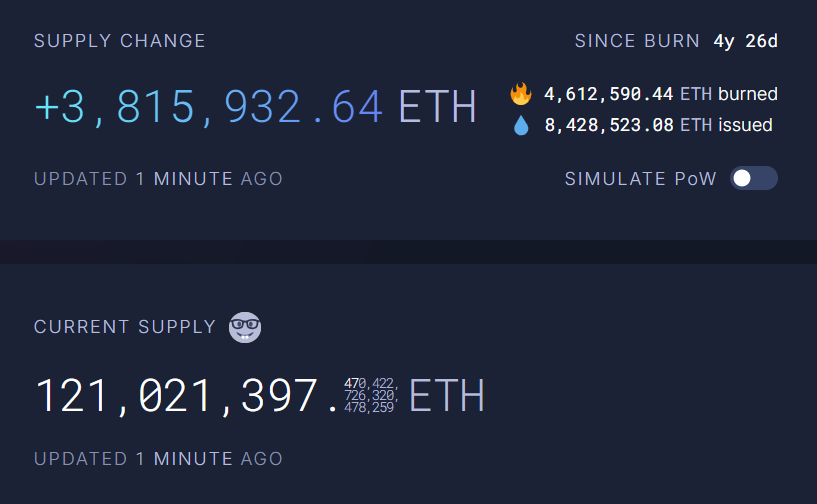 Ethereum’s Circulating Supply. Source:
This mismatch has prompted analysts to question whether Ethereum’s design can consistently enforce scarcity.
However, Ethereum co-founder Joseph Lubin expressed confidence that the community will embrace the new model.
He said developers are already exploring ways to build on BETH, suggesting that proof-of-burn could evolve into industries of its own.
“Burning ETH is going to be a very lucrative thing to do, as it will spawn industries. And a very fun thing to do, as it will become a popular mechanic in Web3 games. This is one way people will get paid to play in Web3,” he added.
Disclaimer: The content of this article solely reflects the author's opinion and does not represent the platform in any capacity. This article is not intended to serve as a reference for making investment decisions.
You may also like
US September CPI to be released tonight: Overall inflation may rise to 3.6%. Can slowing core inflation dispel the Federal Reserve's October rate hike expectations?
Although energy has driven overall inflation higher, cooling core inflation gives the Federal Reserve confidence to hold rates steady in October. Currently, there is an extreme divergence in pricing between the stock and foreign exchange markets: the stock market remains calm, while the forex market is turbulent beneath the surface. Tonight, one side is destined to face a rude awakening.

AI agents ignite a new battle in the payment industry! Bernstein: Visa (V.US), Mastercard (MA.US), etc. embrace new opportunities
Bernstein believes that as agent commercialization evolves, payments may become increasingly strategic, and the next major battle in the payment industry could soon begin.
Insurance funds become new sponsors for AI computing power: CoreWeave (CRWV.US) and other AI infrastructure financing collectively turn to insurance capital pools
CoreWeave plans to use insurance funds to finance its AI infrastructure, and co-founder McBee aims to secure an investment-grade rating for chip-backed debt. The company's financing this year has exceeded $35 billion.

Iron ore price drop and rising costs lead BHP (BHP.US) to lay off 300 workers at Western Australia mines
On October 14, BHP (BHP.US) announced the elimination of approximately 300 positions at its iron ore operations in Western Australia's Pilbara region, affecting the South Flank, Area C, Newman, and Jimblebar mines.

Crypto prices
More


