
XRP Whales Scoop Up $630 Million, But One Risk Remains

XRP price trades near $2.88 after breaking free of a bearish setup. Whale wallets added over 630 million dollars worth of XRP, but heavy profit-taking from smaller holders still weighs on momentum. Key support at $2.85 holds, while $3.35 remains the level that could flip the structure fully bullish.
XRP price trades near $2.88 at press time, up about 2% in the past day. The last four weeks were rough; XRP corrected by over 12.5% during that time. Still, the three-month trend is higher (about +26%).
Now, on-chain data suggests that those weak weeks may be coming to an end. Big buyers moved first. But selling by other holders keeps a lid on a clean breakout.
Whales Step In With $630 Million Buying
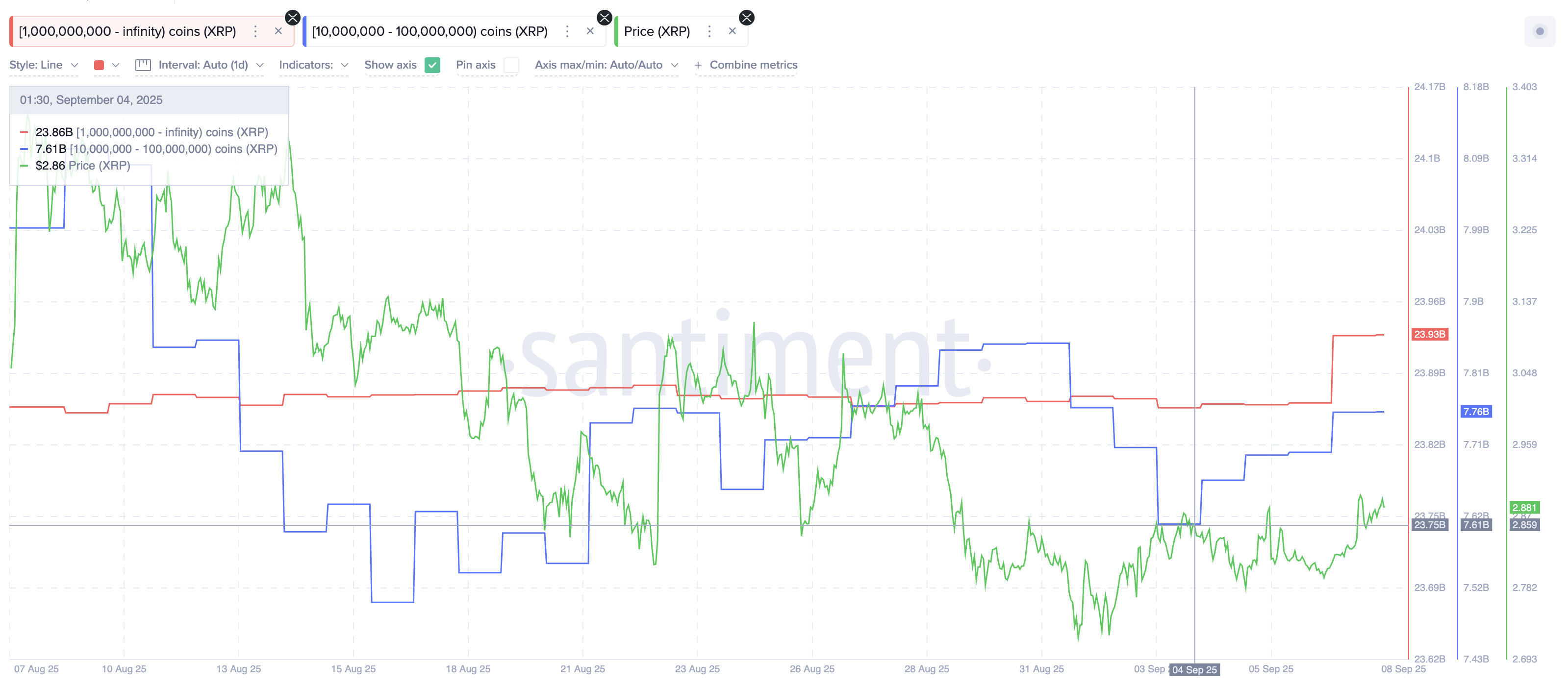
The clearest bullish move came from whales. On September 3, when XRP traded above $2.85, two large cohorts of holders started to add coins. The first group held at least 1 billion XRP, and the second held between 10 million and 100 million.
 XRP Whales Accumulate:
Santiment
XRP Whales Accumulate:
Santiment
Since September 3, these groups grew their balances from 23.86 billion to 23.93 billion, and from 7.61 billion to 7.76 billion. At current prices, this added up to roughly $630 million in new holdings.
This buying was a clear push that helped XRP move above the $2.85 area, the level where most of the buying happened.
That level had been stopping the XRP price from moving higher, and whale demand was the likely main reason the price rose again. Think of whales as big hands pulling the price up by adding coins at those levels.
Want more token insights like this? Sign up for Editor Harsh Notariya’s Daily Crypto Newsletter here.
Profit-Taking Still Blocks Clear Breakout
While whales bought, many other holders sold to lock in gains. Two things show this clearly:
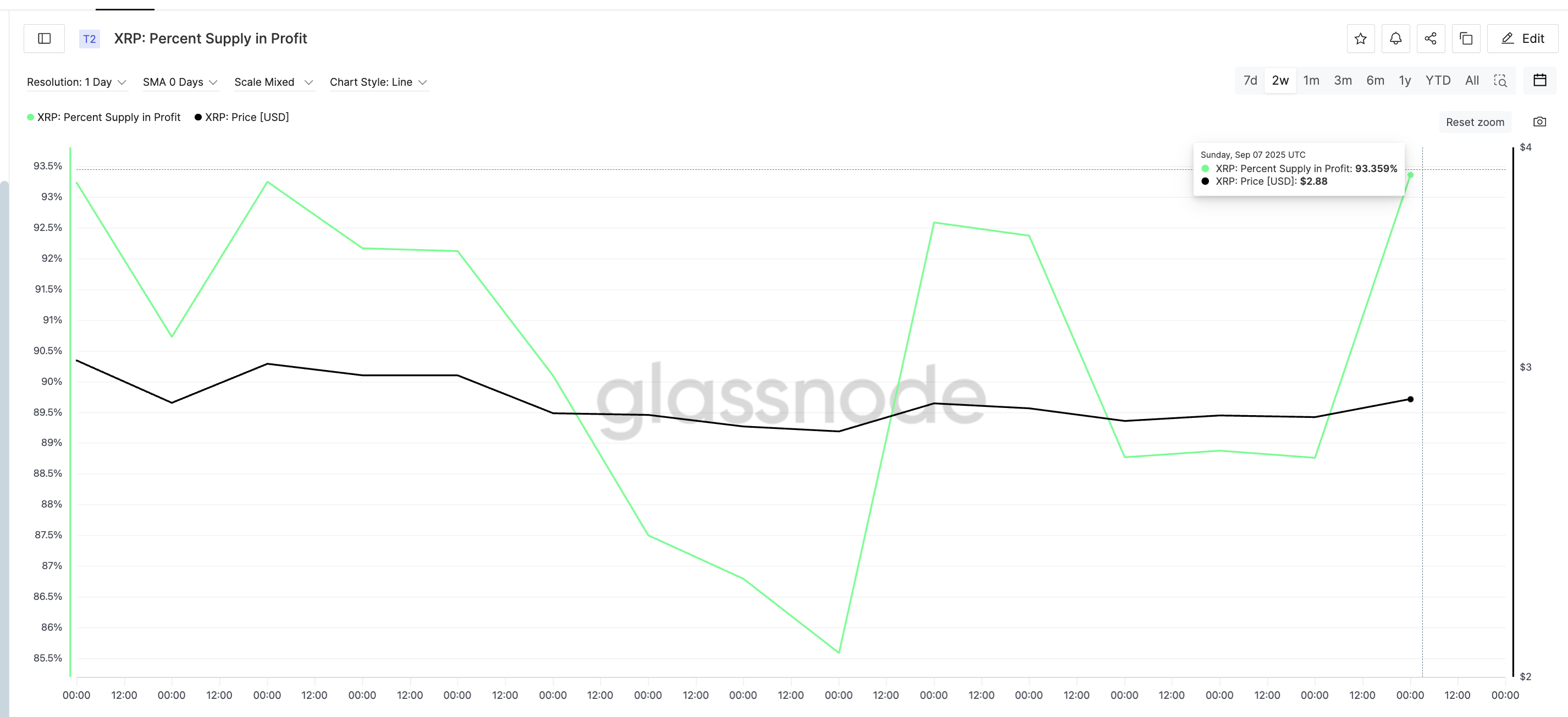
• Percent Supply In Profit: On September 1, about 85.6% of all XRP holders had gains. By September 7, that rose to about 93.4%. When most holders are in profit, many feel tempted to sell.
 XRP Price Shows Profit-Taking Risks:
Glassnode
XRP Price Shows Profit-Taking Risks:
Glassnode
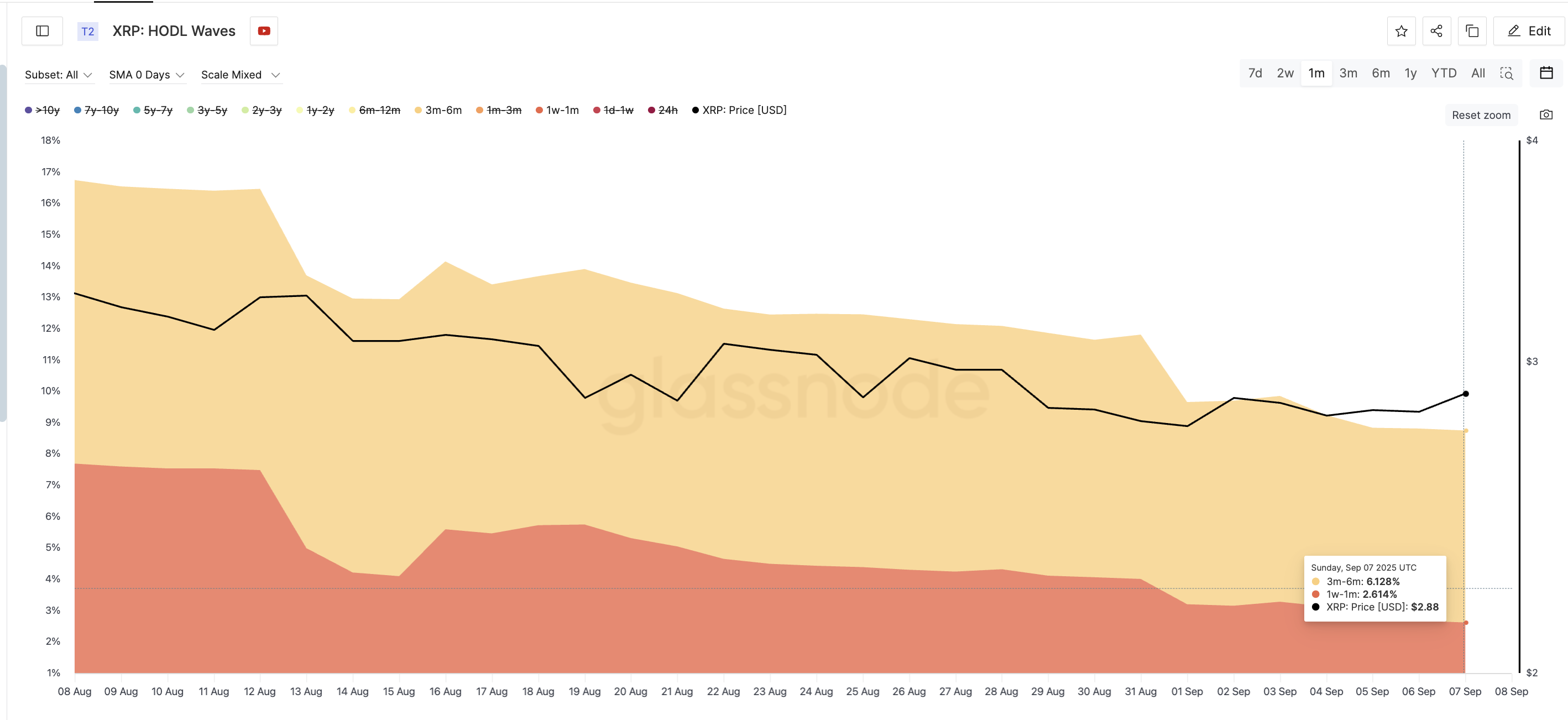
• HODL Waves: HODL waves group coins by how long they are held (short, medium, long). If a HODL band shrinks, it means that the group has sold. The three-to-six-month holders decreased from approximately 9.05% of the supply to 6.12%. One-week to one-month holders fell from about 7.68% to 2.61%. That shows short and mid-term holders sold into the bounce.
 XRP Holders Keep Selling:
Glassnode
XRP Holders Keep Selling:
Glassnode
This means that whales added big amounts and lifted the XRP price, while many smaller holders sold and slowed the rally. That is why the move up hasn’t been aggressive yet.
XRP Price Levels And Bearish Pattern Breakout
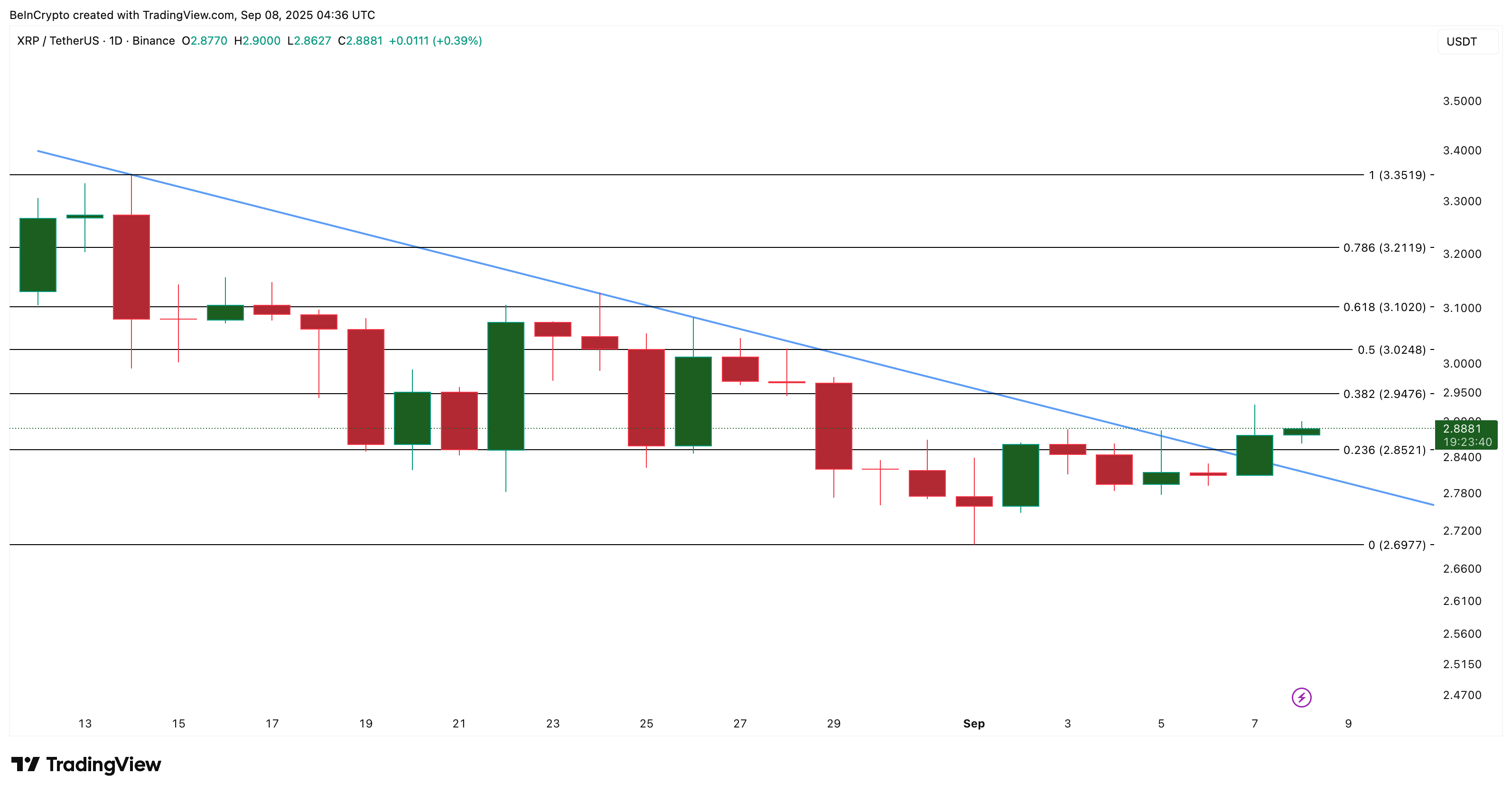
XRP price now trades near $2.88, holding above $2.85 as support. The next resistance levels are $2.94 and $3.10. A clean move past $3.35 would flip the structure fully bullish.
 XRP Price Analysis:
TradingView
XRP Price Analysis:
TradingView
The key shift is in the chart pattern. For weeks, XRP traded inside a descending triangle, a bearish setup where sellers push the price down into flat support. The triangle risked a breakdown under $2.69. Instead, XRP broke out upward, ditching the bearish pattern.
That does not yet make XRP fully bullish — but it does mean the heavy downside risk is gone for now. As long as XRP holds above $2.85 and $2.69, the broader three-month uptrend stays intact. If profit-taking eases, whales may have cleared the way for further upside.
However, if whale buying slows down and profit takers start dumping more, the key support at $2.69 might be at risk. A clean dip under this level could invalidate the short-term bullishness.
Disclaimer: The content of this article solely reflects the author's opinion and does not represent the platform in any capacity. This article is not intended to serve as a reference for making investment decisions.
You may also like
Australia Unemployment Rate set to remain at a five-year high of 4.6% in September

Blackstone's AirTrunk Postpones $1.5 Billion REIT IPO: Yield Raised to 6% but No Takers, AI Infrastructure Financing Faces 5.2% US Treasury Yield
AirTrunk, a data center operator under Blackstone, has decided to postpone the listing of its $1.5 billion Singapore Real Estate Investment Trust (REIT) to the first or second quarter of 2027. Rising U.S. Treasury yields and increased market volatility have made investors more cautious; even raising the yield from 5.5% to around 6% has not boosted demand. High capital costs are becoming a major constraint on the expansion of AI infrastructure.
CoreWeave Faces Dual Shock in Stocks and Bonds! Share Price Plummets 15%, Bonds in Trouble, Musk Exclaims "Scary"
Analysts point out that the company borrows at an interest rate of about 9%, but its investment returns are less than 5%. With total debt and lease obligations amounting to $52 billion, there is a risk that its equity value could go to zero. Rising inflation has pushed up long-term U.S. Treasury yields, leading to systemic doubts about the financing logic of capital-intensive AI companies. Prediction platforms now estimate the company's probability of bankruptcy before 2027 at 17%.

Federal Reserve Beige Book Warns of "Fierce" Oil Prices: Half of Districts Face Strong or Intensifying Price Pressures, Businesses Confront Price Increases and Profit Squeeze
The Beige Book shows that all 12 Federal Reserve districts reported the impact of rising oil prices. Businesses generally indicated that high diesel prices and fuel surcharges are passing additional costs down the entire supply chain. Since the previous Beige Book report just over a month ago, the U.S. economy has experienced moderate growth, with manufacturing serving as the main support. The labor market continues to see low hiring and low layoffs, and firms in nearly half the districts reported that AI investment is impacting employment.
Crypto prices
More


