
Novogratz Declares ‘SOL Season’ Amid $1.65B Treasury Push

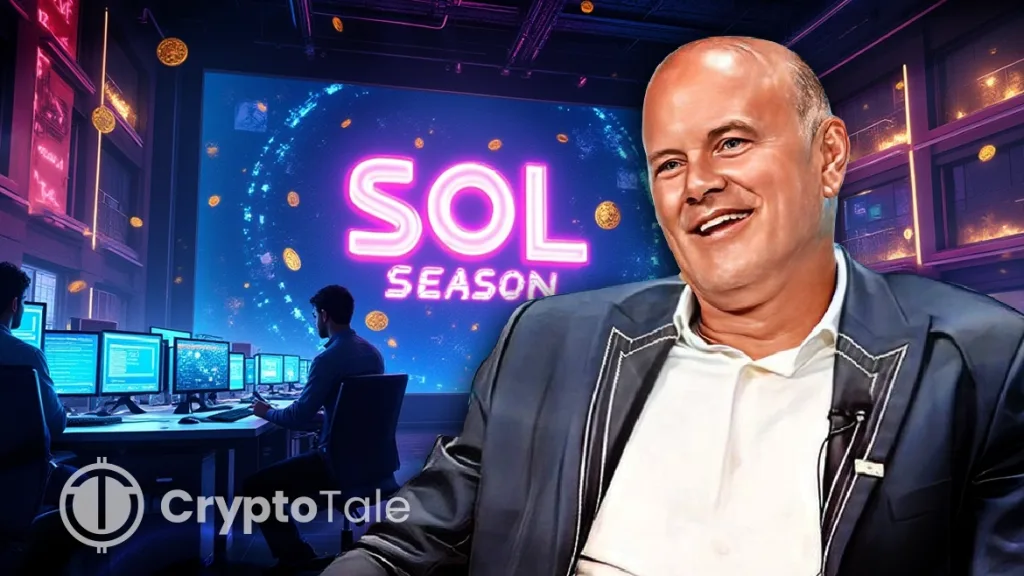
- Novogratz declares the market is in a “SOL season,” pointing to Solana’s growing demand.
- SEC Chair pushes to modernize rules, backing tokenization and onchain capital raises.
- Nasdaq files to list tokenized stocks and ETFs, eyeing blockchain settlement by late 2026.
Galaxy Digital CEO Mike Novogratz said on Thursday that the crypto market has entered what he called “SOL season.” Speaking on CNBC, he linked the term to a $1.65 billion Solana treasury financing led by Galaxy Digital, Jump Crypto, and Multicoin Capital. The move is now alongside new U.S. regulatory efforts and Wall Street filings for tokenized assets.
$1.65 Billion Treasury Backing Boosts Solana
Novogratz pointed to the Solana-focused raise completed by Forward Industries (FORD) earlier this week, describing it as part of a broader trend of crypto treasury companies funneling capital into altcoin markets.
According to him, these treasury funds are bringing liquidity and momentum that resemble the early cycles of Bitcoin and Ethereum ETF approvals. This financing round, which Galaxy, Jump Crypto, and Multicoin led, was noted as the largest Solana treasury strategy to date.
Novogratz stated that the inflows show conviction among institutional investors with long-term balance sheet strategies, adding that such commitments indicate digital assets are moving beyond narrative-driven hype into structured financial infrastructure.
Shifting U.S. Regulatory Field
Alongside the capital flows, Novogratz cited changes in U.S. regulation as another catalyst. Recently, the Securities and Exchange Commission (SEC) Chair Paul Atkins stated that the agency is working to “modernize securities rules and regulations to enable our markets to move onchain.” Novogratz described this stance as a radical move from past policy.
Atkins has reiterated that “most crypto tokens are not securities,” pointing out that investors should be able to raise capital on-chain without extended legal uncertainty. These remarks, coming within weeks of each other, suggest a clear effort to provide regulatory clarity. According to Novogratz, the change is “pushing things in the right direction” for broader institutional adoption.
Adding to the momentum, Nasdaq has filed for a rule change with the SEC to list tokenized stocks and ETFs. If approved, these tokenized versions could trade alongside traditional securities on the same order book. The filing proposes blockchain-based settlement by the third quarter of 2026, thus integrating digital assets with traditional markets.
Related: WLFI and BONKFUN Announce USD1 Trading Pairs on Solana
Novogratz Backs Solana for Wall Street
With the regulatory framework growing, Novogratz highlighted that Solana’s role is suited for financial markets, citing its ability to process billions of daily transactions at speeds surpassing traditional markets like equities, fixed income, and commodities.
Further, he added that Solana’s scale and throughput are effective for Wall Street’s tokenization initiatives, along with Ethereum, and emphasized that the relationship between the two is healthy competition.
He added that multiple blockchains will coexist, connected through bridges, to support global financial infrastructure. Moreover, with interoperability, markets can mature, while institutions gain access to faster and more efficient settlement systems.
While Solana attracts fresh inflows, Novogratz pointed out Bitcoin’s consolidation and explained that capital rotation into Solana and Ethereum markets has slowed Bitcoin’s momentum. However, he expects Bitcoin to rebound by late 2025 as the Federal Reserve begins its interest rate cuts.
Earlier this week, Bitwise CIO Matt Hougan stated the formation of a “Solana season” with potential ETF approvals and corporate treasury adoption, thus boosting demand. Fundstrat’s Tom Lee also commented that Bitcoin could reach $200,000 by year-end, to which Novogratz commented, “His lips to God’s ears.”
Novogratz’s remarks align with several developments in the current market cycle. A $1.65 billion Solana treasury financing, U.S. regulatory changes, and Nasdaq’s tokenization push all point toward deepening institutional engagement. At the same time, Solana’s technical capacity and Bitcoin’s consolidation show how capital is rotating within the broader $4 trillion digital asset market.
The post Novogratz Declares ‘SOL Season’ Amid $1.65B Treasury Push appeared first on Cryptotale.
Disclaimer: The content of this article solely reflects the author's opinion and does not represent the platform in any capacity. This article is not intended to serve as a reference for making investment decisions.
You may also like
Tech Stocks Plunge, Safe-Haven U.S. Treasury Trades Return? 10-Year U.S. Treasury Yield Drops to Three-Week Low
If AI capital expenditure slows down, a sudden halt in computing power construction will severely impact the supply chain while lowering market expectations for demand in electricity, commodities, and high-end hardware. This not only leads to a correction of overvalued assets, but also undermines growth expectations and inflation premiums, ultimately benefiting bonds. This logic is highly similar to the macroeconomic landscape during the bursting of the internet bubble in 2000, when the Nasdaq collapsed and the yield on 10-year US Treasury bonds dropped from a high of 6.5% to the 4% range.
BlackRock (BLK.US) Q3 Conference Call: Huge Financing Demand for AI Infrastructure, Computing Power May Become a New Asset Class
BlackRock (BLK.US) will release its third-quarter 2026 earnings before the US stock market opens on October 14, followed by a conference call.
Litecoin falls 2% to $59.90 as traders watch key $59 support zone
Approaching the "Death Cross"! Korean stocks hit "Black Thursday", KOSPI continuously falls below the 200-day moving average, is a prolonged bear market coming?
Hit hard by rising US inflation and concerns over AI profitability, Korean stocks plummeted 7.57% in a single day on October 15, with two major indices triggering circuit breakers for the first time in two and a half months. Foreign investors have cumulatively sold over 16 trillion won ($12 billion) in eight days. Technical indicators are flashing warnings: the KOSPI has fallen more than 8% below its 200-day moving average, and if it cannot recover within two weeks, the probability of a prolonged bear market is as high as 43%; a "death cross" is expected to form after 16 trading days. The Q3 earnings season will serve as the final validation point.

Crypto prices
More


