
Will MicroStrategy Become the Biggest Bitcoin Bubble? The Truth Behind 638,000 BTC and Potential Systemic Risks

Since 2020, MicroStrategy has gradually transformed itself from a software company into the world's largest corporate bitcoin holder. As of now, its holdings have reached 638,460 BTC, accounting for nearly 3% of the total circulating supply.
In the eyes of the public, this seems to be the strongest endorsement and belief in bitcoin; however, after an in-depth study of its financing structure and market logic, we must admit: this company may also be the biggest potential risk point in the bitcoin market.
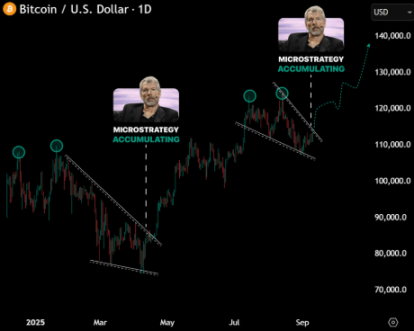
From Software Company to “Bitcoin Fund”
MicroStrategy’s bitcoin purchases began in 2020, when CEO Michael Saylor called bitcoin “digital gold.”
Since then, the company has raised more than $8 billions through bond and stock issuances, continuously increasing its bitcoin holdings.
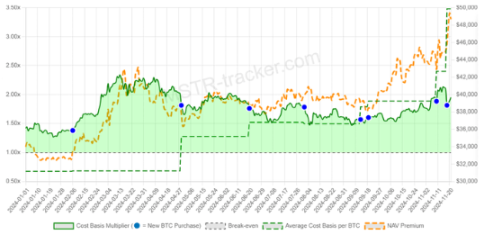
Its average holding cost is close to $73,000 per BTC, which is higher than the current market price.
Essentially, MicroStrategy is no longer a traditional software company, but a highly leveraged bitcoin fund.

Stock Price and the Faith Bubble
Before the launch of bitcoin ETFs, MicroStrategy stock (MSTR) once became an alternative channel for investors to gain BTC exposure:
Investors buying MSTR were essentially making an indirect bet on bitcoin.
The stock price has long traded at a premium of 2–3 times its net asset value (NAV) of held bitcoin.
This premium relies entirely on the market’s trust and enthusiasm for Saylor, rather than the company’s fundamentals.
Once market confidence wavers and the stock price premium evaporates, MicroStrategy’s refinancing channels will be instantly cut off.
Centralization Risk and the Paradox of Bitcoin’s Spirit
The core value of bitcoin lies in decentralization, yet MicroStrategy alone controls nearly 3% of the supply.
This centralization risk means: if the company is forced to sell due to debt or operational pressure, the market will face a systemic shock.
“If even MicroStrategy can sell, who wouldn’t?” This fear could trigger a chain reaction, similar to the market collapses of Mt.Gox or 3AC.
Leverage and the Countdown
MicroStrategy’s bitcoin purchases mostly rely on rolling debt and equity financing:
As debts gradually mature after 2026, the company will face enormous repayment pressure.
If the capital markets no longer support its stock issuance for fundraising, selling bitcoin is almost the only option.
Once liquidation begins, the impact of 638,000 BTC could directly crush market liquidity and trigger cascading panic.

Conclusion
The story of MicroStrategy reveals a paradox in the crypto market:
Its continuous buying has given bitcoin institutional legitimacy and accelerated global adoption;
But at the same time, it has also become the biggest centralization risk in the entire system.
Today, everyone is cheering for MicroStrategy’s buying, but at the same time, everyone is worried about one question: when it stops buying, or even starts selling, will it become the black swan that breaks the market?
The future of bitcoin may still be bright, but we must face the reality: MicroStrategy is not the eternal savior, and it could also be the trigger for the next crisis.
Disclaimer: The content of this article solely reflects the author's opinion and does not represent the platform in any capacity. This article is not intended to serve as a reference for making investment decisions.
You may also like
Wall Street Stands Guard as Bessent Strikes Again: Aftereffects of August's "Treasury Turnaround" Persist, November Refinancing Notice Could Be the Next Flashpoint
As the US Treasury prepares to update its debt management plan in November, key clues may emerge on Friday.
"Coca-Cola belief" never goes out of style! KFC in America says goodbye to Pepsi and embraces Coca-Cola (KO.US); Buffett-style "boring investment" returns to the spotlight
KFC has chosen Coca-Cola as its soda supplier in the United States, abandoning its long-term partner Pepsi. As of the close of the U.S. stock market on Thursday, Coca-Cola's (KO.US) stock price reached a record high, defying the ongoing declines in global tech stocks, especially in the semiconductor and broad AI computing sectors.
AI financing concerns weigh heavily on chip stocks, global tech sector has lost over $1 trillion this week
Multiple pressures, including rising expectations of a Federal Reserve rate hike and increasing AI financing costs, have led to a massive sell-off in global tech stocks this week. The combined market value of the world's top 20 AI and semiconductor stocks has evaporated by more than $1 trillion, and the semiconductor ETF (SOXX) has recorded its longest losing streak in 11 years. On Thursday, SK Hynix continued to plunge by over 10% in a single day, while Nvidia, Samsung, and SoftBank were not spared.
Safe Haven Amid AI Crash! Major Pharmaceutical Stocks Approach Historic Highs
Amid concerns over AI capital expenditures, funds are seeking a "certainty premium." State Street Healthcare ETF reached a record high. Eli Lilly and AbbVie are both approaching their historical highest closing prices, while Gilead and Amgen have surged 7.7% and 7.2% respectively over the past five days. Eli Lilly continues to bet on the future through its GLP-1 dominance and 40 M&A deals totaling $20 billion. AbbVie's core drug Skyrizi has shown positive data for its new subcutaneous formulation, which is expected to extend its patent and drive additional sales.

Crypto prices
More


