
Research Report | Detailed Explanation & Market Value Analysis of the Boundless (ZKC) Project
1. Project Introduction
-
Introduction of the Proof of Verifiable Work mechanism to fairly measure computational complexity and incentivize compute providers;
-
Multi-chain deployment support, inheriting the security properties of each chain to enable high-activity compute resource circulation;
-
Use of Reverse Dutch Auction for price discovery, ensuring users can access distributed computing services at low cost while maintaining market decentralization.
2. Project Highlights
-
Pioneer in Decentralized ZK Computing Market Boundless builds a decentralized marketplace for verifiable computation, treating computing resources as tradeable assets to address on-chain compute scarcity and trust bottlenecks. Through market mechanisms, users and protocols can obtain high-confidence computation proofs at low cost, laying a solid foundation for large-scale blockchain application deployment.
-
Low Entry Barrier and Scalability The technical architecture allows ordinary consumer-grade hardware to participate in ZK computation, requiring no specialized equipment to contribute compute power. The system’s computational capacity scales linearly with the number of hardware nodes, providing flexible and sustainable compute support for diverse applications.
-
Economic Incentives and Fair Mechanism Innovation By binding Proof of Verifiable Work to native tokens, compute providers are fairly rewarded according to actual contributions. Price discovery uses mechanisms such as Reverse Dutch Auction to optimize market efficiency and protect user interests. Decentralized governance supports long-term ecosystem stability.
-
Cross-chain Compatibility and Infrastructure Potential Boundless supports independent multi-chain deployment with high cross-chain compatibility and modular integration. Developers can freely build service agreements to meet diverse on-chain computing needs, positioning Boundless as a key infrastructure layer in the Web3 ecosystem, providing a reliable verifiable computation trust layer for various applications.
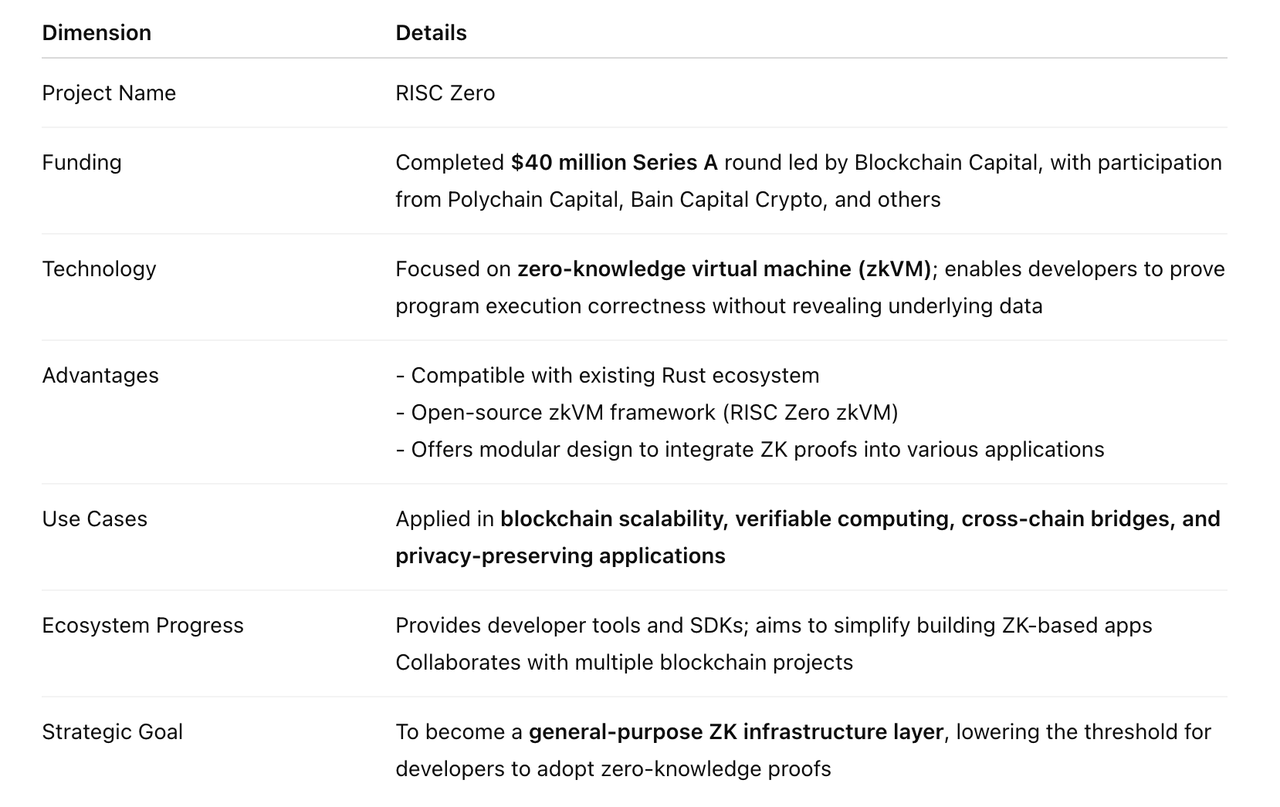
3. Market Cap Expectations
4. Economic Model
-
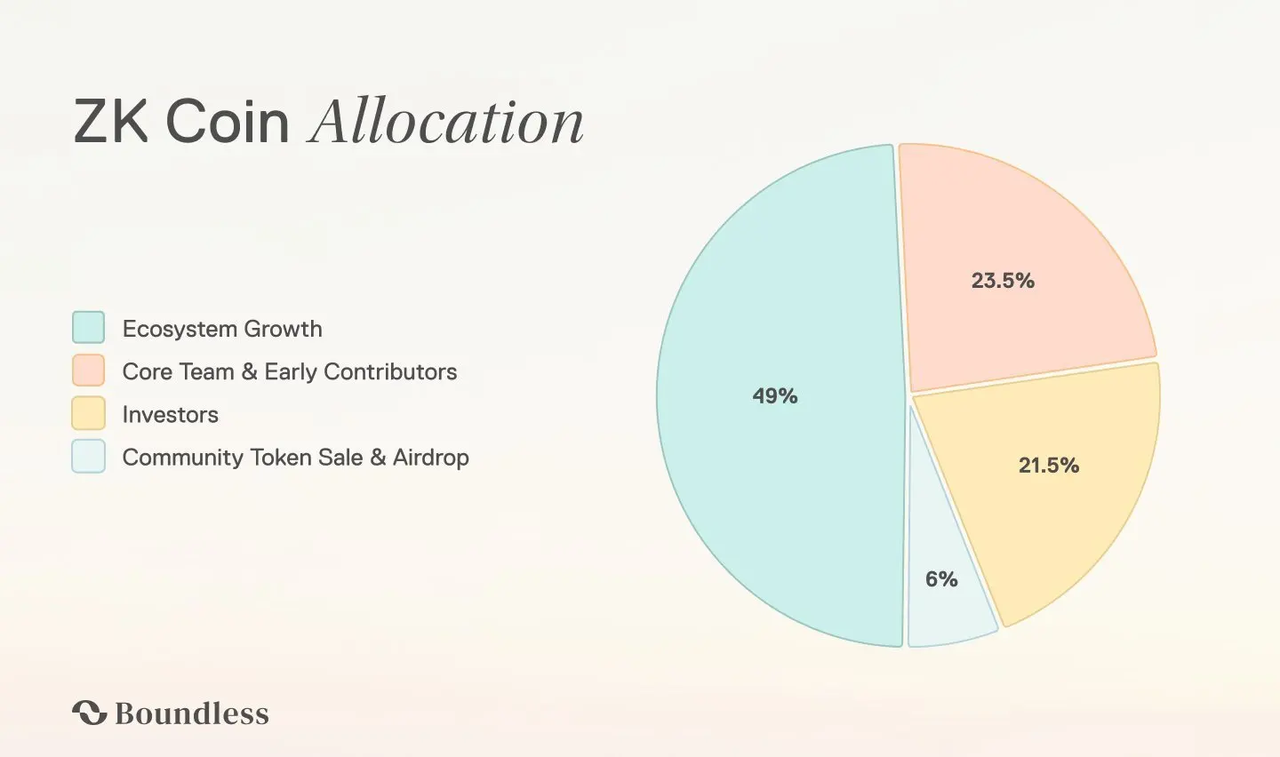
49% for Ecosystem Development: Of this, 31% will be held by the Boundless Foundation as an ecosystem fund. One-quarter of these tokens will be locked for one year, while the remaining three-quarters will be gradually unlocked on a monthly basis over the following 24 months, until the end of the third year.
-
18% for Strategic Growth Fund: Allocated for enterprise integration, business development, and onboarding of institutional-level validators. These tokens will be unlocked gradually over 12 months.
-
23.5% for Core Team and Early Contributors: 20% of the tokens are distributed to the core development team and early contributors who advanced Boundless from concept to mainnet. The remaining 3.5% are allocated to RISC Zero, the company that initially incubated Boundless. The unlocking rules for this portion follow the same schedule as the ecosystem fund.
-
~6% for Community Token Sales and Airdrops: Used to reward early contributors, including witnesses and Kaito Yappers. 50% of community sale tokens will unlock at TGE, with the remaining 50% unlocking six months later. 100% of airdropped tokens will unlock at TGE.
-
21.5% for Investors: This portion follows the same unlocking schedule as the core team.
Token Utility
-
Validator Incentives: Rewards provers for providing ZKP computing resources to the Boundless Marketplace. Rewards are proportional to contributions based on market fees or proof cycles.
-
Market Fee Distribution: Holders can lock $ZKC in the Vault to earn points, which can be used to claim a share of market fees, forming a “staking + earnings” mechanism.
-
Staking and Service Agreements: Supports locking for spot market requests and staking for service periods under agreements, enhancing the credibility of market participants.
-
Decentralized Governance: Holders can participate in on-chain governance, adjusting minting rates and reward frequencies, influencing tokenomics parameters and market incentive strategies.
5. Team and Funding Information
-
Team The Boundless protocol was initiated by the RISC Zero team, which has a strong background in zero-knowledge proofs and previously launched zkVM and Zeth, advancing ZK technology in the industry. Founder Jeremy Bruestle and the team have long been engaged in research on zero-knowledge proofs and mathematical theories such as the PCP theorem.
-
Funding To date, no disclosed funding information has been found for Boundless itself, including seed rounds, private placements, ICOs, or venture investments. The project is still at an early stage, and it is recommended to follow official channels for updates on future funding.
-
Series A Funding: RISC Zero raised $40 million in a Series A round, with investors including Blockchain Capital, Bain Capital Crypto, Galaxy, and others. Public records indicate that RISC Zero has raised a total of $54 million.
-
Token Sale: The token sale accounts for 3% of the total supply, with expected proceeds of $4 million. However, the actual sale amount has not been officially disclosed.
6. Potential Risk Warnings
-
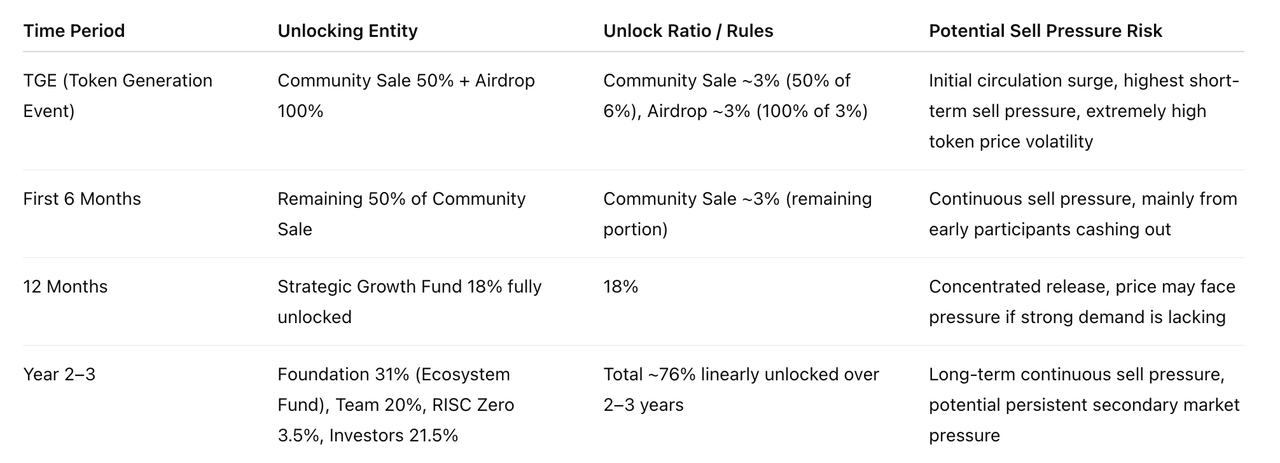
Short-term risk (0–6 months): Heavy sell pressure from airdrops and community sale tokens. Price volatility risk is highest during this phase.
-
Mid-term risk (6–12 months): Strategic Growth Fund unlock (18%) poses a concentrated supply shock.
-
Long-term risk (1–3 years): Large allocations to the foundation, team, and investors unlock gradually, creating a long-lasting sell pressure band that could weigh on market performance unless offset by strong demand growth.
7. Official Links
-
Twitter: https://x.com/boundless_xyz
Disclaimer: This report was generated by AI and human-verified for accuracy. It is not intended as investment advice.
Disclaimer: The content of this article solely reflects the author's opinion and does not represent the platform in any capacity. This article is not intended to serve as a reference for making investment decisions.
You may also like
$33.5 billion! This Amazon number has "shocked" the market
Amazon's free cash flow in Q3 plummeted to -$33.5 billion, four times higher than the market expectation of -$7.7 billion. The sharp decline was caused by the dual impact of $77.3 billion in capital expenditures and $48.1 billion in new debt in a single quarter. Although AWS's growth rate reached a five-year high of 39.3%, it still fell short of buy-side expectations, and its profit margin declined. The Q4 operating profit guidance of $31 billion was entirely below Wall Street and buy-side forecasts. The core issue is that for every $1 earned by AWS, nearly $4 in new spending is tied to it.
Bank of Japan's "hawkish pause" implemented! Core inflation meets target, paving the way for rate hikes to return in December; amid AI selling wave, yen regains safe-haven status
The Bank of Japan has kept interest rates unchanged and, for the first time, stated that the underlying inflation rate has reached the 2% target. This milestone development paves the way for a possible further rate hike as early as December.
10% to 56%: USDC’s remarkable rise in euro-paired stablecoin trading

Hedge funds are amplifying the risks of tech stocks!
Hedge funds are quietly making a risky strategic shift—from shorting individual stocks to shorting indices. This transition is accelerating the rise in stock correlations, and the “anti-leverage” buffer that once dampened volatility is disappearing. According to Goldman Sachs data, funds’ short exposure to indices and ETFs has reached a ten-year high. The VIX faces the risk of disorderly surges, and vulnerability to deep stock price declines is quietly accumulating.

Crypto prices
More


