
Will XRP Price Really Crash to Zero?

The latest warning from Moody’s Analytics has rattled global market and the crypto market : the probability of a U.S. recession within the next year has risen to 48%. Historically, every time this metric has climbed into the mid-40s, a downturn has followed. This context matters for crypto investors, particularly those holding XRP, because economic stress often drains liquidity and reduces appetite for speculative assets. The key question is whether such macroeconomic headwinds could push XRP price to catastrophic levels, even down to zero .
XRP Price Prediction: Why Recession Risk Matters for XRP Price?
Mark Zandi’s analysis highlights structural pressures weighing on the U.S. economy—weak job growth, fragile manufacturing, and policy headwinds like tariffs and reduced immigration. These conditions create a risk-off environment where investors retreat from volatile markets. Cryptocurrencies are among the first assets to be sold during economic contractions.
If recession fears materialize, institutional and retail flows into crypto could dry up. For XRP price , which already faces regulatory uncertainties and fierce competition from other blockchain projects, a recession would magnify pressure. But does that automatically mean a path to zero? Unlikely. XRP’s utility in payments and its deep liquidity base mean that while downside risks are real, a total collapse is not the base case.
Technical Analysis of XRP Daily Chart
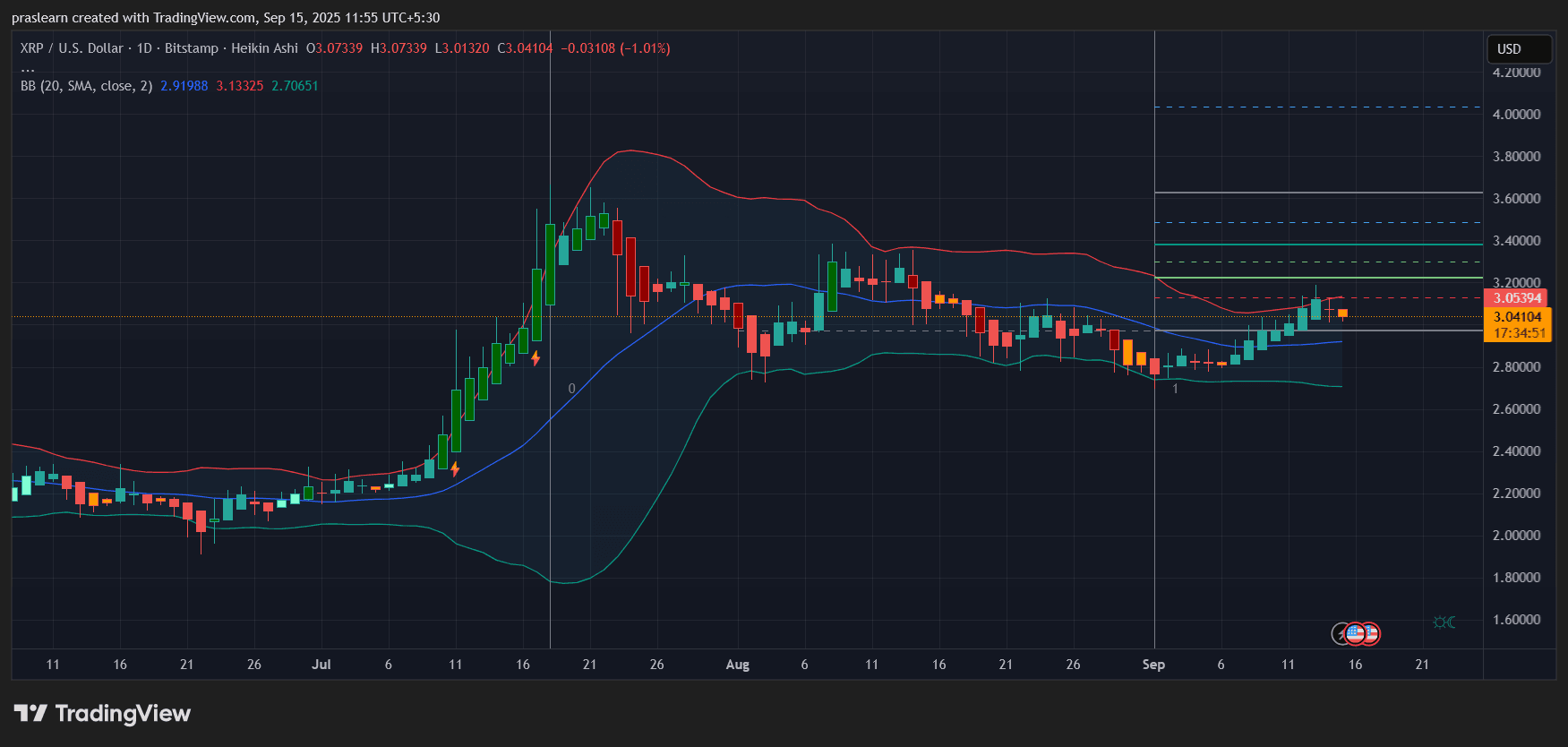 XRP/USD Daily Chart- TradingView
Looking at the XRP price daily chart:
- Current price: around 3.04 USD, slightly below resistance at 3.05 USD.
- Bollinger Bands: The price has tested the upper band near 3.13 and pulled back, signaling short-term overextension. The middle band at 2.91 is acting as a support pivot.
- Trend context: After a strong July rally that pushed XRP above 3.50, the coin consolidated sideways through August and September. The recent uptick shows momentum returning, but sellers remain active at resistance.
- Support zones: Key support lies near 2.70 (lower Bollinger band) and 2.90 (middle band). A break below these levels could open downside to 2.40.
- Resistance zones: First resistance sits at 3.20, with stronger caps at 3.40 and 3.60. A sustained breakout above 3.60 would revive the bull case.
The technical setup suggests consolidation rather than collapse. Unless macro conditions spark panic selling, XRP has enough support to avoid a freefall.
XRP Price Prediction: Could XRP Actually Go to 0?
From both a macro and chart perspective, the idea of XRP going to zero looks more like fear than reality. For XRP price to collapse completely, it would require a black swan—such as Ripple losing all regulatory cases, exchanges delisting it globally, or blockchain utility vanishing. Even in a severe recession, XRP’s liquidity and established adoption make such a scenario remote.
That said, a U.S. downturn could trigger significant volatility. If recession fears spike, XRP could revisit sub-2.50 levels, especially if Bitcoin leads a broader crypto selloff. Traders should brace for higher volatility, with whipsaws between 2.70 and 3.40 likely in the short term.
The balance of forces suggests that XRP will not crash to zero, but risks are tilted to the downside if the U.S. recession probability continues to climb. In the near term:
- If XRP holds above 2.90 support, it could rebound toward 3.20–3.40.
- A break below 2.70 could confirm bearish control, sending the price closer to 2.40.
- Zero remains off the table unless an unprecedented regulatory or systemic collapse occurs.
In short, $XRP is at risk of deeper corrections, but total collapse is not in play. Investors should monitor both U.S. economic data and technical support zones to gauge whether the current consolidation breaks higher or slips lower.
Disclaimer: The content of this article solely reflects the author's opinion and does not represent the platform in any capacity. This article is not intended to serve as a reference for making investment decisions.
You may also like
Wall Street Stands Guard as Bessent Strikes Again: Aftereffects of August's "Treasury Turnaround" Persist, November Refinancing Notice Could Be the Next Flashpoint
As the US Treasury prepares to update its debt management plan in November, key clues may emerge on Friday.
"Coca-Cola belief" never goes out of style! KFC in America says goodbye to Pepsi and embraces Coca-Cola (KO.US); Buffett-style "boring investment" returns to the spotlight
KFC has chosen Coca-Cola as its soda supplier in the United States, abandoning its long-term partner Pepsi. As of the close of the U.S. stock market on Thursday, Coca-Cola's (KO.US) stock price reached a record high, defying the ongoing declines in global tech stocks, especially in the semiconductor and broad AI computing sectors.
AI financing concerns weigh heavily on chip stocks, global tech sector has lost over $1 trillion this week
Multiple pressures, including rising expectations of a Federal Reserve rate hike and increasing AI financing costs, have led to a massive sell-off in global tech stocks this week. The combined market value of the world's top 20 AI and semiconductor stocks has evaporated by more than $1 trillion, and the semiconductor ETF (SOXX) has recorded its longest losing streak in 11 years. On Thursday, SK Hynix continued to plunge by over 10% in a single day, while Nvidia, Samsung, and SoftBank were not spared.
Safe Haven Amid AI Crash! Major Pharmaceutical Stocks Approach Historic Highs
Amid concerns over AI capital expenditures, funds are seeking a "certainty premium." State Street Healthcare ETF reached a record high. Eli Lilly and AbbVie are both approaching their historical highest closing prices, while Gilead and Amgen have surged 7.7% and 7.2% respectively over the past five days. Eli Lilly continues to bet on the future through its GLP-1 dominance and 40 M&A deals totaling $20 billion. AbbVie's core drug Skyrizi has shown positive data for its new subcutaneous formulation, which is expected to extend its patent and drive additional sales.

Crypto prices
More


