
Monero Rallies Despite 18-Block Reorg Breach Linked to Qubic

Contents
Toggle- Quick breakdown
- Monero faces major reorg event
- Qubic blamed for growing influence
- Price defies network setback
- Community eyes centralized safeguards
Quick breakdown
- Monero blockchain hit by an 18-block reorg reversing 117 transactions.
- Qubic mining pool blamed after amassing over 51% of Monero’s hashrate.
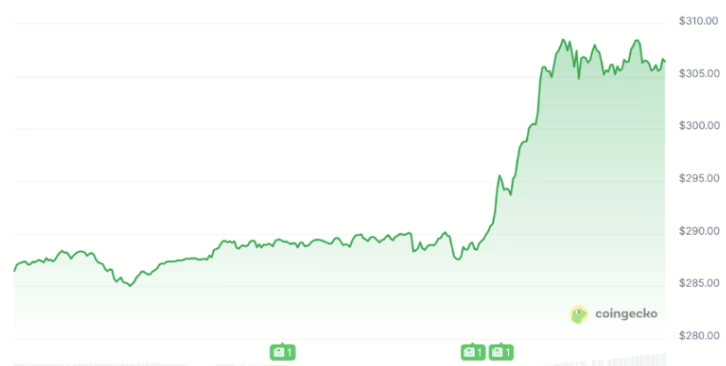
- XMR token surged 7% to $308.55 despite network reliability concerns.
Monero faces major reorg event
Monero’s blockchain suffered an 18-block reorganization on Sunday, reversing around 117 confirmed transactions and reigniting concerns over the network’s long-term stability. The disruption began at block 3,499,659 at 5:12 a.m. UTC and concluded 43 minutes later at block 3,499,676, according to node operators who shared logs on X.
The breach was confirmed by cryptocurrency researcher Rucknium on GitHub and is being described by community members as the largest reorg in Monero’s history.
Qubic blamed for growing influence
The attack is tied to Qubic, an AI-focused blockchain and mining pool that recently secured majority control of Monero’s hashrate. Just last month, Qubic was responsible for a smaller six-block reorg. With more than 51% of the network under its influence, Qubic poses a significant centralization risk to the privacy token’s proof-of-work system.
Crypto podcaster xenu, who first flagged the incident, suggested Qubic’s actions may have been designed to mitigate price pressure on XMR, though the broader community remains skeptical.
Price defies network setback
Despite the severity of the breach, Monero’s native token XMR showed resilience. While the reorg was underway, the price traded steadily before climbing 7.4% from $287.54 to $308.55 within hours, CoinGecko data shows.
 Source
:
CoinGecko
Source
:
CoinGecko
Some analysts, however, remain cautious. “Personally, I don’t consider the Monero network reliable at this point. I’ll stop accepting XMR for payments until this situation is resolved,” crypto commentator Vini Barbosa said on X.
Community eyes centralized safeguards
To curb future attacks, node operators may temporarily adopt Domain Name System (DNS) checkpoints, where trusted block data is fetched from community servers. Past discussions on solutions have included switching consensus mechanisms, merge-mining with Bitcoin or other cryptocurrencies, and adopting Dash’s ChainLocks. However, no consensus has been reached, leaving the network vulnerable.
Rucknium also noted that Monero’s existing 10-block lock mechanism was rendered ineffective, as the reorg exceeded the safeguard by eight blocks.
Security experts, including Yu Xian of SlowMist, warn that unless the Monero community addresses block reorganization risks, the network will continue to operate under constant threat.
Take control of your crypto portfolio with MARKETS PRO, DeFi Planet’s suite of analytics tools.”
Disclaimer: The content of this article solely reflects the author's opinion and does not represent the platform in any capacity. This article is not intended to serve as a reference for making investment decisions.
You may also like
Over $10 billion in market value evaporated in four trading days as CoreWeave (CRWV.US) debt risks trigger sell-off, but Deutsche Bank sees it as a buying opportunity
Deutsche Bank believes that the recent sell-off of CoreWeave lacks sufficient company fundamentals to justify it, and the sharp price correction has instead created a buying opportunity for investors.

Overnight US Stock Market | Inflation Pressure Continues to Rise, All Three Major Indexes Up, Dell (DELL.US) Down 6.8%
At the close of trading, the Dow Jones Industrial Average rose 557.51 points, or 1.08%, to 52,178.99 points; the S&P 500 Index gained 25.18 points, or 0.33%, to 7,744.12 points; and the Nasdaq Composite Index increased by 20.16 points, or 0.08%, to 26,713.03 points.
Interactive Brokers (IBKR.US) Q3 revenue increased by 16% year-on-year, announces over 70% increase in quarterly dividend
Driven by growth in net interest income and commission income, Interactive Brokers' Q3 net revenue increased by 16% year-on-year, with adjusted earnings per share rising by approximately 18% year-on-year.
CoreWeave default probability exceeds 60%! Jensen Huang "puts out the fire": Financing costs are declining, no need for NVIDIA to backstop
After Jensen Huang's speech, CoreWeave's stock price, which had fallen by as much as 9.5% in early trading, turned positive. The company's five-year CDS rose above 1,190 basis points during Thursday’s session, a historical high reflecting the cost of debt default protection, while yields on some of its corporate bonds have climbed above 15% to 16%. The five-year CDS spreads for Oracle, Amazon, Google’s parent company, and Meta are all at historically high levels. Deutsche Bank analysts believe that as the AI capital expenditure cycle is increasingly supported by debt rather than free cash flow, investors must place greater emphasis on signals from the credit market. Overall, while AI-related financing costs are not yet excessively high, worrying signs have begun to emerge.

Crypto prices
More


