
HBAR Tumbles 5% as Institutional Investors Trigger Mass Selloff

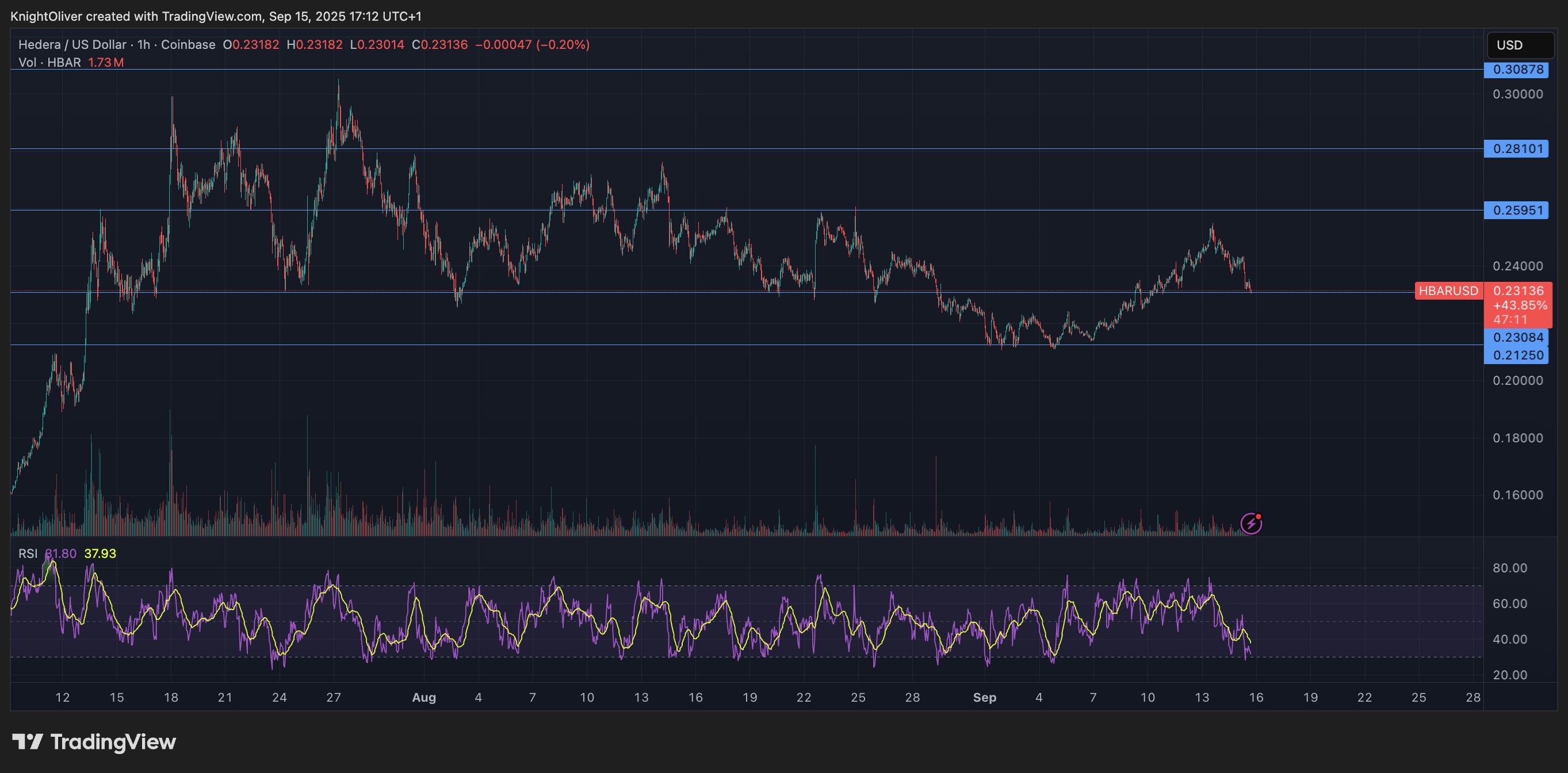
Hedera Hashgraph’s HBAR token endured steep losses over a volatile 24-hour window between September 14 and 15, falling 5% from $0.24 to $0.23. The token’s trading range expanded by $0.01 — a move often linked to outsized institutional activity — as heavy corporate selling overwhelmed support levels. The sharpest move came between 07:00 and 08:00 UTC on September 15, when concentrated liquidation drove prices lower after days of resistance around $0.24.
Institutional trading volumes surged during the session, with more than 126 million tokens changing hands on the morning of September 15 — nearly three times the norm for corporate flows. Market participants attributed the spike to portfolio rebalancing by large stakeholders, with enterprise adoption jitters and mounting regulatory scrutiny providing the backdrop for the selloff.
Recovery efforts briefly emerged during the final hour of trading, when corporate buyers tested the $0.24 level before retreating. Between 13:32 and 13:35 UTC, one accumulation push saw 2.47 million tokens deployed in an effort to establish a price floor. Still, buying momentum ultimately faltered, with HBAR settling back into support at $0.23.
The turbulence underscores the token’s vulnerability to institutional distribution events. Analysts point to the failed breakout above $0.24 as confirmation of fresh resistance, with $0.23 now serving as the critical support zone. The surge in volume suggests major corporate participants are repositioning ahead of regulatory shifts, leaving HBAR’s near-term outlook dependent on whether enterprise buyers can mount sustained defenses above key support.
Technical Indicators Summary
- Corporate resistance levels crystallized at $0.24 where institutional selling pressure consistently overwhelmed enterprise buying interest across multiple trading sessions.
- Institutional support structures emerged around $0.23 levels where corporate buying programs have systematically absorbed selling pressure from retail and smaller institutional participants.
- The unprecedented trading volume surge to 126.38 million tokens during the 08:00 morning session reflects enterprise-scale distribution strategies that overwhelmed corporate demand across major trading platforms.
- Subsequent institutional momentum proved unsustainable as systematic selling pressure resumed between 13:37-13:44, driving corporate participants back toward $0.23 support zones with sustained volumes exceeding 1 million tokens, indicating ongoing institutional distribution.
- Final trading periods exhibited diminishing corporate activity with zero recorded volume between 13:13-14:14, suggesting institutional participants adopted defensive positioning strategies as HBAR consolidated at $0.23 amid enterprise uncertainty.
Disclaimer: The content of this article solely reflects the author's opinion and does not represent the platform in any capacity. This article is not intended to serve as a reference for making investment decisions.
You may also like
Wall Street Stands Guard as Bessent Strikes Again: Aftereffects of August's "Treasury Turnaround" Persist, November Refinancing Notice Could Be the Next Flashpoint
As the US Treasury prepares to update its debt management plan in November, key clues may emerge on Friday.
"Coca-Cola belief" never goes out of style! KFC in America says goodbye to Pepsi and embraces Coca-Cola (KO.US); Buffett-style "boring investment" returns to the spotlight
KFC has chosen Coca-Cola as its soda supplier in the United States, abandoning its long-term partner Pepsi. As of the close of the U.S. stock market on Thursday, Coca-Cola's (KO.US) stock price reached a record high, defying the ongoing declines in global tech stocks, especially in the semiconductor and broad AI computing sectors.
AI financing concerns weigh heavily on chip stocks, global tech sector has lost over $1 trillion this week
Multiple pressures, including rising expectations of a Federal Reserve rate hike and increasing AI financing costs, have led to a massive sell-off in global tech stocks this week. The combined market value of the world's top 20 AI and semiconductor stocks has evaporated by more than $1 trillion, and the semiconductor ETF (SOXX) has recorded its longest losing streak in 11 years. On Thursday, SK Hynix continued to plunge by over 10% in a single day, while Nvidia, Samsung, and SoftBank were not spared.
Safe Haven Amid AI Crash! Major Pharmaceutical Stocks Approach Historic Highs
Amid concerns over AI capital expenditures, funds are seeking a "certainty premium." State Street Healthcare ETF reached a record high. Eli Lilly and AbbVie are both approaching their historical highest closing prices, while Gilead and Amgen have surged 7.7% and 7.2% respectively over the past five days. Eli Lilly continues to bet on the future through its GLP-1 dominance and 40 M&A deals totaling $20 billion. AbbVie's core drug Skyrizi has shown positive data for its new subcutaneous formulation, which is expected to extend its patent and drive additional sales.
Crypto prices
More


