
Crypto Inflows Reach $3.3 Billion Amid Bitcoin, Ethereum Sentiment Recovery

Crypto inflows reached $3.3 billion last week as weaker US economic data boosted Bitcoin and Ethereum demand. Investors see digital assets as portfolio hedges.
Crypto inflows benefited from a weaker-than-expected US macroeconomic data last week, pushing investments to $3.3 billion.
It came as US economic data elevated Bitcoin (BTC) and crypto’s role as an alternative asset class.
US Economic Data Drives Crypto Inflows to $3.3 Billion Last Week
The latest CoinShares report shows crypto inflows rose to $3.3 billion last week, a significant recovery after the $352 million outflows for the week ending September 6.
The correction followed price gains across individual crypto tokens, pushing total assets under management (AuM) to $239 billion. Notably, this was the highest level since the early August all-time high of $244 billion.
CoinShares’ head of research, James Butterfill, ascribes the trend reversal to weaker-than-expected US economic data last week.
Among them was the CPI (Consumer Price Index), which, at 2.9% YoY, aligned with market expectations.
“Digital asset investment products returned to inflows last week, totaling $3.3 billion, following weaker-than-expected US macroeconomic data,” read an excerpt in the latest report.
For regions such as Germany, Friday saw the second-largest daily crypto inflows on record.
Meanwhile, Bitcoin stole the show, attracting $2.4 billion in inflows. This was the largest weekly crypto inflows since July.
Nevertheless, short-bitcoin products recorded modest outflows, bringing their AuM down to just $86 million.
Ethereum Breaks 8 Days of Consecutive Outflows
However, the key highlight in last week’s inflows was Ethereum, which broke a successive streak of negative outflows.
It bucked the trend against the 8-day pattern to record four straight days of inflows last week. This brought their inflows to $646 million.
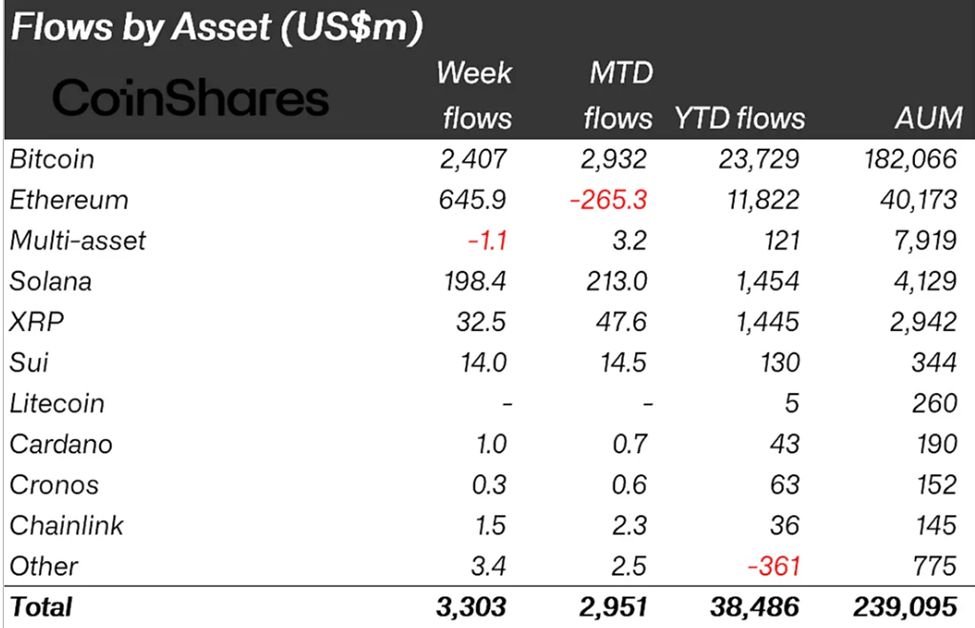 Crypto Inflows Last Week. Source:
CoinShares Report
Crypto Inflows Last Week. Source:
CoinShares Report
In hindsight, Ethereum had been the main cause of the weekly net outflows ending on September 6.
Therefore, the change seen in crypto inflows and outflows over the past several weeks suggests capital flight into riskier assets during economic uncertainty.
It points to an abounding role of crypto and digital assets as portfolio diversifiers and hedges against economic uncertainty.
Disclaimer: The content of this article solely reflects the author's opinion and does not represent the platform in any capacity. This article is not intended to serve as a reference for making investment decisions.
You may also like
Wall Street Stands Guard as Bessent Strikes Again: Aftereffects of August's "Treasury Turnaround" Persist, November Refinancing Notice Could Be the Next Flashpoint
As the US Treasury prepares to update its debt management plan in November, key clues may emerge on Friday.
"Coca-Cola belief" never goes out of style! KFC in America says goodbye to Pepsi and embraces Coca-Cola (KO.US); Buffett-style "boring investment" returns to the spotlight
KFC has chosen Coca-Cola as its soda supplier in the United States, abandoning its long-term partner Pepsi. As of the close of the U.S. stock market on Thursday, Coca-Cola's (KO.US) stock price reached a record high, defying the ongoing declines in global tech stocks, especially in the semiconductor and broad AI computing sectors.
AI financing concerns weigh heavily on chip stocks, global tech sector has lost over $1 trillion this week
Multiple pressures, including rising expectations of a Federal Reserve rate hike and increasing AI financing costs, have led to a massive sell-off in global tech stocks this week. The combined market value of the world's top 20 AI and semiconductor stocks has evaporated by more than $1 trillion, and the semiconductor ETF (SOXX) has recorded its longest losing streak in 11 years. On Thursday, SK Hynix continued to plunge by over 10% in a single day, while Nvidia, Samsung, and SoftBank were not spared.
Safe Haven Amid AI Crash! Major Pharmaceutical Stocks Approach Historic Highs
Amid concerns over AI capital expenditures, funds are seeking a "certainty premium." State Street Healthcare ETF reached a record high. Eli Lilly and AbbVie are both approaching their historical highest closing prices, while Gilead and Amgen have surged 7.7% and 7.2% respectively over the past five days. Eli Lilly continues to bet on the future through its GLP-1 dominance and 40 M&A deals totaling $20 billion. AbbVie's core drug Skyrizi has shown positive data for its new subcutaneous formulation, which is expected to extend its patent and drive additional sales.

Crypto prices
More


