
Polkadot Bets on pUSD Stablecoin — But Can It Escape aUSD’s Shadow?

Polkadot’s pUSD aims to unlock DeFi but faces fears of repeating aUSD’s failure and risks tied to DOT-only collateral.
Polkadot (DOT) is preparing to launch a new stablecoin, pUSD, through the RFC-155 proposal. The Polkadot community is championing pUSD as a key solution to unleash its DeFi potential, cut dependence on USDT/USDC, and boost ecosystem autonomy.
However, some are concerned that they might repeat past mistakes. pUSD is an over-collateralized stablecoin fully backed by DOT, deployed on Asset Hub, and using the Honzon protocol developed by Acala. Acala is the former issuer of aUSD, a stablecoin project that failed disastrously.
Can pUSD Stablecoin Avoid the Same Fate as aUSD?
Reusing Honzon – the framework Acala previously relied on to issue aUSD is raising concerns. That incident eroded trust in the Acala team, with some even accusing them of “blaming a hack” while failing to compensate users adequately.
“Acala’s stablecoin (aUSD) launch was a complete disaster and it really killed my trust in the team. I don’t see myself supporting their project anymore. What I’d love to see is a proper, reliable, native solution. Honestly, it’s frustrating that with all the talent in the Polkadot/Substrate space, nobody has managed to build something better yet.” – A community member shared.
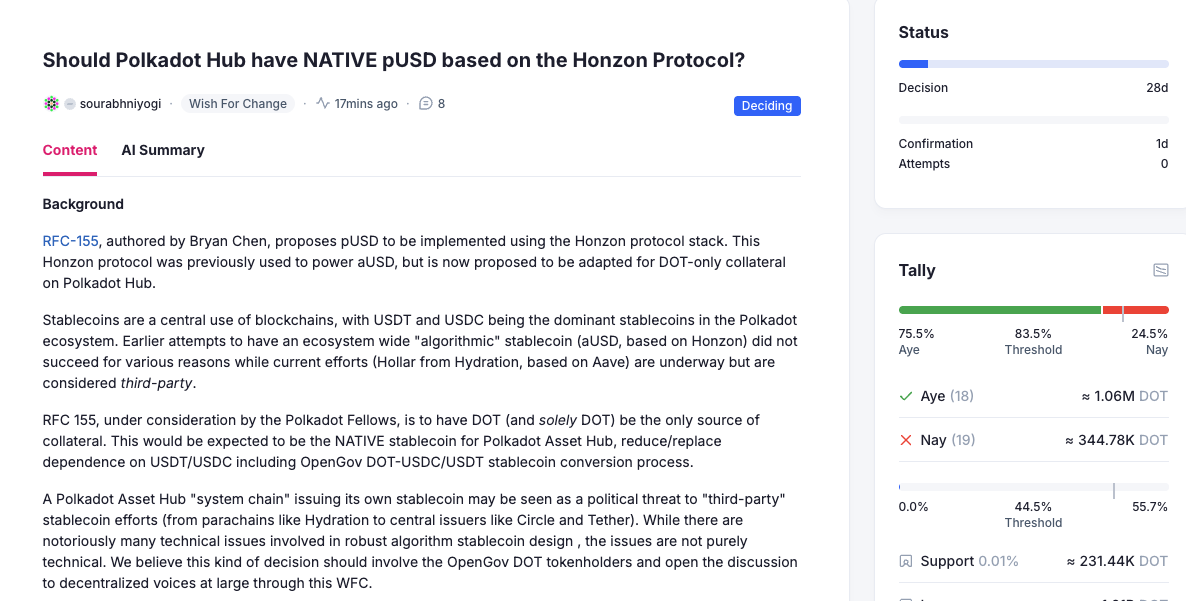 Approval rate of the proposal at the time of writing. Source:
Polkadot
Even those who support Polkadot launching its native stablecoin still see Honzon and Acala as lessons that cannot be ignored. They propose the project should “move forward independently from the Acala team.” In addition, they call for the Technical Council to take clear responsibility for governance.
“With these assurances, I would be prepared to vote AYE. Without them, the risk of repeating past mistakes is too great.” Another member noted.
Too Many Risks
Setting aside concerns about Honzon and the Acala team, Polkadot’s pUSD also faces skepticism within the community. One primary reason is the structure that DOT solely backs it.
While the exact overcollateralization ratio remains unclear, this could trigger liquidation cascades and add selling pressure on the token. Although the pUSD model is safer than Terra’s UST because it is overcollateralized, relying only on DOT as collateral introduces significant risks.
Previously, MakerDAO’s DAI also started as ETH-only collateral. But today, MakerDAO supports Multi-Collateral DAI (MCD). They allow users to back DAI with crypto assets such as ETH, WBTC, LINK, UNI, stETH, and even Real World Assets (RWAs) like US Treasuries.
“Backed only by DOT, which could trigger liquidation cascades and add additional selling pressure on the token. Remember the notorious DAI depeg in 2020, which forced MakerDAO to diversify its collateral.”
Additionally, another X user pointed out that the Polkadot ecosystem already has more advanced native solutions like HOLLAR. The Hydration runtime builds this stablecoin, optimizes it for appchains, and positions it as superior to the legacy aUSD architecture. Therefore, many argue that instead of repeating a “regular” EVM model, Polkadot should leverage its unique strengths. This would enable the creation of a stable, secure solution worthy of its ecosystem’s potential.
pUSD is undoubtedly a strategic move by Polkadot to unlock DeFi potential. It could bring significant benefits if it proves secure and sees widespread adoption in the ecosystem. However, the ghost of aUSD’s failure continues to cast doubt within the community.
To avoid repeating the same mistakes, Polkadot must work to dispel those lingering concerns. The fact that the DOT supply is capped at 2.1 billion, as reported by BeInCrypto, could help fuel the ecosystem’s growth.
Disclaimer: The content of this article solely reflects the author's opinion and does not represent the platform in any capacity. This article is not intended to serve as a reference for making investment decisions.
You may also like
Early Exercise of Green Shoe Leads to "No One Supporting the Price the Next Day," Anthropic Nearly Fell Below Issue Price, Criticized for "Eager to Cash Out"
Listed for just one day and already exercising options, raking in $12.2 billion. The core controversy lies in: despite a 19% increase in issuance size, a slump in tech stocks, and the heavy pressure of $26 billion in insiders unlocking and selling shares, the company abandoned the "insurance" mechanism designed to support the stock price in order to quickly secure massive cash. This move exposes investors directly to the risk of share price dropping below the issue price, revealing a speculative mentality that disregards market conditions and aims for extreme fundraising.

Funds swarm into US Treasuries, helping the "anchor of global asset pricing" fall below 5%! After "Black Friday," can tech stocks take advantage and rebound?
On November 20th, Eastern Time, the yields on 10-year and 30-year U.S. Treasury bonds fell to 4.92% and 5.31% respectively, while the Philadelphia Semiconductor Index plunged by 10.73%. On "Black Friday," long-term bonds realized their value as safe-haven assets, while AI computing power and semiconductors continued to digest investors' concerns about returns on AI capital expenditures.
After Starship recovery success, Citigroup raises SpaceX (SPCX.US) target price: Launch leading advantage is "rapidly expanding into a 20-year gap", Starlink will become the core for value realization
After SpaceX successfully caught the Starship upper stage with the launch tower for the first time, Citi released a research report, raising its target price for the stock from $240 to $280. The report also pointed out that the gap between SpaceX and other players in the aerospace launch industry is widening further.

After a week of "bloodbath" in US stocks, valuations now show investment value, but no one dares to say the bottom has arrived.
Last week, U.S. stocks experienced a massive sell-off, but in fact, there have been no fundamental changes in the underlying factors. Multiple valuation indicators now highlight their investment value, and the willingness of contrarian funds to buy the dip should be strong.

Crypto prices
More


