
XRP At $10K? Analyst Sees $800 Trillion Liquidity Boom

A sharp debate has opened inside the XRP community over whether the token could ever reach the kind of eye-popping prices some enthusiasts imagine. Numbers and theory are being thrown around. Practical limits are being argued right back.
Market Cap Math And Limits
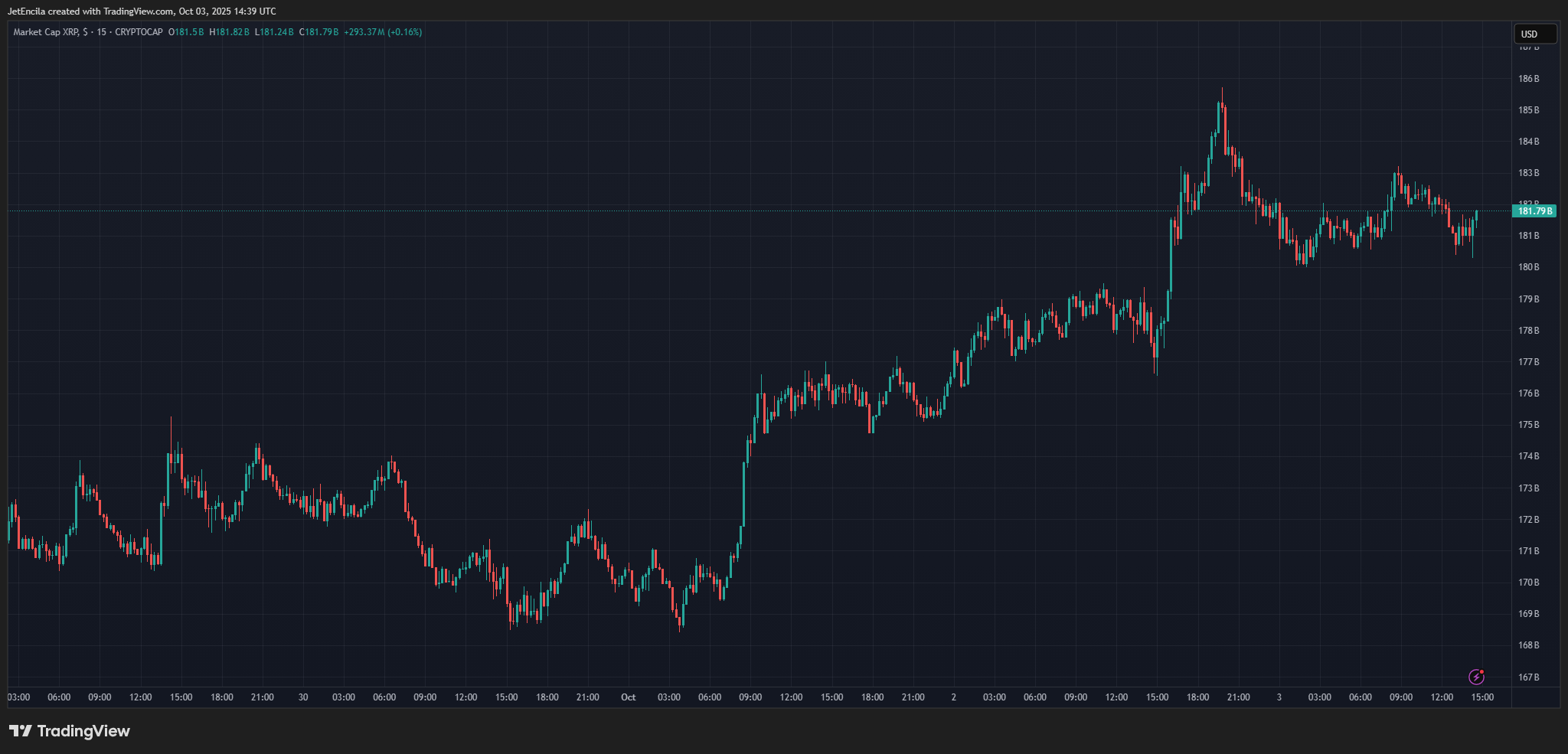
According to reports, the numbers make a simple point: with a circulating supply of close to 60 billion XRP, a price of $1,000 would value the token at about $59.91 trillion.
That total would more than double the market cap of gold and top many of the biggest assets on earth. Some analysts use that math to say such prices are not realistic any time soon.
Their argument rests on a basic idea — money supply and valuation interact, and extreme price targets imply extreme market value.
Garlinghouse Predicts 14% Of SWIFT Volume
At the XRPL Apex event in Singapore in 2025, US-based Ripple CEO Brad Garlinghouse drew a line between messaging systems and actual liquidity.
Based on reports from that stage, he told a journalist that XRPL’s future depends more on liquidity than on messaging alone.
He estimated the ledger could handle about 14% of SWIFT’s global transaction volume within five years. That figure is large, but it is an adoption target that sits far below the trillion-dollar claims floated elsewhere.
I keep telling everyone, the problem crypto solves is liquidity.
You can’t print more money to create liquidity, that will just collapse fiat.
But you can have limitless (almost unlimited) liquidity simply by having say a token like XRP reaches $10k, that will create over $800T… https://t.co/YpLUe6Sgal
— Vincent Van Code (@vincent_vancode) October 2, 2025
A Different Way To See Liquidity
Software engineer Vincent Van Code pushed a contrasting view. According to Van Code, XRP should be judged as a tool that can move liquidity around, not as an asset that must be fully cashed out into fiat to matter.
He proposed that, at a $10,000 price, XRP could unlock more than $800 trillion in liquidity. Van Code used an analogy likened to a logarithmic decay to explain why converting that liquidity to cash would not simply crash markets.
His point: market mechanics and swap processes could expand usable liquidity without requiring a one-to-one conversion into existing money supplies.
Easily, because it is just a “swap” or bridge token.
Liquidity in FX is more about available trading pairs than simply loads of currency. Further, where that liquidity is sitting in crucial.
Your point is more related to economic and monetary policy, which is vastly different…
— Vincent Van Code (@vincent_vancode) October 3, 2025
Critics Point To Central Banks And Money Supply
Other market participants have pushed back. They note that central banks control liquidity through tools like QE and QT, and that broader money measures such as M2 keep changing.
Reports show M2 has continued to grow over time in many countries. Those critics ask why governments would hand over control of liquidity to a neutral digital token.
They also warn that the math Van Code uses assumes wide adoption, large trading pairs, and guaranteed counterparty trust — all hard to achieve.
Featured image from Gemini, chart from TradingView
Disclaimer: The content of this article solely reflects the author's opinion and does not represent the platform in any capacity. This article is not intended to serve as a reference for making investment decisions.
You may also like
Wall Street Stands Guard as Bessent Strikes Again: Aftereffects of August's "Treasury Turnaround" Persist, November Refinancing Notice Could Be the Next Flashpoint
As the US Treasury prepares to update its debt management plan in November, key clues may emerge on Friday.
"Coca-Cola belief" never goes out of style! KFC in America says goodbye to Pepsi and embraces Coca-Cola (KO.US); Buffett-style "boring investment" returns to the spotlight
KFC has chosen Coca-Cola as its soda supplier in the United States, abandoning its long-term partner Pepsi. As of the close of the U.S. stock market on Thursday, Coca-Cola's (KO.US) stock price reached a record high, defying the ongoing declines in global tech stocks, especially in the semiconductor and broad AI computing sectors.
AI financing concerns weigh heavily on chip stocks, global tech sector has lost over $1 trillion this week
Multiple pressures, including rising expectations of a Federal Reserve rate hike and increasing AI financing costs, have led to a massive sell-off in global tech stocks this week. The combined market value of the world's top 20 AI and semiconductor stocks has evaporated by more than $1 trillion, and the semiconductor ETF (SOXX) has recorded its longest losing streak in 11 years. On Thursday, SK Hynix continued to plunge by over 10% in a single day, while Nvidia, Samsung, and SoftBank were not spared.
Safe Haven Amid AI Crash! Major Pharmaceutical Stocks Approach Historic Highs
Amid concerns over AI capital expenditures, funds are seeking a "certainty premium." State Street Healthcare ETF reached a record high. Eli Lilly and AbbVie are both approaching their historical highest closing prices, while Gilead and Amgen have surged 7.7% and 7.2% respectively over the past five days. Eli Lilly continues to bet on the future through its GLP-1 dominance and 40 M&A deals totaling $20 billion. AbbVie's core drug Skyrizi has shown positive data for its new subcutaneous formulation, which is expected to extend its patent and drive additional sales.

Crypto prices
More


