
16 million people liquidated, $20 billion "1011" epic liquidation, trade war restarts and bloodbath sweeps global capital markets

No one expected that the seemingly ordinary October 11, 2025, would become a day to go down in history.
According to data at 8 a.m. on the 11th, over $19.1 billion in liquidations occurred in the cryptocurrency industry within 24 hours, with more than 1.6 million people being liquidated. Every figure set a new ten-year record for crypto contract trading.
Reviewing the K-line, bitcoin actually started its downward trend at $111,700 on the evening of October 10, but no one paid attention. There was no negative news in the market, only an unknown whale on Hyperliquid who opened short positions on bitcoin and ethereum with $1.1 billion.
Whales using hundreds of millions of dollars to leverage trade cryptocurrencies has become commonplace in this cycle. We've seen several whales go to zero—so what could possibly happen with this "$1.1 billion" whale?
A few hours later, around 5 a.m. on the 11th, the epic "1011" crash officially began. If you happened to be awake and looking at the 1-minute K-line of bitcoin at that time, you would have seen bitcoin drop continuously without resistance for 30 minutes, with an average decline of nearly 1% per minute. The most extreme movement occurred at 5:19 a.m., when bitcoin plunged over 4% in a single minute, dropping nearly $5,000 and finally bottoming out at $102,000.
Bitcoin, a global commodity with a total market cap of over $2 trillion, plunged 12% overnight.
The culprit finally emerged in the news: Trump has restarted the trade war with China, and the U.S. President announced that starting November 1, the U.S. will impose a 100% tariff on China.
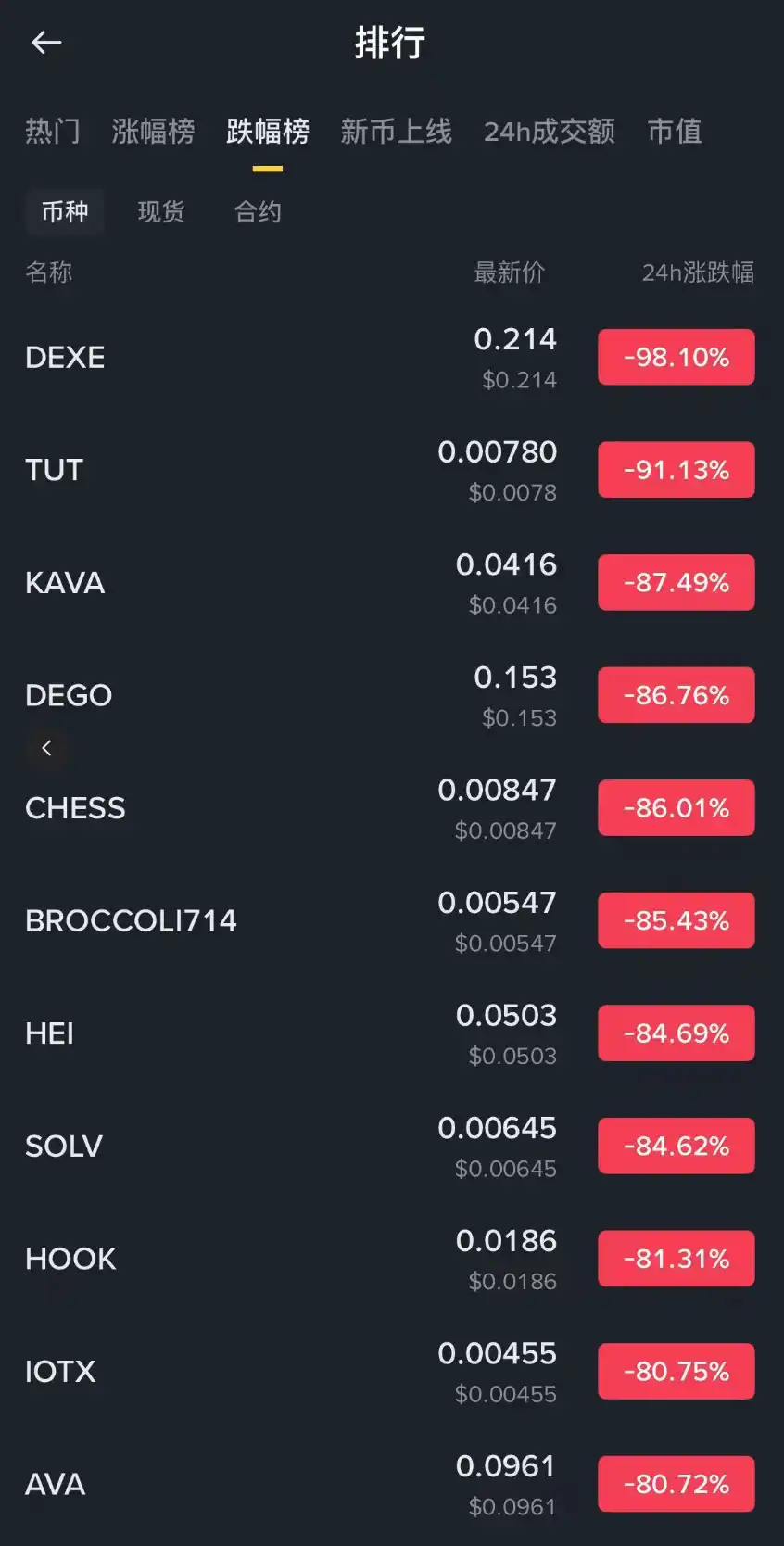
No matter how explosive the belated news was, it didn't matter anymore—altcoins were already bleeding. To give a few examples of major altcoins: SUI, which had been at $3.5 for days, was stabbed down to $0.55 in a single move; WLD, the AI leader, plunged from $1.4 to $0.26 in a single spike; even dogecoin, a top ten market cap coin, saw a 50% drop.
This is just the large market cap altcoins—small caps basically went to zero.
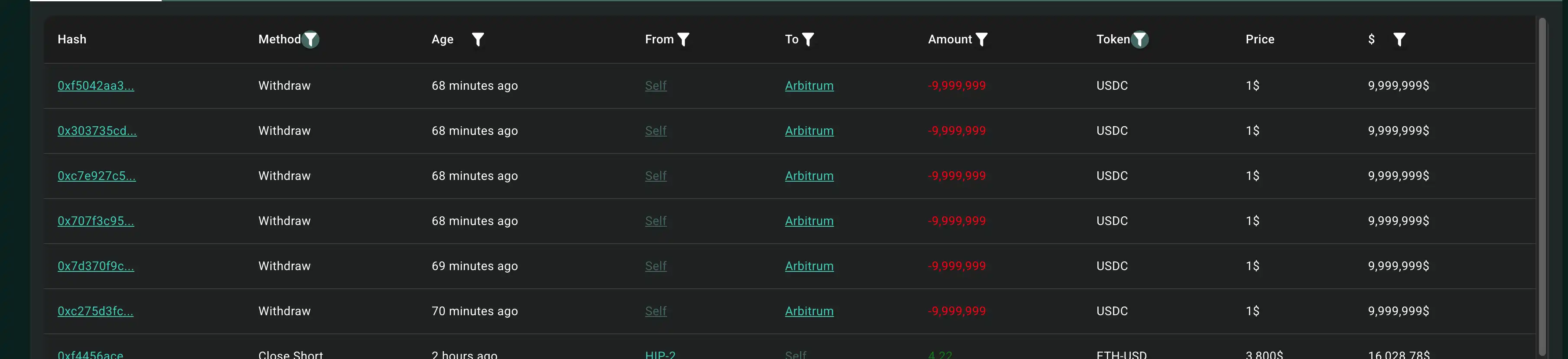
Perhaps no one could calmly make it through this night, except for that $1.1 billion whale. Before the crash, he used $30 million to open $1.1 billion in short positions, took profits at the climax of the disaster, doubled his principal in less than 20 hours in the wailing crypto world, earning $30 million in profit, and exited quickly with $60 million in just a few minutes. Such precise operations—and we don't even know who he is.
In fact, it wasn't just cryptocurrencies—looking across global capital markets, it was a black swan day. The S&P 500 closed down 182.61 points on October 10, a drop of 2.71%, marking the largest weekly decline since May. The Nasdaq fell 3.5%, the largest single-day drop since April 10. Hang Seng Index futures closed down 5% in the night session. FTSE A50 index futures closed down 4.26% in consecutive night sessions—all cliff-like declines.
Only gold didn't fall.
In hindsight, the recent boom in precious metals was actually a warning to the market. The fact that gold, with a market cap of tens of trillions of dollars, could continue to rise in a short period was already a reminder that the world's super-large funds were seeking safety. Unfortunately, none of us predicted it.
Respect the market. After such a disaster, all we can do is remind everyone to respect the market. No matter how big the bull market, not everyone can leave with full returns. Always remind yourself to have risk control. Principal is capital, and it is the foundation for survival in the market.
Click to learn about job openings at BlockBeats
Disclaimer: The content of this article solely reflects the author's opinion and does not represent the platform in any capacity. This article is not intended to serve as a reference for making investment decisions.
You may also like
U.S. chip stocks drop for eight consecutive sessions! $2 trillion wiped out in market value, marking the longest losing streak since 2008
This week, the investment prospects of AI were questioned by the market. The Philadelphia Semiconductor Index fell by 11.4%, and the Nasdaq dropped more than 4% in a single week. CoreWeave's stock price fell over 25% during the week, and its bonds dropped to distressed levels, casting doubt on the high-yield debt financing model. Strategists warned that being overly bearish could lead to missing opportunities, while "Wood Sister" bucked the trend and increased her holdings of CoreWeave.
In August, overseas funds returned to the U.S. Treasury market; UK holdings surpassed $1 trillion for the first time; Japan and China continued to reduce holdings, with China’s U.S. Treasury holdings hitting the lowest level since 2008
According to a report by the U.S. Treasury Department, overseas investors made net purchases of $108.9 billion in U.S. Treasury bonds in August, reversing a two-month decline in holdings. Among the top ten countries and regions holding U.S. debt, only China and Japan reduced their holdings in August. Japan, the largest holder, saw its holdings drop for the fourth consecutive month, reaching a 22-month low in the same month it intervened in the foreign exchange market. China’s holdings declined for the third straight month, hitting new lows for two consecutive months not seen since 2008. The UK, the second-largest holder, posted historic highs for two consecutive months. Canada recorded the largest increase in August, up $38.3 billion, ranking fifth overall. Belgium had the second-largest increase, up $19.8 billion.

Strategy surpasses JPMorgan in trading volume as MSTR neared 49M shares in August

Crypto prices
More


