
BREAKING: Ethereum Crashes Below $4K as Crypto Market Suffers Massive Selloff

Ethereum Takes a Major Hit – Down Over 10%
Ethereum ( $ETH ) has joined $Bitcoin in one of the worst market crashes of 2025, dropping over 10% in 24 hours and breaking below the $4,000 mark for the first time in weeks. The current price sits around $3,900, after hitting a low near $3,436 during the panic selloff.
The sharp drop follows the market-wide crash triggered by Trump’s 100% tariff announcement on China, set to take effect on November 1st — a move that sent shockwaves across global risk assets, from stocks to crypto.
Chart Analysis: ETH Breaks Key Support
As seen in the attached chart, Ethereum experienced a massive red candle, collapsing below its 50-day SMA (~$4,400) and slicing through the critical support at $4,356.
ETH/USD 1-day chart - TradingView
Key takeaways from the chart:
- ETH plunged over 10.6% in one day, wiping out weeks of gains.
- Next major supports lie around $3,840, $3,500, and $3,200.
- The 200-day SMA sits near $3,098, a potential long-term floor if the selloff deepens.
This breakdown confirms a strong bearish reversal, as ETH failed to sustain its breakout and quickly reversed into a liquidation-driven dump.
Altcoins Join the Crash
$Ethereum wasn’t alone — the entire altcoin market turned red, with top assets showing heavy double-digit losses:
- $BNB: down 13.09%, now trading near $1,093
- $XRP: down 17.16%, sitting at $2.32
- Solana ($SOL): fell 14.31% to $189.21
- TRON ($TRX): down 5.06% to $0.32
- Even top memecoins like $DOGE plunged 26.48%, showing the intensity of the crash
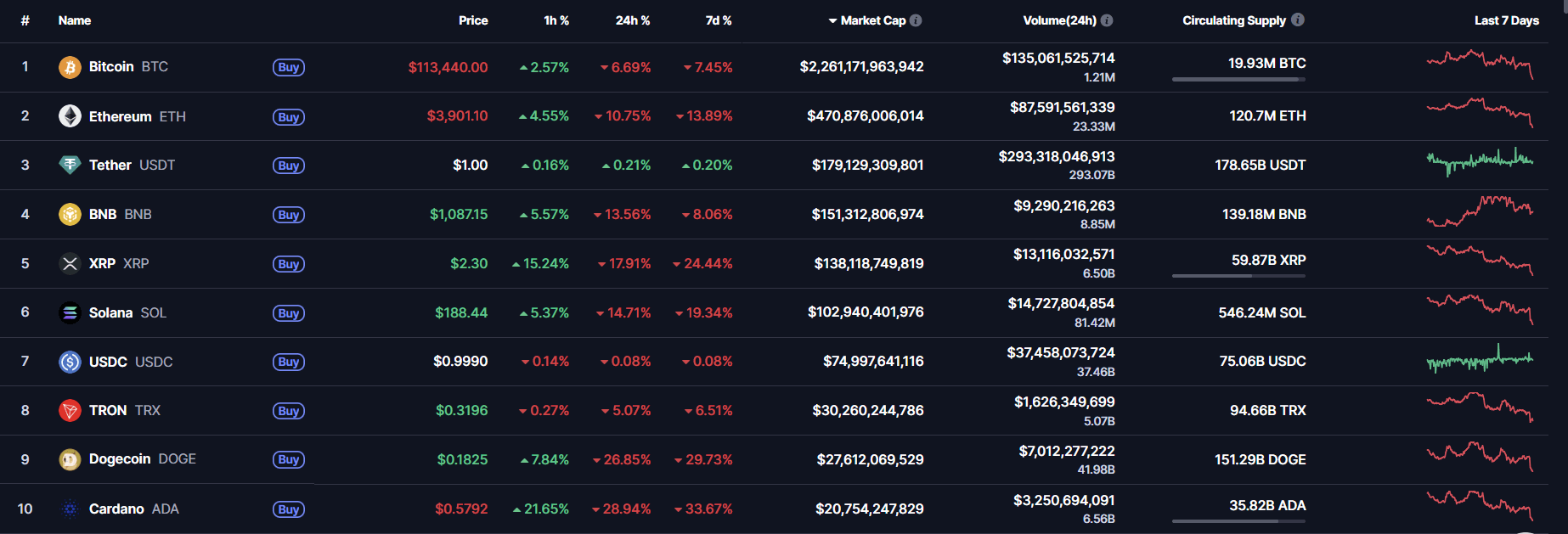
Across the board, over $400 billion in market capitalization vanished, dragging total crypto valuation from over $4.1 trillion to below $3.7 trillion before a slight recovery attempt.
Why the Market Is Crashing
The selloff was triggered by the BREAKING news that President Trump has imposed a 100% tariff on all Chinese imports, effective November 1st.
This announcement has raised fears of:
- A renewed U.S.–China trade war,
- Higher inflation, and
- Reduced global liquidity — all of which are bad for speculative assets like crypto.
With investors rushing to safer positions, risk assets were dumped heavily, causing cascading liquidations across futures markets.
What’s Next for Ethereum?
Traders are now watching whether ETH can hold above $3,800–$3,500. If this range fails, the next stop could be $3,200–$3,100, near the 200-day moving average.
However, a quick rebound remains possible if Bitcoin stabilizes around the $111K–$113K zone. In that case, ETH could retest $4,200–$4,400 before regaining bullish momentum.
For now, the short-term outlook remains bearish, with volatility expected to stay high through the coming week.
Disclaimer: The content of this article solely reflects the author's opinion and does not represent the platform in any capacity. This article is not intended to serve as a reference for making investment decisions.
You may also like
U.S. chip stocks drop for eight consecutive sessions! $2 trillion wiped out in market value, marking the longest losing streak since 2008
This week, the investment prospects of AI were questioned by the market. The Philadelphia Semiconductor Index fell by 11.4%, and the Nasdaq dropped more than 4% in a single week. CoreWeave's stock price fell over 25% during the week, and its bonds dropped to distressed levels, casting doubt on the high-yield debt financing model. Strategists warned that being overly bearish could lead to missing opportunities, while "Wood Sister" bucked the trend and increased her holdings of CoreWeave.
In August, overseas funds returned to the U.S. Treasury market; UK holdings surpassed $1 trillion for the first time; Japan and China continued to reduce holdings, with China’s U.S. Treasury holdings hitting the lowest level since 2008
According to a report by the U.S. Treasury Department, overseas investors made net purchases of $108.9 billion in U.S. Treasury bonds in August, reversing a two-month decline in holdings. Among the top ten countries and regions holding U.S. debt, only China and Japan reduced their holdings in August. Japan, the largest holder, saw its holdings drop for the fourth consecutive month, reaching a 22-month low in the same month it intervened in the foreign exchange market. China’s holdings declined for the third straight month, hitting new lows for two consecutive months not seen since 2008. The UK, the second-largest holder, posted historic highs for two consecutive months. Canada recorded the largest increase in August, up $38.3 billion, ranking fifth overall. Belgium had the second-largest increase, up $19.8 billion.

Strategy surpasses JPMorgan in trading volume as MSTR neared 49M shares in August

Crypto prices
More


