
This Crypto Trader Made $160 Million Profit During Trump’s Market Bloodbath

The crypto whale's profit coincided with Trump’s announcement of 100% tariffs on Chinese imports, which triggered a $20 billion liquidation across crypto markets.
A crypto whale has pocketed over $160 million in profits after correctly betting on Bitcoin and Ethereum’s recent price decline.
On October 11, blockchain analysis platform Lookonchain reported that a long-term Bitcoin holder had opened more than $1.1 billion in short positions on the top two cryptocurrencies by market capitalization.
How Bitcoin Crash Made This Trader $160 Million Richer
The trader effectively wagered that both assets would drop in value despite their recent bullish momentum.
Within just 30 hours, that prediction proved right—Bitcoin and Ethereum prices fell sharply, earning the trader an estimated $160 million in realized profit.
Insane — over $160M profit in just 30 hours! 😱This #BitcoinOG has closed most of his $BTC and $ETH shorts, leaving only 821.6 $BTC($92M) short, making a profit of more than $160M!
Following the sell-off, the trader began closing most of the positions, retaining only 821.6 BTC worth about $92 million.
The timing of this move has fueled speculation about whether the whale had early insight into upcoming macroeconomic shifts that triggered the broader market decline.
On Friday, Trump announced a 100% tariff on Chinese imports and new export controls targeting critical software industries.
The tariff, scheduled to take effect on November 1, spooked investors in both traditional and crypto markets, sparking widespread sell-offs in risk assets.
According to BeInCrypto data, Bitcoin’s price dropped to as low as $105,262 before recovering to $111,052 as of press time.
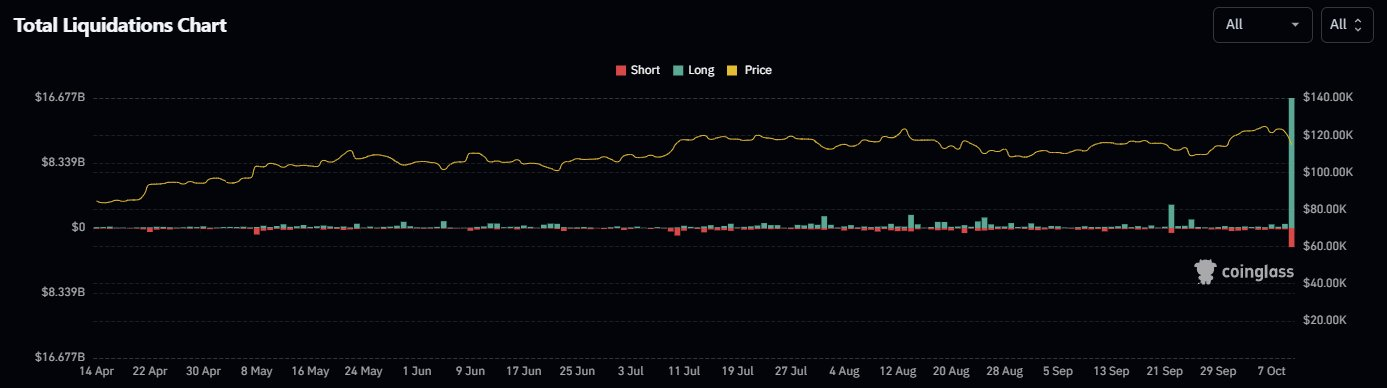
Other major assets such as Ethereum, Solana, Dogecoin, and XRP followed similar trajectories. Their sharp declines triggered the highest daily liquidation figures ever recorded.
Indeed, more than 1.6 million traders were liquidated, wiping out $19.31 billion in positions within 24 hours, according to CoinGlass data.
 Crypto Market Record Liquidation. Source:
Long traders—those expecting further price gains—absorbed the bulk of the losses, totaling $16.82 billion. Short traders, despite the downturn, lost an additional $2.5 billion.
Bitcoin accounted for $5.37 billion of the total liquidations, followed by Ethereum with $4.43 billion. Solana traders lost $2 billion, while HYPE and XRP traders lost $890.37 million and $708.24 million, respectively.
Amid the volatility, decentralized exchange Hyperliquid emerged as the largest liquidation venue, handling $10.3 billion or about 53% of all liquidations. Bybit followed with $4.65 billion, while Binance and OKX recorded $2.39 billion and $1.21 billion, respectively.
The episode underscores how geopolitical shocks and whale-scale trades can swiftly reshape crypto market dynamics. In such situations, even seasoned traders can be exposed to massive losses or extraordinary gains.
Disclaimer: The content of this article solely reflects the author's opinion and does not represent the platform in any capacity. This article is not intended to serve as a reference for making investment decisions.
You may also like
U.S. chip stocks drop for eight consecutive sessions! $2 trillion wiped out in market value, marking the longest losing streak since 2008
This week, the investment prospects of AI were questioned by the market. The Philadelphia Semiconductor Index fell by 11.4%, and the Nasdaq dropped more than 4% in a single week. CoreWeave's stock price fell over 25% during the week, and its bonds dropped to distressed levels, casting doubt on the high-yield debt financing model. Strategists warned that being overly bearish could lead to missing opportunities, while "Wood Sister" bucked the trend and increased her holdings of CoreWeave.
In August, overseas funds returned to the U.S. Treasury market; UK holdings surpassed $1 trillion for the first time; Japan and China continued to reduce holdings, with China’s U.S. Treasury holdings hitting the lowest level since 2008
According to a report by the U.S. Treasury Department, overseas investors made net purchases of $108.9 billion in U.S. Treasury bonds in August, reversing a two-month decline in holdings. Among the top ten countries and regions holding U.S. debt, only China and Japan reduced their holdings in August. Japan, the largest holder, saw its holdings drop for the fourth consecutive month, reaching a 22-month low in the same month it intervened in the foreign exchange market. China’s holdings declined for the third straight month, hitting new lows for two consecutive months not seen since 2008. The UK, the second-largest holder, posted historic highs for two consecutive months. Canada recorded the largest increase in August, up $38.3 billion, ranking fifth overall. Belgium had the second-largest increase, up $19.8 billion.

Strategy surpasses JPMorgan in trading volume as MSTR neared 49M shares in August

Crypto prices
More


