
Unichain: Can UniSwap and Flashbots Solve the MEV Problem?

Unichain empowers UNI by mitigating the negative impacts of MEV through a built-in MEV redistribution mechanism, fast confirmation times, and transparent transaction ordering rules, but it cannot completely eliminate MEV.
Unichain empowers UNI by alleviating the negative impacts of MEV through a built-in MEV redistribution mechanism, fast confirmation times, and transparent transaction ordering rules, though it cannot completely eliminate MEV.
Written by: 0XNATALIE
Yesterday, Uniswap announced a partnership with Flashbots to launch Unichain, an Ethereum L2 designed specifically for DeFi. Unichain is an Optimistic Rollup based on OP Stack, aiming to address some of the challenges faced by DeFi. Notably, Uniswap, Flashbots, and Optimism are all backed by investment from Paradigm.
Currently, Ethereum L1 has a block time of 12 seconds, and slow transaction speeds limit user experience. In addition, the MEV issue urgently needs to be addressed. The existing block construction mechanism allows certain participants to gain unfair profits by manipulating transaction order, thereby reducing market efficiency. To tackle these problems, Unichain introduces a 1-second block time and 250-millisecond "Flashblocks," combined with a verifiable priority ordering mechanism and Trusted Execution Environment (TEE), significantly improving transaction speed while increasing the transparency and fairness of transaction ordering, injecting new vitality into the Layer 2 DeFi ecosystem.
Technical Features of Unichain
1. Verifiable Block Building
This is a new block construction mechanism introduced by Unichain, implemented by Rollup-Boost. It aims to improve the transparency of transaction ordering on the blockchain, reduce unfair MEV extraction, and increase transaction processing speed. The basic idea is to use TEE to execute the block construction process, providing a transparent and trustworthy ordering mechanism. Rollup-Boost is a verifiable block building platform developed by Flashbots to upgrade Rollup performance, optimizing the block construction process through TEE. Unichain is its first real-world application. Rollup-Boost is integrated into Unichain as sidecar software, leveraging its technical features (such as fast confirmation of Flashblocks and verifiable priority ordering) to enhance Unichain's performance and user experience.
The working principle of verifiable block building:
- Block construction using TEE: TEE is a hardware security technology that can execute computational tasks in an isolated environment, ensuring the external environment cannot tamper with or interfere. In Unichain, block builders run within the TEE, ensuring the construction process is secure and reliable. The TEE simulates transaction execution, detects whether any transactions will fail, and removes failed transactions, thus preventing users from paying high fees for failed transactions.
- Generating Flashblocks: In Unichain, a block is generated every second, and a pre-confirmation mechanism called Flashblocks is introduced, dividing each block into four Flashblocks (i.e., pre-confirmations every 250 milliseconds), which are transmitted in real time to the sequencer. Users can receive early confirmation before their transactions are officially included in a block, preventing transaction rollbacks due to block reorganizations and reducing extra costs caused by uncertainty. This mechanism speeds up transaction settlement and reduces opportunities for MEV extraction.
- Priority ordering and verifiability: Rollup-Boost provides a verifiable transaction ordering method, allowing users to verify the execution order of their transactions within a block. By constructing blocks in the TEE, transaction priority ordering can be transparently conducted according to specific rules (such as priority fees paid), and verification proofs confirm whether block construction complies with these rules. This mechanism not only prevents block builders from abusing ordering power but also internalizes MEV, i.e., sets rules (such as MEV tax) to allocate part of the MEV revenue to the protocol or liquidity providers.
2. Unichain Validation Network (UVN)
The Unichain Validation Network (UVN) addresses risks in single-sequencer architectures and accelerates economic finality on the blockchain through staking and distributed validation.
UVN consists of multiple nodes, each of which can independently validate the state of blocks, ensuring all transaction records are legitimate and untampered. This prevents block equivocation risk or invalid block risk present in single-sequencer systems, thereby enhancing network security. Operators wishing to become UVN validator nodes must stake UNI tokens on the Ethereum mainnet; nodes with more staked tokens have greater weight and a higher chance of becoming active validator nodes.
Additionally, UVN provides a faster economic finality mechanism by reducing potential delays caused by a single sequencer through parallel validation by multiple nodes. Each validator node confirms the validity of blocks during the validation cycle and publishes validation information to the network, increasing the credibility of the chain's state. Once a block passes validation, these transactions are considered irreversibly completed (i.e., economically final). Validators must validate blocks and publish attestations during each validation cycle, or they will not receive the corresponding rewards.
How Does the Community View Unichain?
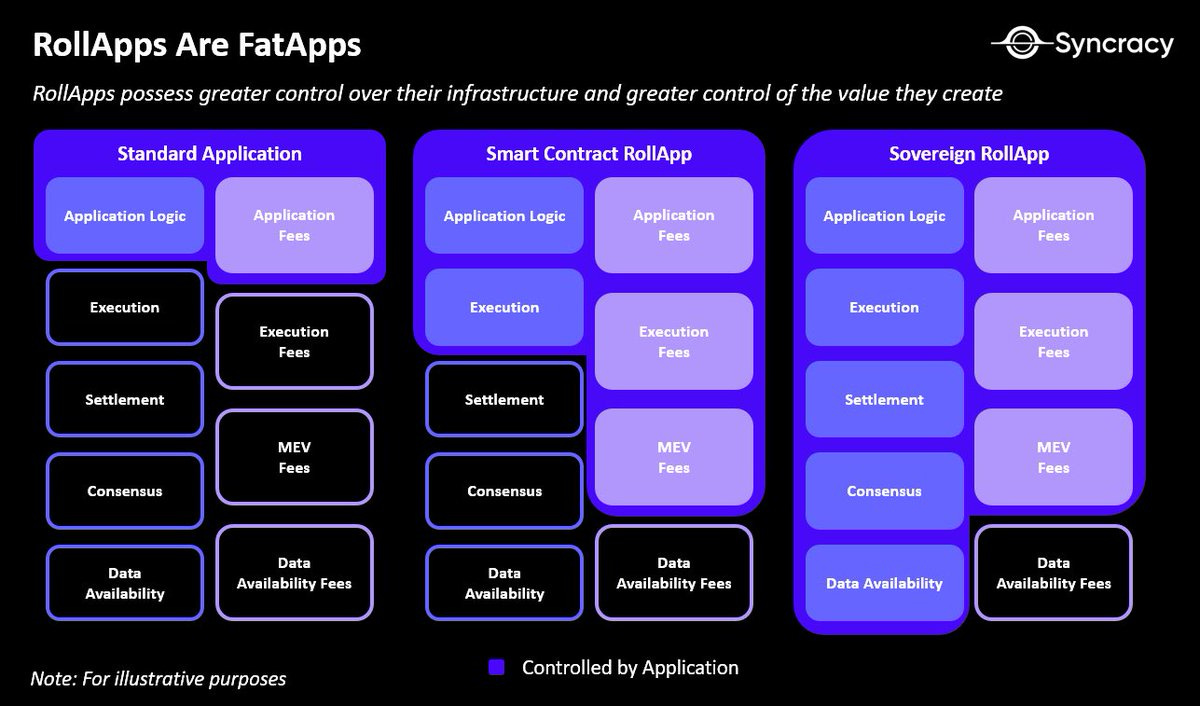
Ryan Watkins, co-founder of Syncracy Capital, proposed the view that "RollApps are FatApps," believing that the RollApp represented by Unichain has greater control and flexibility, similar to fat applications, with more control and management capabilities over infrastructure, and can better capture the value it creates. He divides application structures into three types and compares their control scope:
- Standard Application: These applications only control application logic and application fees, while execution, settlement, consensus, and data availability rely on blockchain infrastructure. The scope of control for the application is relatively small.
- Smart Contract RollApp: By extending application functionality and control through smart contracts, covering the execution layer, applications can manage their own execution logic and fees, but still rely on the underlying blockchain (such as Ethereum) for consensus and data availability.
- Sovereign RollApp: These applications can control almost all layers (except data availability), are more independent on the infrastructure level, and can provide higher customization and control for users and developers.
Yuki, a researcher at Fenbushi Capital, pointed out that Unichain is not a blockchain (app-chain) designed specifically for a particular application, but rather a general-purpose L2 solution with a built-in MEV redistribution mechanism. However, it still requires some customized mechanisms (such as hooks) to ensure that MEV revenue flows to specific target groups (such as users or liquidity providers).
Researcher Haotian believes that Uniswap's launch of Unichain is not a departure from Ethereum, but rather a further push for the development of the Ethereum L2 ecosystem. The current L2 ecosystem has not yet fully unleashed the vitality of DeFi, and Unichain will act as a catalyst for DeFi expansion. Unlike dYdX and MakerDAO, which have chosen completely independent architectures and consensus mechanisms, Unichain is based on OP Stack and still aligns with Ethereum's Rollup-Centric scaling strategy, while also giving the UNI token more functionality. Unichain will compete with other L2s, helping to boost the overall vitality of the L2 market.
There are also some differing opinions. For example, KOL sudo rm believes that the current scaling strategies ignore the resolution of some core issues. L2s expand network processing capacity, but user security issues have not been effectively addressed. Instead of investing large amounts of funds in L2 development, it would be better to first solve the most basic and fundamental problems in the Ethereum ecosystem, such as user security and attack resistance. KOL Temmy questioned the necessity of Uniswap launching Unichain and is confused about whether more L2 solutions are needed, as he believes the existing L2s are already sufficient. Uniswap's move may lead to further liquidity fragmentation, and if other dApps follow suit, the situation could become worse than expected.
Disclaimer: The content of this article solely reflects the author's opinion and does not represent the platform in any capacity. This article is not intended to serve as a reference for making investment decisions.
You may also like
Credit panic hits AI trading: CoreWeave bond yields remain high, Nasdaq posts biggest weekly drop since late June
Concerns over the debt risk of AI infrastructure companies continue to rise. Yields on some CoreWeave bonds briefly exceeded 15% on Thursday and remained elevated on Friday. CoreWeave's stock price plunged another 12% on Friday, and the Nasdaq Composite Index fell about 4.5% for the week. Analysts point out that as capital costs rise to unbearable levels, companies will have no choice but to reduce their capital expenditures.
Philadelphia Semiconductor Index Experiences Longest Losing Streak Since 2008; Jensen Huang Responds Calmly: Short-term Fluctuations Won't Change AI's Long-term Growth Prospects
Despite recent sell-offs in AI-related stocks, Nvidia CEO Jensen Huang remains confident in the long-term prospects of the AI industry.
U.S. chip stocks drop for eight consecutive sessions! $2 trillion wiped out in market value, marking the longest losing streak since 2008
This week, the investment prospects of AI were questioned by the market. The Philadelphia Semiconductor Index fell by 11.4%, and the Nasdaq dropped more than 4% in a single week. CoreWeave's stock price fell over 25% during the week, and its bonds dropped to distressed levels, casting doubt on the high-yield debt financing model. Strategists warned that being overly bearish could lead to missing opportunities, while "Wood Sister" bucked the trend and increased her holdings of CoreWeave.
In August, overseas funds returned to the U.S. Treasury market; UK holdings surpassed $1 trillion for the first time; Japan and China continued to reduce holdings, with China’s U.S. Treasury holdings hitting the lowest level since 2008
According to a report by the U.S. Treasury Department, overseas investors made net purchases of $108.9 billion in U.S. Treasury bonds in August, reversing a two-month decline in holdings. Among the top ten countries and regions holding U.S. debt, only China and Japan reduced their holdings in August. Japan, the largest holder, saw its holdings drop for the fourth consecutive month, reaching a 22-month low in the same month it intervened in the foreign exchange market. China’s holdings declined for the third straight month, hitting new lows for two consecutive months not seen since 2008. The UK, the second-largest holder, posted historic highs for two consecutive months. Canada recorded the largest increase in August, up $38.3 billion, ranking fifth overall. Belgium had the second-largest increase, up $19.8 billion.

Crypto prices
More


