
Zcash recovers to pre-crash highs following crypto market meltdown

The price of Zcash (ZEC), a supply-capped, shielded, layer-1 coin dedicated to user privacy, fully recovered following Friday’s market crash, forming a new recent high of about $291 on Saturday before retracing to about $273 at the time of this writing.
Zcash plummeted by 45% on Friday, falling from a high of about $273 to $150, following a social media post from United States President Donald Trump announcing 100% tariffs on China, which sent the crypto markets into a meltdown.
ZEC is only down about 5.5% from its recent high, making it a standout in this market crash. Many cryptos are still down by double digits from their recent highs, including Ether (ETH), which is down by about 22% from its recent and all-time high of $4,957.
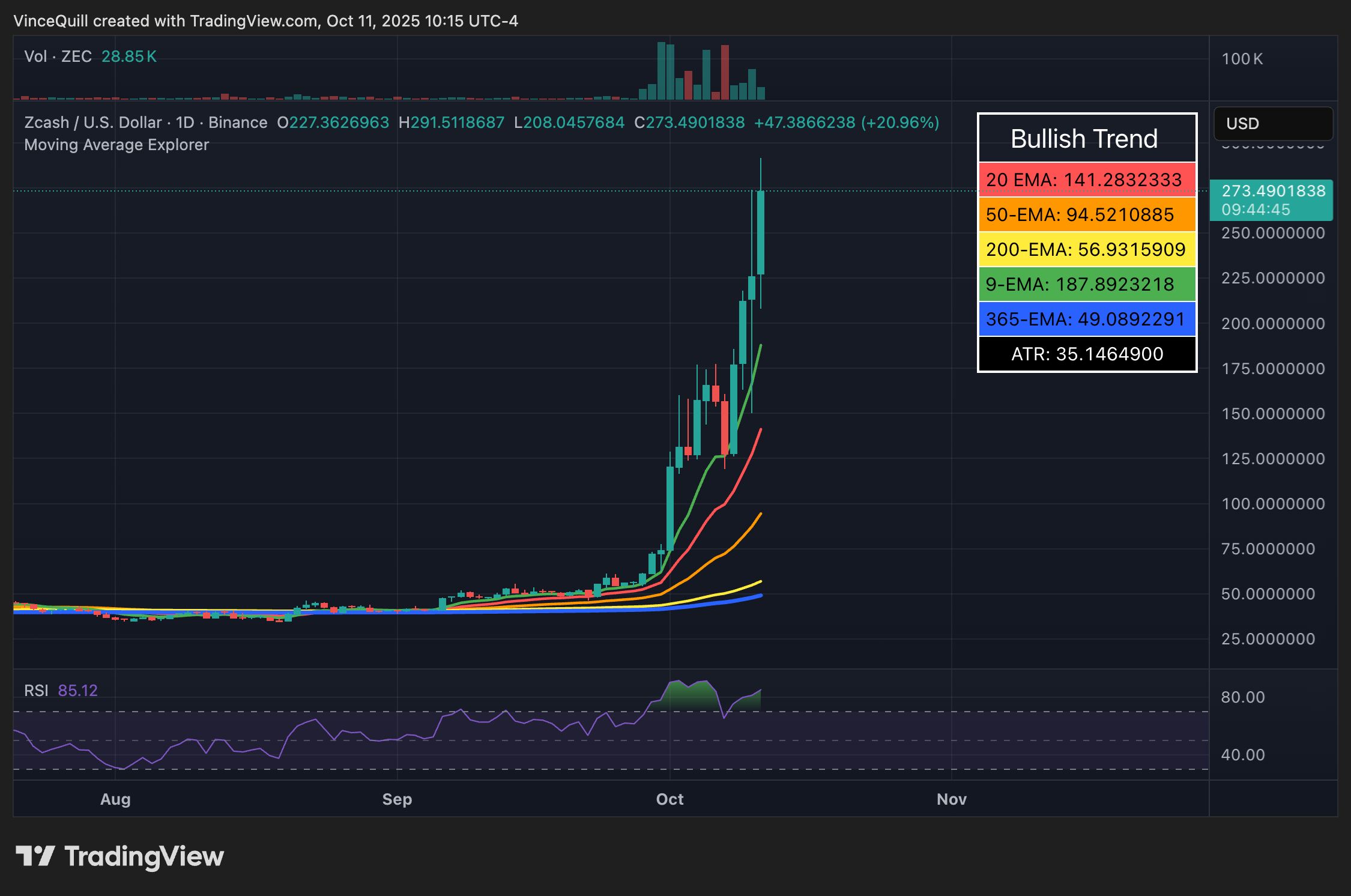
Before the market downturn, ZEC went on a meteoric price rally, rising from $74 on October 1 to $291 on Saturday — a price increase of nearly 4x in less than two weeks.
The crypto market experienced one of the most severe liquidation events in its history on Friday after Trump’s tariff announcement, which caused $20 billion in liquidations within hours of his social media post, leaving many traders disillusioned with the markets.
Related: Bitcoin may get ‘dragged around a bit’ amid Trump tariff fears: Exec
US President Donald Trump crashes markets with just two social media posts
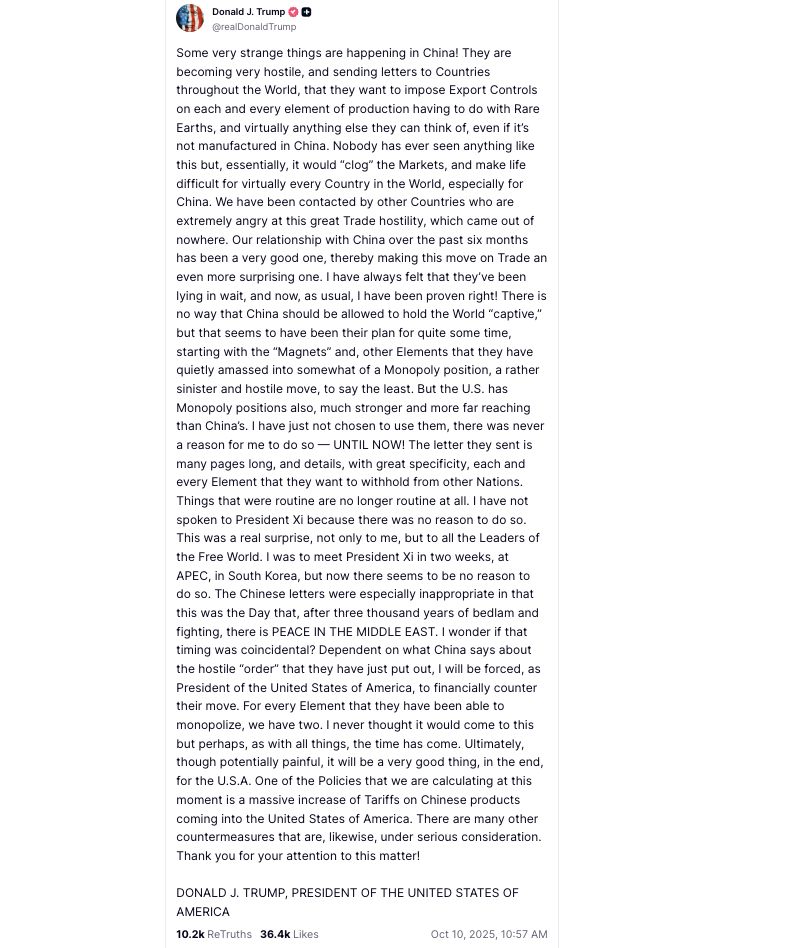
Trump crashed markets with only two social media posts on Friday, signaling that the global trade war is back on.
In his first post, he said the Chinese government’s expanded export controls on rare earth minerals, crucial to tech manufacturing and industrial equipment used in the mineral refining process, are “very hostile” and will “clog” global trade.
Over 90% of the world’s rare earth minerals and rare earth magnets that are used in electric batteries, computer chips, consumer electronics, and military defense systems come from China, according to Reuters.
“I was to meet President Xi in two weeks, at APEC, in South Korea, but now there seems to be no reason to do so,” Trump wrote, sparking fears of reigniting an extended trade war. The same fears wiped away trillions of dollars from capital markets in April.
Trump followed up the post hours later by announcing an additional 100% tariff on all goods from China, which is set to take effect on November 1, 2025, or earlier.
Magazine: Ether could ‘rip like 2021’ as SOL traders brace for 10% drop: Trade Secrets
Disclaimer: The content of this article solely reflects the author's opinion and does not represent the platform in any capacity. This article is not intended to serve as a reference for making investment decisions.
You may also like
Credit panic hits AI trading: CoreWeave bond yields remain high, Nasdaq posts biggest weekly drop since late June
Concerns over the debt risk of AI infrastructure companies continue to rise. Yields on some CoreWeave bonds briefly exceeded 15% on Thursday and remained elevated on Friday. CoreWeave's stock price plunged another 12% on Friday, and the Nasdaq Composite Index fell about 4.5% for the week. Analysts point out that as capital costs rise to unbearable levels, companies will have no choice but to reduce their capital expenditures.
Philadelphia Semiconductor Index Experiences Longest Losing Streak Since 2008; Jensen Huang Responds Calmly: Short-term Fluctuations Won't Change AI's Long-term Growth Prospects
Despite recent sell-offs in AI-related stocks, Nvidia CEO Jensen Huang remains confident in the long-term prospects of the AI industry.
U.S. chip stocks drop for eight consecutive sessions! $2 trillion wiped out in market value, marking the longest losing streak since 2008
This week, the investment prospects of AI were questioned by the market. The Philadelphia Semiconductor Index fell by 11.4%, and the Nasdaq dropped more than 4% in a single week. CoreWeave's stock price fell over 25% during the week, and its bonds dropped to distressed levels, casting doubt on the high-yield debt financing model. Strategists warned that being overly bearish could lead to missing opportunities, while "Wood Sister" bucked the trend and increased her holdings of CoreWeave.
In August, overseas funds returned to the U.S. Treasury market; UK holdings surpassed $1 trillion for the first time; Japan and China continued to reduce holdings, with China’s U.S. Treasury holdings hitting the lowest level since 2008
According to a report by the U.S. Treasury Department, overseas investors made net purchases of $108.9 billion in U.S. Treasury bonds in August, reversing a two-month decline in holdings. Among the top ten countries and regions holding U.S. debt, only China and Japan reduced their holdings in August. Japan, the largest holder, saw its holdings drop for the fourth consecutive month, reaching a 22-month low in the same month it intervened in the foreign exchange market. China’s holdings declined for the third straight month, hitting new lows for two consecutive months not seen since 2008. The UK, the second-largest holder, posted historic highs for two consecutive months. Canada recorded the largest increase in August, up $38.3 billion, ranking fifth overall. Belgium had the second-largest increase, up $19.8 billion.

Crypto prices
More


